Our Top Picks
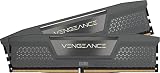
 Corsair Vengeance RGB RS DDR5 32GB32GB (2 x 16GB)5.43 x 0.27 x 1.77 Inches0.11 poundsCheck on Amazon

Top 3 picks at a glance
Currency Check
Verified as of October 2026: DDR5 is the mainstream desktop memory for new gaming builds, and the memory market is tight. TrendForce’s September 30 outlook says conventional DRAM contract prices should keep rising in the fourth quarter, by roughly 10 to 15%, and expects PC memory supply to shrink further in 2027 as capacity shifts to servers. Contract prices do not map directly onto retail, so check current listings. Press coverage of Valve’s September 2026 Steam survey reports that 32GB passed 16GB as the most common installed amount. Nothing in this guide depends on unreleased hardware.
For a new gaming PC in 2026, 32GB of DDR5 in two matched modules is the best default, 16GB is still enough for esports and older games on a tight budget, and 64GB is rarely worth it for gaming alone. The extra memory mostly helps stability and minimum frame rates when many apps are open, not average frame rate. This guide explains where each capacity makes sense, how speed and timings fit in, and how to check your own setup.
Quick Verdict
| Your situation | Our verdict |
|---|---|
| New mid-range or high-end build, mixed AAA gaming | 32GB (2 x 16GB) DDR5. It is the safest default and now the most common configuration among Steam users. |
| Esports titles, older games, strict budget | 16GB is enough. Put the saved money into the graphics card. |
| You stream, record or keep many apps open while gaming | 32GB. Background apps eat into a 16GB total quickly. |
| Heavy simulation or modded games | 32GB, with 64GB only if you know a specific workload exceeds it. |
| Video editing, local AI or virtual machines alongside gaming | 64GB is justified here, but for the other work, not for the games. |
| Upgrading an older DDR4 system | Adding more DDR4 is a short-term fix; a new platform means DDR5 and a full replacement. |
What Changes Between 16GB, 32GB and 64GB
Capacity matters at the edges, not on average
Most of the evidence in press coverage points the same way: average frame rates are often close between 16GB and 32GB systems, and the difference shows up in 1% lows, stutter and texture loading when memory fills. When Windows runs out of physical memory it moves data to the SSD, which you feel as hitching. That is why a game that uses 10 to 12GB of its own can still stutter on a 16GB system with a browser, a launcher and a voice chat app open. Treat any specific usage numbers you see as examples that depend on the game, settings and background load.
Capacity also depends on the graphics card. A card with limited video memory leans harder on system memory, so a build with a smaller GPU can feel the pinch sooner.
Speed and timings: DDR5-6000 is the usual target
AMD has publicly called DDR5-6000 the sweet spot for Ryzen 7000-class processors, and EXPO profiles are designed for it. Intel platforms use XMP profiles, and many kits carry both. Higher numbers on the box are not automatically better: a kit that is rated above what your CPU’s memory controller handles well may need manual tuning or may run slower than advertised. The listing wording “up to 6000” usually means the rated speed is reached by enabling the profile in the BIOS, because JEDEC default speeds are lower.
| Setup | What to expect |
|---|---|
| Two modules, one per channel | Easiest to run at rated speed. Recommended for gaming. |
| Four modules | Supported, but higher speeds are harder to reach. AMD’s original Ryzen 7000 specifications list lower official speeds with two modules per channel. |
| Single module | Runs in single-channel mode, which cuts bandwidth. Avoid for gaming. |
| Mixed kits | G.Skill’s own listing warns against mixing kits because it can cause instability. |
| Profile off (default speed) | Works, but leaves rated speed unused. Enable EXPO or XMP in the BIOS. |
Two modules beat one, and kits are matched for a reason
Dual-channel operation needs at least two modules. A 2 x 16GB kit gives 32GB in dual channel, while a single 32GB module runs in single channel. Kits are tested as a set, and the maker’s advice is not to combine different kits. Adding a second kit later to reach 64GB can cause trouble, so buy the final amount at once if you can.
CPU, GPU and memory work as a system
Memory capacity is one part of a balanced build. A graphics card with 8GB of video memory pushes more data into system memory when textures do not fit, so the weaker the GPU’s own memory, the more the system RAM matters. A fast processor with slow or single-channel memory can also leave performance unused in CPU-bound games. For that reason, the useful question is not “how much RAM is best” but “where is the next bottleneck in my build”. If your graphics card is the limit, extra RAM will not move the needle; if memory use is pinned near the total while you play, it will.
Operating system overhead sets the floor. Windows 11 itself, a game launcher, a chat app, an overlay and a few browser tabs can together take several gigabytes before the game starts. That is why a game that lists 16GB as its recommended amount can still feel cramped on a 16GB PC once everything else is running. Recommended specifications from publishers describe the game, not the whole desktop.
Rank and module count
Memory modules can be single-rank or dual-rank. Kits of 2 x 16GB are commonly dual-rank or single-rank depending on the maker’s chips, and rank affects how easily a kit reaches its rated speed. AMD’s published guidance notes that dual-rank and two-modules-per-channel arrangements make memory overclocking harder on both AMD and Intel platforms. The practical takeaway is to buy a kit that appears on your motherboard’s qualified vendor list, or one from a maker that states EXPO or XMP validation for your platform. When in doubt, a common 2 x 16GB DDR5-6000 kit is the lowest-risk choice.
When 64GB makes sense
For gaming alone, the extra capacity rarely changes the experience. It pays off for workloads such as large video projects, local AI models, virtual machines or heavy mod stacks. It also costs more in a market where memory is already expensive, and 4-module configurations add compatibility risk. Buy it for the work that needs it.
What the market is doing
The tight supply is not a gaming-specific effect. DRAM makers have been moving capacity toward server memory for AI, and TrendForce expects that to continue into 2027. Micron also exited its Crucial consumer memory business, with shipments ending in early 2026, which removed a widely stocked retail brand. For buyers, that means fewer brands on shelves and prices that do not behave like past cycles. This does not change how much memory you need; it changes how carefully you should budget it.
How to Decide
- Check what you run. Open Task Manager during a normal gaming session with your usual background apps. If memory use sits near your total, you are limited by capacity. If it stays well below, more memory will not help.
- Apply a headroom rule of thumb. Keep peak use under roughly 80% of installed memory so Windows does not start paging. If a game plus your background apps peaks at 14GB, a 16GB system leaves little margin and 32GB leaves plenty.
- Weigh the opportunity cost. On a fixed budget, moving from 32GB to 16GB can free money for a better graphics card, which usually raises frame rates more. This is a general planning heuristic, not a measured result.
- Match memory to the platform. For an AMD AM5 board, choose a DDR5-6000 kit with an EXPO profile. For Intel, check the board’s memory support list and pick XMP kits.
- Check physical fit. Look at the heatspreader height against your CPU cooler. Low-profile kits are easier under big air coolers. The Corsair listing here gives a height of about 1.73 inches, equal to roughly 44 mm, which is worth checking against your cooler’s memory clearance.
- Decide the final capacity first. Buy the full amount in one kit instead of planning to add later.
- Enable the profile. After installing, turn on EXPO or XMP in the BIOS and confirm the speed in the system information screen.
Products That Fit
The three kits below are examples that fit the 32GB, dual-channel, DDR5-6000 situation described above. They are not a ranking. All three are listed as 2 x 16GB kits with EXPO and XMP 3.0 profiles. Check timings, voltage and clearance on each listing.
Corsair Vengeance RS 32GB – for a clean, low-key gaming build
As an Amazon Associate we earn from qualifying purchases at no extra cost to you.

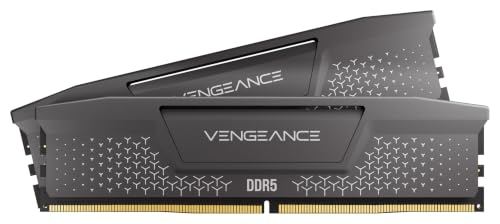
This kit is the non-RGB Vengeance RS variant, listed in a gray finish. It suits a builder who wants a straightforward 32GB dual-channel kit without lighting and who may be using Corsair’s iCUE software for tuning. The listing stresses onboard voltage regulation and hand-sorted chips. Its stated dimensions are small, which helps with cooler clearance.
- 32GB (2 x 16GB), DDR5, listed as up to 6000MHz
- AMD EXPO and Intel XMP 3.0 compatible, per the listing
- Maximum speed requires BIOS adjustment; the listing says so explicitly
- Dimensions listed at about 5.43 x 0.28 x 1.73 inches; confirm on listing
Caveat: the listing does not give full timings, so compare CAS latency against other kits before buying.
Corsair Vengeance RGB RS 32GB – for a build with visible lighting

This is the lit version of the same family. It fits a builder with a glass-panel case who wants the memory to be part of the lighting scheme. Retailer text for this product references 6000 speeds and CL36 timings, though the full set of numbers should be confirmed on the listing. Memory capacity and speed class match the non-RGB option, so the choice is mostly about looks and software.
- 32GB (2 x 16GB) DDR5, up to 6000MHz
- AMD and Intel profile support is indicated in the product name; confirm profile types on listing
- RGB lighting, with control through Corsair software
- Full timings and voltage: confirm on listing
Caveat: lighting adds a software layer, and RGB control from several brands can conflict. If you do not want that, the non-RGB kit is simpler.
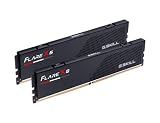
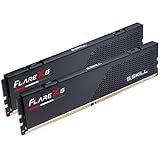
G.Skill Flare X5 32GB – for AMD builds that want a rated CL36 kit

The Flare X5 carries both an AMD EXPO profile and an Intel XMP 3.0 profile, per the listing. It is the most fully specified of the three on the page: 6000 MT/s with CL36-36-36-96 at 1.35V, plus a JEDEC default profile. It is a good match for a Ryzen build that targets the DDR5-6000 sweet spot.
- 32GB (2 x 16GB), DDR5 U-DIMM, 288-pin, non-ECC
- Rated 6000 MT/s, CL36-36-36-96, 1.35V, model F5-6000J3636F16GX2-FX5
- Includes a JEDEC default profile plus AMD EXPO and Intel XMP 3.0 profiles
- Matte black finish; the listing warns not to mix memory kits
Caveat: rated speed needs BIOS adjustment, and compatibility with your exact board should be checked on its memory support list.
Common Mistakes
- Buying one 32GB module. It leaves the system in single-channel mode. Choose two modules.
- Leaving the profile off. The kit then runs at the default speed. Enable EXPO or XMP.
- Mixing kits to reach 64GB. It can cause instability, and makers recommend matched kits.
- Paying for speed the platform cannot use. A kit well above your CPU’s comfortable range may need tuning or fall back to a lower speed.
- Overbuying for gaming. 64GB is for other work, not for most games.
- Ignoring cooler clearance. Check the memory slot clearance on your air cooler.
Questions
Is 16GB of RAM still enough for gaming in 2026?
For many games, yes, especially esports titles and older releases. It leaves little margin when you run a browser, voice chat and a launcher, and some large modern games can push beyond it. If you are buying new, 32GB is the safer choice when the budget allows.
Does more RAM increase FPS?
Not directly. More memory helps when you were running out, and it shows up as smoother frame times and fewer stutters. If you already have enough, more capacity has little effect on average frame rate.
Is DDR5-6000 worth it over slower DDR5?
For AMD Ryzen 7000-class platforms, AMD itself has called it the sweet spot. For Intel, check the board’s supported speeds. Beyond that point, gains are small and cost more.
Should I use two or four memory sticks?
Two is the simplest option and the easiest to run at rated speed. Four sticks are supported, but they add signal complexity, and AMD lists lower official speeds with two modules per channel.
Do I need XMP or EXPO turned on?
Yes, if you want the rated speed. Without it the memory runs at its default speed, which is lower than the number on the box.
Will memory prices come down soon?
TrendForce expects contract prices to keep rising in the fourth quarter of 2026 and supply to stay tight into 2027. Retail behavior can differ, so watch current listings rather than assuming a drop.
Update History
- October 14, 2026 – Initial publication.
- Check the product page for current specifications and availability before buying.
Sources and Methodology
Facts came from manufacturer and market-analyst publications and from retailer listing fields for product details. Where sources disagreed or were secondary, the claim is attributed or left out. No benchmark figures are quoted, because none were produced for this article.
- TrendForce press release on fourth-quarter 2026 memory contract prices
- AMD statements on DDR5-6000 for Ryzen 7000 as reported by TechPowerUp, TechSpot and Guru3D
- Press coverage of Valve’s September 2026 Steam Hardware Survey
- Corsair product pages for the Vengeance DDR5 family
- G.Skill listing fields for the Flare X5 series
- Retailer listing fields for the products named above