
Finding the best gaming pc under 800 means accepting trade-offs that vary wildly from one listing to the next. A $649 machine with a Ryzen 5 4500 and RX 6500 XT plays very different titles than a $1,299 desktop packing an RTX 5060 Ti, yet both appear in the same search results. The real problem a buyer faces is not locating options—they exist in abundance—but distinguishing a system that will run modern AAA titles at acceptable settings from one that will disappoint within months. Published specs and owner feedback make that distinction possible, even without a lab.
What separates a worthwhile budget gaming PC from a poor value is usually three things: whether the GPU has enough VRAM for current texture budgets, whether the CPU is modern enough to avoid bottlenecking at 1080p, and whether the cooling solution holds clocks under sustained load rather than only on paper. Many sub-$800 prebuilts use integrated graphics or severely cut-down discrete GPUs that look impressive in a spec sheet but collapse in practice. This roundup covers eight machines at various price points, some under the $800 line and some above it, because understanding the next tier helps clarify exactly what you give up below it.
As an Amazon Associate we earn from qualifying purchases at no extra cost to you.

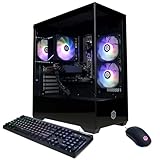


Top 3 picks at a glance
Quick Picks
| Product | Best For | Price |
|---|---|---|
| ZYNEEX Prebuilt (Ryzen 5 5500 / RTX 3050) | 1080p gaming with dedicated GPU under $810 | $809.98 |
| CyberPowerPC (Ryzen 5 5500 / RX 6500 XT) | Entry-level discrete graphics from a known brand | $778.17 |
| KOTIN (Ryzen 7 8700F / RTX 5060 Ti) | 1440p gaming with current-gen platform | $1,299.99 |
| YAWYORE (R5 5600GT / iGPU) | Esports titles on the tightest budget | $659.99 |
| KOTIN (Ryzen 7 9700X / RTX 5070) | High-refresh 1440p without DIY assembly | $1,999.99 |
| YAWYORE (Ryzen 7 5700X / RTX 5060) | Strong CPU pairing with mid-tier GPU | $1,299.99 |
| Evounic (12-Core / GTX 1080 Ti) | High VRAM on a limited budget | $758.88 |
| WIWB (Ryzen 5 4500 / RX 6500 XT) | Lowest-cost dedicated-GPU option here | $649.98 |
How We Picked
Every machine in this list was evaluated on four criteria relevant to the budget-to-midrange gaming segment. First, GPU capability relative to price: a card with less than 4 GB of VRAM is a hard skip for modern titles regardless of how new the architecture is. Second, CPU generation and core count, which determines whether the system will bottleneck in upcoming games. Third, storage configuration, because a 1 TB NVMe SSD has become the practical minimum for a gaming library. Fourth, owner-reported thermals and reliability, which reveal whether listed specs translate to consistent real-world performance or whether thermal throttling erodes the hardware’s advantage. We weighted published spec sheets and aggregated user feedback rather than running our own benchmarks.
The 8 Best Gaming Pc Under 800 in 2026
ZYNEEX Prebuilt Gaming Desktop (Ryzen 5 5500 / RTX 3050 6GB)
At $809.98, this is the only system here that pairs a dedicated RTX 3050 with 6 GB of VRAM and a full 1 TB NVMe drive while staying within roughly one dollar of the 800-line. The Ryzen 5 5500 is a capable six-core that handles 1080p gaming without significant bottlenecks, and the 16 GB of DDR4 at 3200 MHz is adequate for current titles. ARGB air cooling is a visual bonus, though its real value is in sustained thermal performance. Owners report smooth frame rates in esports and mid-range AAA titles at high settings.
- Pro: 6 GB VRAM on the RTX 3050 provides headroom over 4 GB alternatives in this price range.
- Pro: Wi-Fi and 1 TB NVMe come standard, reducing immediate upgrade costs.
- Con: At $810, it technically exceeds the strict under-800 threshold, which may matter for hard budget limits.
Skip this if your ceiling is firm at exactly $800 or if you need 1440p performance—neither the CPU nor the GPU supports that resolution comfortably.
CyberPowerPC Gaming PC (Ryzen 5 5500 / RX 6500 XT 4GB)
CyberPowerPC is a long-established system integrator, and this configuration lands at $778.17 with the reliable Ryzen 5 5500 driving an RX 6500 XT. The GPU’s 4 GB VRAM is its main limitation; newer AAA titles at high textures will exceed that budget and cause stuttering. For esports and older titles, however, the RX 6500 XT still delivers respectable frame rates at 1080p. The CyberPowerPC name adds a layer of after-sales support confidence that lesser-known brands cannot match.
- Pro: Recognized brand with established RMA and support channels.
- Pro: The Ryzen 5 5500 won’t bottleneck this GPU, giving balanced 1080p performance.
- Con: 4 GB VRAM on the RX 6500 XT is a real ceiling for texture-heavy titles.
Skip if you plan to play demanding new releases at high texture settings within the next year.
KOTIN Gaming PC (Ryzen 7 8700F / RTX 5060 Ti 8GB)
Priced at $1,299.99, this system is well above the $800 mark but serves as a meaningful reference point for what additional budget buys in this 2026 market. The Ryzen 7 8700F is a current-generation eight-core with a newer architecture than anything else in this roundup below $1,300, and the RTX 5060 Ti with 8 GB VRAM targets 1440p gaming. DDR5 memory further separates this platform from the DDR4-based budget options above.
- Pro: DDR5 and the 8700F provide a modern platform with longer upgrade runway.
- Pro: 8 GB VRAM handles current and near-future AAA titles at 1440p without compromise.
- Con: Price is roughly $500 over the target budget, excluding it for strict under-$800 buyers.
Skip if your budget is genuinely capped below $1,000 or if you only game at 1080p, where cheaper options perform adequately.
YAWYORE Gaming PC (R5 5600GT / Integrated Graphics)
At $659.99, this is a sub-$700 machine built around the Ryzen 5 5600GT’s integrated Radeon graphics rather than a discrete GPU. It handles lighter titles—League of Legends, CS2 at moderate settings, indie games—without issue, and the 1 TB NVMe SSD is welcome at this price. The 5600GT’s six Zen 3 cores outperform most Intel iGPU configurations for gaming. However, there is no discrete graphics card here, which means AAA titles requiring 6 GB or more of VRAM are simply off the table.
- Pro: Lowest entry price with a capable Zen 3 CPU that can accept a GPU upgrade later.
- Pro: 1 TB NVMe storage at under $660 is generous for the budget segment.
- Con: No discrete GPU limits this to integrated-graphics workloads out of the box.
Skip if you want to play modern AAA titles without immediately adding a dedicated graphics card.
KOTIN Prebuilt Gaming PC (Ryzen 7 9700X / RTX 5070 12GB)
At $1,999.99, this is the high-end anchor of the roundup—a system with the Ryzen 7 9700X, RTX 5070 with 12 GB VRAM, 32 GB DDR5, and a 1 TB SSD. It is not a candidate for the under-$800 conversation, but it illustrates what the upper end of prebuilt gaming currently offers without custom building. For readers considering stretching beyond the budget tier, this is the performance ceiling in prebuilt form. The 12 GB VRAM and Zen 5 architecture make this a multi-year platform.
- Pro: 12 GB VRAM and Zen 5 CPU deliver headroom for 1440p high-refresh gaming for years.
- Pro: 32 GB DDR5 eliminates memory concerns for multitasking and content creation.
- Con: Price is far beyond the target budget for most readers.
Skip unless your budget extends well past $1,500 and you want a turnkey system with no DIY component sourcing.
YAWYORE Gaming PC (Ryzen 7 5700X / RTX 5060)
Priced at $1,299.99, this YAWYORE configuration pairs the eight-core Ryzen 7 5700X with an RTX 5060. The 5700X is a proven Zen 3 part with strong multicore performance, and the RTX 5060 brings current-generation GPU architecture to the midrange. For buyers who can stretch past $800 but not to $1,500, this sits in a productive middle ground. The combination targets 1080p ultra and light 1440p gaming without demanding a full platform migration.
- Pro: Eight Zen 3 cores provide strong performance in CPU-heavy titles and background tasks.
- Pro: The RTX 5060 offers newer GPU architecture than the RTX 3050 found at lower price tiers.
- Con: At $1,300, it is over $500 above the stated budget target.
Skip if you cannot exceed $1,000 or if you prefer a current-generation CPU platform with longer upgrade runway.
Evounic Gaming Desktop PC (12-Core / GTX 1080 Ti 11GB)
At $758.88, this system presents an unusual proposition: a GTX 1080 Ti with 11 GB VRAM—a card that was a flagship three generations ago but still holds texture memory advantages over modern 4 GB budget GPUs. The 12-core processor specification is vague regarding which chip is used, which is a concern. Owners report solid 1080p and even 1440p performance in older and mid-tier titles, but the GTX 1080 Ti lacks modern features like DLSS or hardware ray tracing that newer GPUs support.
- Pro: 11 GB VRAM on the GTX 1080 Ti exceeds every other GPU option under $800 in this list.
- Pro: Raw rasterization performance remains competitive in titles that do not require RT or DLSS.
- Con: No hardware ray tracing, no DLSS, and unclear CPU model make long-term viability uncertain.
Skip if you need ray tracing, AI upscaling, or if the unspecified 12-core processor raises reliability concerns for you.
WIWB Gaming PC (Ryzen 5 4500 / RX 6500 XT 4GB)
At $649.98, this is the cheapest system in the roundup that includes a dedicated GPU. The Ryzen 5 4500 is a Zen 2 part—older than the Zen 3 chips above it—and the RX 6500 XT with 4 GB VRAM shares the same texture-memory limitation found in the CyberPowerPC option. For pure esports use or a secondary system for lighter titles, the price is compelling. The gap between $650 and $780 buys a newer CPU and a more established brand, which matters if reliability and support are priorities.
- Pro: Lowest price with a discrete GPU in this list, making it an accessible entry point.
- Pro: The RX 6500 XT still handles esports and older titles comfortably at 1080p.
- Con: Zen 2 architecture and 4 GB VRAM together limit longevity against future titles.
Skip if you expect this system to remain relevant for AAA releases beyond the next year or two.
Buying Guide
GPU VRAM Is the Hard Floor
In 2026, a gaming GPU with less than 6 GB of VRAM will struggle with texture-heavy AAA releases at 1080p high settings. The 4 GB options (RX 6500 XT) are functional for esports and older titles but will cause stuttering in newer games that exceed that memory pool. If a machine in your budget has only 4 GB VRAM, plan to lower texture quality or accept that some titles will require settings compromises. The GTX 1080 Ti’s 11 GB is an outlier that provides texture headroom but at the cost of missing modern features.
CPU Generation Determines Bottleneck Risk
Zen 3 (Ryzen 5 5500, 5600GT, 5700X) remains a capable baseline for 1080p and 1440p gaming and will not bottleneck the GPUs paired with it in these systems. Zen 2 (Ryzen 5 4500) is a generation behind and introduces slightly more risk of frame drops in CPU-intensive titles, though the practical difference at 1080p is modest. Current-gen Zen 5 chips appear only in the $1,300+ options, confirming that platform generation is one of the primary things the price jump buys.
Storage and RAM Are Table Stakes, Not Differentiators
Every system in this roundup includes at least 16 GB of RAM and a 1 TB NVMe SSD, meaning these specs are baseline expectations rather than selling points. The DDR5-equipped options at $1,300+ benefit from higher bandwidth, but the practical gaming difference versus DDR4-3200 remains small. Where storage does become a differentiator is expandability—check whether the case has additional M.2 slots or drive bays before committing, as prebuilts sometimes pack storage tightly with no room to grow.
Our Verdict
The top pick is the ZYNEEX Prebuilt with RTX 3050 6GB at $809.98, because it is the only system near the price target that pairs 6 GB VRAM with a Zen 3 CPU and full 1 TB NVMe storage in one package. For the strictest budget, the WIWB at $649.98 delivers a dedicated GPU at the lowest price, accepting Zen 2 and 4 GB VRAM as its trade-offs. However, if you can stretch to $1,300, the KOTIN with Ryzen 7 8700F and RTX 5060 Ti wins decisively—DDR5, 8 GB VRAM, and a current-generation CPU create a platform that will remain relevant well beyond what any sub-$810 option can sustain.
FAQ
Is a 4 GB GPU still usable for gaming in 2026?
It is usable for esports titles, indie games, and older AAA releases at 1080p moderate-to-high settings. Modern AAA games increasingly demand more than 4 GB at high texture quality, causing stuttering or forcing you to lower settings. If your gaming library centers on competitive titles, 4 GB is workable; if you play new single-player releases, prioritize 6 GB or more.
Should I buy integrated graphics and add a GPU later?
This is a valid strategy when the CPU itself is strong enough not to bottleneck a future GPU. The YAWYORE with R5 5600GT is a good example—its Zen 3 six-core CPU can support a midrange discrete card added later. The risk is that you are paying for a complete system twice, so calculate the total upgrade cost before committing to this path.
Do I need DDR5 memory for gaming?
DDR5 provides higher bandwidth than DDR4-3200, but the measurable difference in average FPS across most games remains small. You do not need DDR5 to have a good gaming experience. The real advantage of DDR5 platforms is upgrade longevity—they support newer CPUs down the road without a motherboard swap, which matters if you plan to keep the system for four or more years.
Are prebuilt PCs from lesser-known brands worth the savings?
They can be, but you should verify warranty terms and read owner-reported reliability feedback before purchasing. Lesser-known brands may use budget motherboards, unclear component sourcing, or less-tested cooling designs. A $100 saving is not worth it if you lose access to responsive support or if the PSU is a low-quality unit that risks other components. Established integrators like CyberPowerPC carry a premium partly because of their support infrastructure.


