Our Short List of 3
All 5 Picks at a Glance
| Product | Specs | Action |
|---|---|---|
 WD Red Plus 4TB (WD40EFPX): the NAS all-rounder | Check price on Amazon | |
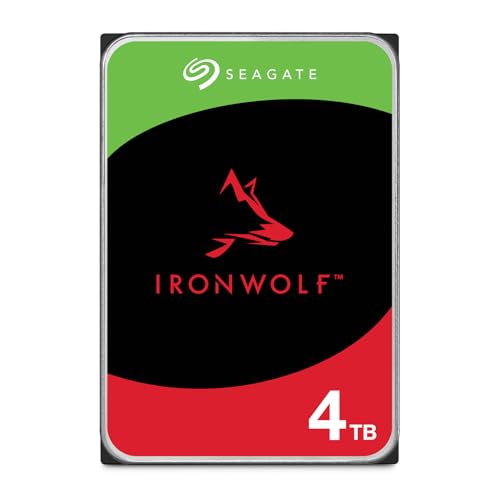
| Seagate IronWolf 4TB (ST4000VN006): NAS storage with recovery cover | Check price on Amazon | |
 WD Black 4TB (WD4006FZBX): the fast desktop spinner | Check price on Amazon | |
 Toshiba X300 4TB (HDWR440XZSTA): 7,200 RPM CMR value in the performance class | Check price on Amazon | |
 Seagate BarraCuda 4TB (ST4000DM004): the desktop archive drive, SMR stated plainly | Check price on Amazon |
As an Amazon Associate, we earn from qualifying purchases made through links on this page.
Four terabytes is the capacity where a mechanical drive stops being a stopgap and becomes a genuine storage tier: room for a full game library, years of photos and video, a local backup set, or the media folder of a small home server. This roundup covers one product type only — internal 3.5-inch SATA hard drives at exactly 4TB, the kind that mounts inside a desktop case or a NAS enclosure and connects with a SATA data cable and a SATA power lead. USB desktop drives and portable models are covered in other roundups on this site, and the large NAS drives picked for Plex duty here run at much higher capacities, so none of those pools overlap with the five drives below.
Within that frame, the real dividing lines are recording technology, spindle speed and the workload figure printed in the manufacturer data sheet. Four of the five picks use CMR (conventional magnetic recording); the fifth uses SMR (shingled magnetic recording) and is included deliberately, with its rewrite limits stated plainly, because it suits cold archive duty inside a desktop. Two picks spin at 7,200 RPM for desktop performance, and three spin at 5,400 RPM, two of them tuned for round-the-clock NAS service. Every specification below comes from the manufacturer’s published data for the exact model named, and every drive is a current 4TB model from its maker’s lineup.
Our Top Picks
Top 3 picks at a glance
What to look for in a 4TB storage hard drive
Recording technology: CMR versus SMR. A CMR drive writes each track without overlapping the next, so rewriting data already on the disk runs at full speed. An SMR drive overlaps tracks like shingles on a roof; reads are unaffected, but rewriting a region forces the drive to rewrite neighbouring tracks too, and sustained write speed can fall sharply during long copies. For a drive that will hold a NAS share, a backup target written every night, or any pool built with RAID, CMR is the safer specification. SMR is defensible only where data is written once and mostly read back, such as a media archive.
Workload figure and power-on hours. Desktop drives are built for a part-time duty cycle: Seagate publishes a workload limit of 55 TB per year for its BarraCuda line. NAS drives from both WD and Seagate carry a 180 TB per year limit and an 8,760 power-on hours figure, meaning the maker builds them to run continuously. If the drive will live in a NAS or a home server that never sleeps, match the workload figure to that duty instead of saving the difference on a desktop model.
Spindle speed and cache. A 7,200 RPM drive moves data faster in sequential transfers and answers small requests sooner; WD publishes up to 267 MB/s for its 4TB Black model, while the 5,400 RPM NAS drives here publish 180 to 202 MB/s. Cache size matters less at this capacity — four of the five picks carry 256 MB — but a larger cache helps when many small files move at once.
NAS-specific hardware. Drives built for enclosures add rotational vibration sensors, firmware that limits how long the drive spends on error recovery (so a RAID controller does not drop it from the array), and balancing tuned for several drives spinning in one box. A lone desktop bay does not need any of that; a four-bay enclosure does.
Warranty length. The spread at 4TB runs from two years on the desktop and performance Toshiba and Seagate models to three years on the NAS drives and five years on the WD Black. For a drive bought to hold the only copy of anything important, the warranty term is part of the specification, and a backup copy elsewhere matters more than any single drive’s build.
Formatted capacity. A 4TB drive holds 4 trillion bytes by the maker’s decimal count, and a computer counts in binary units, so the formatted volume appears as roughly 3.63 TB in system tools. That gap is arithmetic, not missing space, and it applies to every drive in this roundup equally.
WD Red Plus 4TB (WD40EFPX): the NAS all-rounder
The Red Plus is WD’s CMR NAS line for home and small-office enclosures, and the 4TB model WD40EFPX is the balanced entry in it: 5,400 RPM, a 256 MB cache and a published maximum transfer rate of 180 MB/s. WD builds the line around NASware 3.0 firmware, which tunes error recovery behaviour for RAID arrays, and publishes a workload limit of 180 TB per year with a mean time between failures figure of 1,000,000 hours. The drive is built for enclosures that run continuously, with vibration handling intended for multi-bay boxes rather than a single desktop mount.
View the WD Red Plus 4TB on Amazon
Who it suits. Anyone filling a small NAS with bulk storage — shared folders, a media library, backup targets for several computers — who wants a drive whose published duty figures match that job. It also works as a single storage drive in a desktop that stays on for long stretches.
Limits from the specification. The 5,400 RPM spindle and 180 MB/s ceiling make it the joint-slowest reader in this roundup, so it is the wrong pick for a drive that loads games or scrubs video timelines all day. WD supports the Red Plus line for small and mid-size enclosures; very large arrays sit in the Red Pro tier instead. The warranty runs three years, shorter than the WD Black below.
Seagate IronWolf 4TB (ST4000VN006): NAS storage with recovery cover
Seagate’s IronWolf 4TB, model ST4000VN006, matches the Red Plus on the headline NAS figures and adds two extras. It is a CMR drive at 5,400 RPM with a 256 MB cache, and Seagate’s data sheet gives a maximum sustained transfer rate of 202 MB/s — the highest figure among the 5,400 RPM picks here. The workload limit is 180 TB per year, the MTBF figure is 1,000,000 hours, and the drive is built for enclosures of one to eight bays, with rotational vibration sensors and AgileArray firmware for multi-drive boxes. Uniquely in this group, the purchase includes three years of Seagate’s Rescue data recovery services alongside the three-year drive warranty.
View the Seagate IronWolf 4TB on Amazon
Who it suits. NAS owners who value the bundled recovery cover and the slightly higher transfer ceiling, and anyone building a two- to eight-bay enclosure that will run without pause. IronWolf Health Management, available in supported enclosures, adds drive-health reporting that plain desktop drives do not expose.
Limits from the specification. The health-management features only appear inside enclosures whose software supports them; in a desktop case this behaves as a regular SATA drive and the extras go unused. Some Amazon listings print a 64 MB cache figure in the title text for this model family — that number belongs to the older ST4000VN008 generation; Seagate’s current data sheet for the ST4000VN006 specifies 256 MB, which is the figure to trust and to check on the label when the drive arrives.
WD Black 4TB (WD4006FZBX): the fast desktop spinner
The WD Black is the performance desktop entry: 7,200 RPM, CMR recording, a 256 MB cache and a published transfer rate of up to 267 MB/s, the highest in this roundup. WD adds a dual-core processor on the drive electronics and StableTrac technology, which secures the motor shaft at both ends to keep tracking accurate under vibration. The warranty is five years, the longest here by a wide margin, and the drive is positioned for a gaming or workstation desktop that needs a large mechanical tier beside a fast SSD.
View the WD Black 4TB on Amazon
Who it suits. Desktop builders who keep a big installed game library, capture footage, or a working media pool on the mechanical drive and feel the difference spindle speed makes during long sequential reads and writes. The five-year warranty also suits a drive expected to stay in the machine through several other upgrades.
Limits from the specification. WD publishes no NAS workload figure for this line and includes no rotational vibration sensor set tuned for dense enclosures, so it is a desktop drive by design rather than an array drive. A 7,200 RPM mechanism makes more noise and draws more power than the 5,400 RPM picks, which matters in a quiet room or a small case. It remains a mechanical drive: an SSD of any tier answers random requests far faster, so the Black complements a solid-state boot drive rather than replacing one.
Toshiba X300 4TB (HDWR440XZSTA): 7,200 RPM CMR value in the performance class
Toshiba’s X300 line is its performance desktop range, and the 4TB HDWR440XZSTA matches the WD Black on the core hardware: CMR recording, a 7,200 RPM spindle and a 256 MB cache, in the same 3.5-inch SATA 6 Gb/s format. Toshiba positions the drive for performance and gaming desktops, with internal shock sensors and ramp-load technology to protect the platters, and tuning aimed at sustained sequential work such as game installs and video files.
View the Toshiba X300 4TB on Amazon
Who it suits. Builders who want the 7,200 RPM CMR specification for a desktop storage tier and are comparing the full field rather than defaulting to the two biggest brands. It covers the same use cases as the WD Black: game libraries, media pools and capture storage inside a tower case.
Limits from the specification. The warranty is two years, the shortest in this roundup alongside the BarraCuda, against five on the WD Black — a real difference for a drive bought for the long term. Toshiba publishes no workload figure aimed at NAS duty and no enclosure features, so despite the CMR recording this stays a desktop pick, not the drive to populate a NAS with.
Seagate BarraCuda 4TB (ST4000DM004): the desktop archive drive, SMR stated plainly
The BarraCuda is Seagate’s mainstream desktop line, and the 4TB ST4000DM004 is the one SMR drive in this roundup. Its published figures are 5,400 RPM, a 256 MB cache and a maximum sustained transfer rate of 190 MB/s for fresh sequential writes, with a workload limit of 55 TB per year and a two-year warranty. Those numbers describe a drive built for capacity inside an ordinary desktop that is powered for part of the day: a documents and media archive, a download folder, a second copy of a photo library.
View the Seagate BarraCuda 4TB on Amazon
Who it suits. A desktop owner who needs four terabytes of mostly-read storage — media collections, installers, archived projects — and writes to it in occasional large batches rather than constant churn. In that pattern the SMR layout rarely shows its weakness, because reads run at full speed.
Limits from the specification. The SMR recording is the honest caveat: during very long write sessions, once the drive begins rewriting shingled regions, write speed drops well below the headline figure until the drive gets idle time to reorganise itself. Seagate’s own positioning excludes it from NAS duty, the 55 TB per year workload limit is the lowest here, and it should never be the drive a RAID array is built on. Buyers who write heavily every day should take one of the CMR picks instead.
Comparison table
| Drive | Recording | Spindle | Cache | Max transfer (maker figure) | Workload limit | Warranty |
|---|---|---|---|---|---|---|
| WD Red Plus 4TB (WD40EFPX) | CMR | 5,400 RPM | 256 MB | 180 MB/s | 180 TB/year | 3 years |
| Seagate IronWolf 4TB (ST4000VN006) | CMR | 5,400 RPM | 256 MB | 202 MB/s | 180 TB/year | 3 years |
| WD Black 4TB (WD4006FZBX) | CMR | 7,200 RPM | 256 MB | 267 MB/s | Not published for NAS duty | 5 years |
| Toshiba X300 4TB (HDWR440XZSTA) | CMR | 7,200 RPM | 256 MB | Not headlined by maker | Not published for NAS duty | 2 years |
| Seagate BarraCuda 4TB (ST4000DM004) | SMR | 5,400 RPM | 256 MB | 190 MB/s | 55 TB/year | 2 years |
Frequently asked questions
Is a NAS drive a sensible choice for a normal desktop?
Yes, with eyes open. The Red Plus and IronWolf work as ordinary SATA drives in a desktop bay, and their 180 TB per year workload figures and continuous-duty build exceed what a desktop asks of them. The trade is spindle speed: both spin at 5,400 RPM, so a 7,200 RPM desktop drive moves bulk data faster. The NAS firmware features, such as enclosure health reporting, only appear inside a supported NAS.
Why does the formatted drive show less than 4TB?
Makers count a terabyte as one trillion bytes, while computers group bytes in powers of two. The same physical drive therefore appears as about 3.63 TB in system tools. Every 4TB drive from every maker behaves this way; nothing is missing and no setting recovers the difference, because the difference is in the counting, not the hardware.
Which of these drives belong in a RAID array?
The four CMR drives are the candidates, and the two NAS models are the natural fit because their firmware limits error-recovery time so the array controller does not eject a drive that is busy fixing a bad spot. The SMR BarraCuda is the exclusion: its rewrite behaviour under sustained load conflicts with how arrays rebuild, and Seagate does not position it for that work.
Can one of these drives hold a full backup of a computer?
Capacity-wise, yes for most machines: a 4TB drive swallows a full image of a typical desktop with room for several dated copies beside it. Keep the backup drive’s duty in mind, though — a target written every night accumulates workload quickly, which is one more argument for the 180 TB per year NAS models in that role. A backup on a single drive in the same machine is also only one copy; important data deserves a second copy somewhere else.
Conclusion
Match the drive to the duty and the choice makes itself. For a NAS or an always-on home server, the WD Red Plus 4TB and the Seagate IronWolf 4TB are the two built for that life, split mainly by the IronWolf’s bundled recovery services and higher transfer figure. For a desktop storage tier that should feel as quick as a mechanical drive can, the WD Black 4TB brings the fastest spindle and the longest warranty, with the Toshiba X300 4TB covering the same 7,200 RPM CMR ground on a shorter warranty. The Seagate BarraCuda 4TB earns its place only as a mostly-read desktop archive, with its SMR rewrite limits understood before purchase. Whichever model you choose, confirm the exact model number on the listing matches the one named here — every brand in this roundup sells several 4TB generations side by side, and the specification that matters is the one printed for that model.
Related guides
More from Amazon
Programs that pair well with the guide above. Offers and eligibility are set by Amazon and may change.
A free business account with business pricing and bulk-buying tools for work, shop or home office.
Create a business accountFree shipping on eligible items, Prime Video and more. Eligible new members can start with a free trial.
Start a Prime free trialAudiobooks and podcasts to listen to on the go. Eligible new members can start with a free trial.
Try Audible freeAd-free music streaming. Eligible new subscribers can start with a free trial.
Try Music Unlimited freeAs an Amazon Associate we earn from qualifying purchases.