
Understanding what is a vpn concentrator starts with a simple problem: your branch offices, remote workers, and cloud services all need encrypted tunnels back to your data center, and managing dozens of those tunnels by hand does not scale. A VPN concentrator is a dedicated gateway that terminates, encrypts, and decrypts multiple simultaneous VPN sessions, offloading that work from your general-purpose firewall or router so that throughput stays predictable even as connection counts climb.
What separates a strong concentrator from a weak one comes down to three things: encryption throughput under real concurrent-session loads, how cleanly it integrates with your existing routing and policy framework, and whether the licensing model makes the total cost of ownership transparent. A device that lists impressive peak numbers but degrades badly after eight simultaneous tunnels is not a concentrator in any practical sense. Conversely, a modest-spec box that holds steady across dozens of connections and offers straightforward management wins the day. This roundup compares published specifications, street prices, and owner feedback across eight devices that address this category from different angles.
As an Amazon Associate we earn from qualifying purchases at no extra cost to you. Product prices and availability are accurate as of the date shown and are subject to change.




Top 3 picks at a glance
Quick Picks
| Product | Best for | Price |
|---|---|---|
| Cisco Meraki MX105 (No License) | Multi-site SD-WAN with integrated VPN | $5,499.90 |
| Cisco Meraki MX105 (Security Appliance) | High-throughput cloud-managed deployments | $6,750.00 |
| Juniper SRX300 | Small branch with policy-rich routing | $759.94 |
| Cisco Meraki MX65 (Renewed) | Budget lab or pilot projects | $70.00 |
| Juniper Secure Access 2500 | Large-scale SSL VPN termination | $2,009.03 |
| Fortinet FortiGate-50E | SMB perimeter with basic VPN needs | $299.65 |
| NETGEAR ProSafe SSL312 | Dedicated SSL VPN on a tight budget | $81.70 |
| Zyxel USGFLEX500H | Multi-gig sites with 300-user capacity | $1,008.55 |
How We Picked
We weighted four criteria. First, stated VPN session capacity and encryption throughput, because those numbers tell you whether the device is a true concentrator or a router with a secondary VPN feature. Second, management model—cloud-managed, CLI-only, or hybrid—since operational overhead compounds over a multi-year lifecycle. Third, whether the listed price includes licenses or leaves you exposed to a second purchase. Fourth, real-world owner feedback on stability under sustained tunnel loads, which reveals gaps that spec sheets never show.
The 8 Best What Is A Vpn Concentrator in 2026
Cisco Meraki MX105 (No License)
This is the MX105 hardware unit without a bundled license, aimed at organizations that already have a Meraki licensing pool and want to add a high-capacity site. The 3 Gbps throughput and ten GbE ports give it headroom for dozens of concurrent IPsec and SSL tunnels, and the SD-WAN integration means VPN termination and path selection happen in one policy pane. Owner feedback praises the dashboard simplicity but flags that the appliance is inert without a license activation. If your team already runs Meraki elsewhere, this is the most seamless expansion path; skip it if you need a standalone device with no recurring cloud dependency.
- Pro: Unified SD-WAN and VPN management through a single cloud dashboard
- Pro: 3 Gbps aggregate throughput supports high concurrent session counts
- Con: Requires a separate license purchase; unusable out of the box
Cisco Meraki MX105 (Security Appliance)
The second listing for the same hardware carries a higher price and explicitly markets Layer 7 visibility alongside VPN and SD-WAN. It suits security teams that want application-aware policies layered on top of encrypted tunnel management. The hardware specs are identical, so throughput and port count match the entry above. The distinction is packaging: you are paying for a clearer positioning toward threat-aware use cases. If your existing stack lacks application-layer filtering, this framing justifies the premium; otherwise, the lower-priced listing delivers the same silicon.
- Pro: Layer 7 application visibility enables granular tunnel routing policies
- Pro: Cloud-managed firmware updates reduce patch-cycle friction
- Con: Price premium over the equivalent hardware with no added performance
Juniper SRX300
The SRX300 is a compact services gateway that handles IPsec and SSL VPN termination alongside stateful firewalling and zone-based policies. It fits small branch offices needing more than a simple router but not enough traffic to justify a chassis-class platform. Owners appreciate the JUNOS operating system for its scripting flexibility and predictable upgrade path. The trade-off is a lower session ceiling than enterprise-class alternatives, so it is not the right answer for hundreds of simultaneous tunnels. Skip it if your site exceeds roughly fifty concurrent sessions or you lack JUNOS familiarity.
- Pro: JUNOS policy engine offers deep per-tunnel and per-user routing control
- Pro: Compact footprint suits space-constrained branch deployments
- Con: Session capacity limits it to small or mid-size sites
Cisco Meraki MX65 (Renewed)
At seventy dollars this renewed MX65 is a curiosity more than a production recommendation. It offers cloud-managed firewall and VPN features in a package that once retailed for several hundred dollars. For a home lab, a pilot evaluation, or a learning environment, the price is hard to argue with. Owner notes confirm the unit functions correctly after renewal grading, but it lacks a power adapter and its stated throughput is a fraction of the MX105. Do not deploy this in a production branch expecting sustained encrypted traffic; it is a sandbox tool.
- Pro: Extremely low entry price for hands-on Meraki evaluation
- Pro: Cloud management works identically to full-priced units
- Con: No power adapter included and reduced throughput ceiling
Juniper Secure Access 2500
When you hear “VPN concentrator” in the traditional enterprise sense, the Secure Access 2500 is what many engineers picture. It is a purpose-built SSL VPN platform designed to terminate thousands of concurrent encrypted sessions with granular access control. The base system does not include user licenses, so factor those into your total cost. Owners in large organizations value the split-tunnel and posture-check capabilities. Skip this if your environment has moved toward Zero Trust Access models or if your session count stays below a few hundred.
- Pro: Purpose-built SSL termination scales to high concurrent session counts
- Pro: Clientless access and posture checking extend beyond basic tunneling
- Con: Base system excludes user licenses, inflating effective cost
Fortinet FortiGate-50E
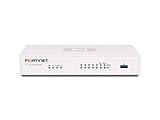
The FortiGate-50E is a next-generation firewall with integrated IPsec and SSL VPN, aimed at SMBs wanting one device for perimeter defense and remote access. Seven GbE RJ45 ports provide connectivity for a small office, and FortiOS gives a unified policy interface for firewall rules and tunnel profiles. Owner feedback highlights ease of initial setup but notes that encryption throughput drops noticeably beyond roughly ten to fifteen concurrent tunnels. It is a capable concentrator for light-duty use; skip it for branch sites with heavy encrypted traffic or more than twenty active VPN users.
- Pro: Single OS unifies firewall, VPN, and SD-WAN policy management
- Pro: Compact and fanless, suitable for quiet office placement
- Con: Encryption throughput degrades under moderate concurrent tunnel loads
NETGEAR ProSafe SSL312
The SSL312 is one of the few remaining dedicated SSL VPN concentrators from a mainstream networking vendor, supporting up to twenty-five simultaneous SSL tunnels. At under eighty-five dollars it fills a niche for small teams that need browser-based remote access without a full firewall platform. The setup wizard is approachable, and the device operates independently of any router. The limitation is obvious: twenty-five sessions is a hard ceiling, and the management interface feels dated compared to cloud-managed alternatives. Skip it if you need more than a handful of users or want application-aware routing.
- Pro: Dedicated SSL termination at a price well below general firewalls
- Pro: Standalone operation—no router or firewall integration required
- Con: Hard cap of twenty-five concurrent sessions limits scalability
Zyxel USGFLEX500H
The USGFLEX500H brings multi-gigabit Ethernet with two PoE+ ports, making it viable as both a VPN concentrator and a small office switch in one chassis. Zyxel rates it for up to three hundred users with Nebula cloud management providing the same policy flexibility as larger competitors. Owners note strong hardware value for the price. The caveat is that the unit ships hardware-only with no perpetual license tier clarified in this listing, so confirm your management model before purchasing. Skip it if your site already runs Meraki or Fortinet and you prefer a single-vendor policy plane.
- Pro: 2.5 GbE ports with PoE+ reduce need for a separate switch
- Pro: 300-user capacity approaches mid-tier enterprise platforms
- Con: Hardware-only listing leaves license and management costs ambiguous
Buying Guide
Session Capacity Versus Throughput
Manufacturers advertise peak encryption throughput, but a VPN concentrator’s real job is holding many sessions open simultaneously without collapsing bandwidth per tunnel. Check whether the stated throughput applies to a single tunnel or the aggregate across all sessions. A device rated at 3 Gbps aggregate with a fifty-session cap behaves very differently from one rated at 1 Gbps with a five-hundred-session cap. Match the numbers to your expected concurrency before comparing price.
Management and Licensing Model
Cloud-managed platforms like Meraki and Zyxel Nebula simplify fleet operations but introduce recurring costs. On-premises management tools like JUNOS or FortiOS give you more control and no subscription, but demand in-house expertise. Determine whether your total cost of ownership includes only the hardware price or hides a per-seat license behind the initial purchase. Several devices in this list require a second purchase before they become functional.
VPN Protocol and Integration Depth
Not all concentrators handle the same protocols. Some support only IPsec, others add SSL and DTLS, and a few integrate with Zero Trust frameworks or certificate authorities. Confirm that the device speaks the protocol your client fleet already uses. Layer 7 application visibility, SD-WAN path selection, and posture-check capabilities are value-adds only if your architecture calls for them; paying for features you will not configure wastes budget.
Our Verdict
Top pick: the Juniper Secure Access 2500 remains the clearest answer to what is a vpn concentrator in the traditional sense—purpose-built SSL termination at scale with no compromises on session count or access granularity. Budget pick: the NETGEAR ProSafe SSL312 delivers genuine dedicated VPN concentration under one hundred dollars, ideal for small teams. Conditional winner: the Zyxel USGFLEX500H takes the prize when you need multi-gigabit switching and VPN in one box and your user base sits in the one- to three-hundred range.
FAQ
What is a VPN concentrator and how does it differ from a firewall?
A VPN concentrator is a device whose primary role is terminating many encrypted tunnels simultaneously and routing traffic from those tunnels to internal networks. A firewall’s primary role is packet filtering and access control. Many modern appliances combine both functions, but a dedicated concentrator optimizes CPU and memory for cryptographic operations rather than rule matching.
Do I need a separate VPN concentrator if my firewall already supports VPN?
Not always. If your concurrent session count stays below the firewall’s stated capacity and encryption throughput meets your bandwidth needs, the integrated feature suffices. Consider a separate concentrator when tunnel management begins to affect firewall policy performance or when you need protocol features your current firewall lacks.
Are renewed or refurbished units safe for production VPN use?
For lab testing and pilot evaluations, renewed units like the Meraki MX65 in this list work reliably. For production, the absence of a manufacturer warranty and the unknown component wear history introduce operational risk that typically outweighs the cost savings.
How many concurrent VPN sessions should I plan for?
Start with the number of users who will connect during peak hours, not total employees, and add a margin of twenty to thirty percent for growth. Then select a device whose rated session capacity exceeds that number with room to spare, because real-world encryption overhead consumes more resources than marketing figures imply.


