
Pick the RX 7900 XT if you game at 1440p high refresh or 4K. It is a full performance tier above, roughly 60-90% faster in GPU-bound games, and has 20 GB of VRAM. The RX 6750 XT is the sensible choice for 1080p and lighter 1440p gaming on a tighter budget and a smaller power supply. These cards are not direct rivals. One is an upper-midrange RDNA 2 refresh, and the other was AMD’s second-fastest RDNA 3 card. The real question is whether your monitor and games need the extra power.
Neither card is AMD’s current generation. The Radeon RX 9000 series (RX 9060 XT, 9070, 9070 XT, 9070 GRE) replaced RDNA 3 in 2025. That changes the math for anyone buying today, as covered further down. Both cards are still widely available used and in remaining new stock, and both handle current games well at the right resolution.
As an Amazon Associate we earn from qualifying purchases at no extra cost to you.
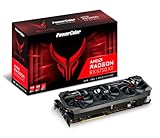
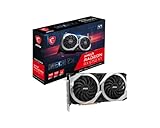


Our Top Picks

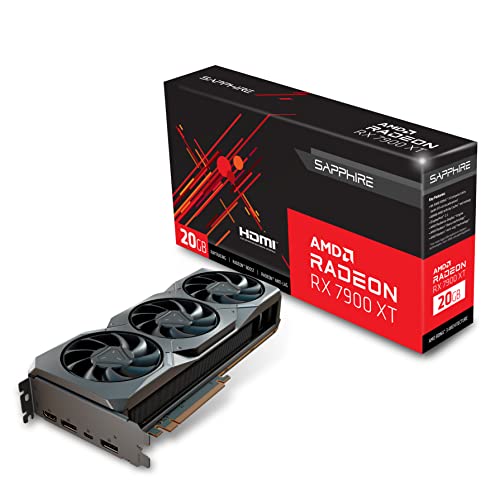

Top 3 picks at a glance
Spec Sheet Comparison
| Specification | Radeon RX 6750 XT | Radeon RX 7900 XT |
|---|---|---|
| Architecture / process | RDNA 2.0, 7 nm | RDNA 3.0, 5 nm |
| Release date | 3 March 2022 | 3 November 2022 |
| Launch MSRP | $549 | $899 |
| Stream processors | 2560 | 5376 |
| Boost clock | 2600 MHz | 2394 MHz |
| VRAM | 12 GB GDDR6 | 20 GB GDDR6 |
| Memory bus / bandwidth | 192-bit / 432.0 GB/s | 320-bit / 800.0 GB/s |
| Cache | 3 MB L2 + 96 MB Infinity Cache | 6 MB L2 + 80 MB Infinity Cache |
| Interface | PCIe 4.0 x16 | PCIe 4.0 x16 |
| Board power | 250 W | 300 W |
| Power connectors | 1x 6-pin + 1x 8-pin | 2x 8-pin |
| Length / width | 267 mm, 2-slot | 276 mm, 2-slot |
| Outputs | 1x HDMI 2.1, 3x DP 1.4a | 1x HDMI 2.1a, 2x DP 2.1, 1x USB-C |
The RX 7900 XT has more than twice the stream processors, nearly double the memory bandwidth and 8 GB more VRAM. The RX 6750 XT’s clock speed is slightly higher, but that does little to close a gap this large. RDNA 3 also moved to a chiplet design, with the memory controllers and Infinity Cache on separate dies. This is part of why the 7900 XT’s bandwidth jumps so much.
How Much Faster Is the RX 7900 XT?
The gap depends heavily on resolution. Tom’s Hardware’s launch testing put the RX 7900 XT around 12% ahead of the RX 6950 XT at 1440p, and TechSpot found it modestly ahead of the RX 6900 XT in many titles. The RX 6750 XT sits well below those flagship RDNA 2 cards. Comparison data compiled from published benchmarks puts the RX 7900 XT at roughly:
- 1080p: about 15-35% faster. The CPU often limits frame rate here, especially in esports titles.
- 1440p: about 50-90% faster in demanding, GPU-bound games such as Cyberpunk 2077.
- 4K: about 70-100% faster. The RX 6750 XT runs out of bandwidth and cache hit rate at this resolution.
In practical terms, the RX 6750 XT is a strong 1080p card that handles most 1440p games at high settings, often at 60-90 FPS depending on the title. The RX 7900 XT pushes many of those same games past 120 FPS at 1440p and makes native or lightly upscaled 4K at 60+ FPS realistic. All frame rates vary with settings, CPU and game patch, so treat them as rough ranges.
Ray Tracing and Upscaling
Both cards are weaker at ray tracing than Nvidia’s equivalents and AMD’s newer RX 9000 series. RDNA 3 improved ray tracing throughput per compute unit compared with RDNA 2, and the RX 7900 XT has many more units. Its ray tracing lead over the RX 6750 XT is usually as large as, or larger than, its raster lead. With moderate RT effects at 1440p, the RX 7900 XT is playable without much compromise. The RX 6750 XT typically needs FSR upscaling and lighter RT settings to stay above 60 FPS.
On upscaling and frame generation, both cards are in the same position. Both support FSR 3.1 (with frame generation in supported games) and AMD Fluid Motion Frames 2 at the driver level. FSR 4, AMD’s machine-learning upscaler, is officially built for RDNA 4. Neither card has it as an official feature, so FSR 3.x image quality is the baseline for both. Since the RX 7900 XT has more native performance to start with, it can use FSR’s Quality mode where the RX 6750 XT has to drop to Balanced or Performance. That gives it a visible image-quality advantage.
VRAM Headroom: 12 GB vs 20 GB
The RX 6750 XT’s 12 GB is still comfortable for 1080p and adequate for most 1440p games at high textures. Ultra texture packs at 1440p sometimes push close to the limit. The RX 7900 XT’s 20 GB is effectively a non-issue at any resolution this card can drive, including 4K with high-resolution textures and ray tracing. A simple VRAM guide for 2026 releases:
- 1080p high: 8-10 GB, and both cards are fine
- 1440p high/ultra: 10-14 GB, so the RX 6750 XT is adequate and the RX 7900 XT is comfortable
- 4K ultra with RT: 14-20 GB, which only the RX 7900 XT covers well
The extra memory also helps outside gaming. Local AI models, large texture work and heavy video editing timelines all benefit from 20 GB.
Cost Per Frame: Launch Math
Taking the RX 6750 XT as 100 and the RX 7900 XT as about 170 at 1440p (midpoint of the range above):
- RX 6750 XT: $549 / 100 = about $5.49 per performance point
- RX 7900 XT: $899 / 170 = about $5.29 per performance point
At launch MSRP, the two cost about the same per frame at 1440p. The RX 7900 XT pulls ahead at 4K, and the RX 6750 XT wins at 1080p where the bigger card is held back by the CPU. Real prices have moved far from MSRP since then. Used RX 6750 XT cards usually sell in the $230-$300 range, and used RX 7900 XT cards in the $480-$600 range. Rerun this math with the prices you actually see. The newer RX 9070 XT is often roughly as fast as or faster than the RX 7900 XT in raster, much better in ray tracing, and gets official FSR 4 support. Compare against it before paying near-new prices for a 7900 XT.
Power Supply and Case Fit
A simple PSU sizing formula is GPU board power + CPU power + about 150 W of headroom:
- RX 6750 XT with a 125 W CPU: 250 + 125 + 150 = 525 W. A quality 650 W unit is a safe pick.
- RX 7900 XT with a 150 W CPU: 300 + 150 + 150 = 600 W. A quality 750 W unit is the safer pick, because RDNA 3 cards can produce brief power spikes above their rated board power.
Connectors differ slightly. The RX 6750 XT reference design uses one 6-pin and one 8-pin, while the RX 7900 XT uses two 8-pin connectors. Some factory-overclocked RX 7900 XT models add a third 8-pin, so check your PSU has enough separate PCIe cables. Avoid daisy-chaining both connectors from one cable on the higher-power card.
The reference dimensions are similar: 267 mm versus 276 mm, both listed as dual-slot. Many partner RX 7900 XT cards are much larger, though, often 300-340 mm long and 2.5 to 3.5 slots thick, with heavy coolers that benefit from a support bracket. Partner RX 6750 XT cards usually fit mid-tower cases without trouble. If you have a compact case, measure length and slot clearance before ordering a 7900 XT.
On outputs, the RX 7900 XT adds DisplayPort 2.1. That matters only for very high refresh 4K monitors that support it. The RX 6750 XT’s DisplayPort 1.4a and HDMI 2.1 still handle 4K at 120-144 Hz with Display Stream Compression.
Pick the RX 6750 XT If / the RX 7900 XT If
| Scenario | Recommended card |
|---|---|
| 1080p, any refresh rate, budget focus | RX 6750 XT |
| 1440p at 60-100 Hz, high settings | RX 6750 XT |
| 1440p at 144 Hz or higher in demanding games | RX 7900 XT |
| 4K gaming | RX 7900 XT |
| Ray tracing at 1440p | RX 7900 XT (or consider an RX 9070 XT / RTX 50 card) |
| 500-650 W power supply, mid-size case | RX 6750 XT |
| Local AI or heavy creative work needing VRAM | RX 7900 XT |
The bottom line: the RX 7900 XT is the better card in every performance measure, but its advantage only matters if your display and games can use it. For a 1080p player, the RX 6750 XT delivers most of the experience for well under half the price. For 1440p high-refresh or 4K, the 7900 XT, or a current-generation RX 9070 XT, is the right tier.
Frequently Asked Questions
Is the RX 7900 XT worth it over the RX 6750 XT for 1080p?
Usually not. At 1080p the CPU often limits frame rate, so the RX 7900 XT’s lead shrinks to roughly 15-35% in many games. That is a small return for about twice the price and power. The money is better spent on a faster CPU or a 1440p monitor.
Do both cards support FSR 4?
FSR 4 is officially built for RDNA 4 (Radeon RX 9000) graphics cards. Both the RX 6750 XT and RX 7900 XT officially rely on FSR 3.1 upscaling and frame generation, plus driver-level AMD Fluid Motion Frames 2. If FSR 4 image quality matters to you, an RX 9060 XT or RX 9070-series card is the route.
What PSU does the RX 7900 XT need?
A quality 750 W power supply is the safe choice with a typical gaming CPU. The calculation is 300 W for the card, roughly 150 W for the CPU and about 150 W of headroom for the rest of the system and power spikes. Use two separate 8-pin PCIe cables rather than one daisy-chained cable.
Is 12 GB on the RX 6750 XT enough for 1440p?
For most current games at 1440p with high textures, 12 GB is enough. A few releases with ultra texture packs or heavy ray tracing come close to the limit, and lowering textures one step fixes it. At 4K, 12 GB becomes restrictive more often.
Should I buy an RX 7900 XT or an RX 9070 XT in 2026?
The RX 9070 XT generally matches or beats the RX 7900 XT in rasterized games, is clearly stronger in ray tracing, and officially supports FSR 4. The RX 7900 XT’s advantage is 20 GB of VRAM against 16 GB. Unless a used RX 7900 XT is clearly cheaper, the newer card is the more future-proof purchase.

