
The RX 6800 is the clearly faster card, roughly 40-60% ahead of the Arc A770 in rasterized games, and the right pick for 1440p high-refresh gaming; the Arc A770 16GB only wins on price, ray-tracing efficiency per dollar and XeSS image quality, so it suits buyers who cannot stretch to RX 6800 money and mainly play at 1080p or entry-level 1440p.
As an Amazon Associate we earn from qualifying purchases at no extra cost to you.

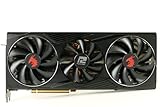

Our Top Picks

Top 3 picks at a glance
Same Memory, Different Leagues
On paper these cards look similar in one important respect: both carry 16 GB of GDDR6 on a 256-bit bus with 512 GB/s of bandwidth. Beyond that, they come from very different tiers. AMD’s RX 6800 launched in October 2020 at $579 as an upper-tier RDNA 2 card that competed with NVIDIA’s RTX 3070 and RTX 3070 Ti. Intel’s Arc A770 launched in October 2022 at $329 as the top Alchemist card, targeting the RTX 3060 class.
Both are now previous generation. Their successors are the RX 9070 series for AMD and the Arc B580 for Intel. In the used and clearance market, though, they can end up surprisingly close in price, which is why the comparison keeps coming up.
Spec Comparison
| Specification | Radeon RX 6800 | Arc A770 |
|---|---|---|
| Architecture | RDNA 2.0 | Xe-HPG (Generation 12.7) |
| Release date | 28 October 2020 | 12 October 2022 |
| Launch MSRP | $579 | $329 |
| Shader units | 3840 | 4096 |
| Boost clock | 2105 MHz | 2400 MHz |
| Process | 7 nm | 6 nm |
| Memory | 16 GB GDDR6 | 16 GB GDDR6 |
| Bus / bandwidth | 256-bit / 512.0 GB/s | 256-bit / 512.0 GB/s |
| Cache | 4 MB L2 + 128 MB L3 | 16 MB L2 |
| Interface | PCIe 4.0 x16 | PCIe 4.0 x16 |
| Board power | 250 W | 225 W |
| Power connectors | 2x 8-pin | 1x 6-pin + 1x 8-pin |
| Length / width | 267 mm / 2-slot | Varies by model / 2-slot |
| Outputs | 1x HDMI, 2x DisplayPort, 1x USB-C | 1x HDMI 2.1, 3x DisplayPort 2.0 |
The RX 6800’s 128 MB Infinity Cache is the hidden difference. It raises effective bandwidth well above the raw 512 GB/s figure, particularly at 1080p and 1440p, while the A770 relies on a 16 MB L2.
Frame Rates: How Far Apart Are They?
Rasterization
Hardware Unboxed/TechSpot’s RX 6800 review placed it about 14% ahead of the RTX 3070 at 1440p, and TechPowerUp’s data put it comfortably above the 3070 as well. The Arc A770, in the TechSpot and TechPowerUp launch reviews, landed roughly around RTX 3060 level, and driver updates since then have moved it up modestly. Placing both cards against those NVIDIA reference points, the RX 6800 typically leads the A770 by roughly 40-60% in rasterized games, with the gap largest at 1080p and 1440p where Infinity Cache helps most and the A770’s driver overhead shows.
As an approximate illustration, a demanding title the A770 runs around 50-60 fps at 1440p high might run around 75-90 fps on the RX 6800. Specific numbers vary with game, settings, CPU and driver version.
Ray tracing
Intel’s RT units are relatively strong for their class, while RDNA 2’s ray accelerators are AMD’s first-generation design. That narrows the gap in ray-traced games: the RX 6800 is still usually ahead because of its higher overall throughput, but by a smaller margin than in raster, and in some heavily ray-traced scenes the two are close. Neither card is suited to heavy path-traced modes.
Driver maturity
The RX 6800 is the more consistent card across older and less mainstream games. Arc’s driver issues have improved dramatically since 2022, especially for DirectX 11 and DirectX 9 titles, but its performance still varies more from game to game. On the AMD side, RDNA 2 moved to a separate driver branch in late 2025; AMD clarified that RX 6000 cards continue to receive game support, optimizations and fixes.
Upscaling and Frame Generation Options
- RX 6800: FSR up to 3.1 including frame generation in supported games, plus AMD Fluid Motion Frames at the driver level. FSR 4 is officially aimed at RX 9000 hardware. XeSS runs via its DP4a path.
- Arc A770: XeSS on dedicated XMX units, which generally gives better image quality than DP4a XeSS or FSR 3 at the same internal resolution. XeSS 2 adds frame generation and low latency in supported games. FSR also works.
Neither card supports DLSS. The A770 has the better upscaler, but the RX 6800’s raw speed means it often does not need upscaling at 1440p.
VRAM: A Draw
Both cards have 16 GB, which is plenty for 1080p and 1440p and workable at 4K in current games. This is one of the few spec categories where the cheaper card fully matches the faster one, and it is the reason both age better than 8 GB cards from the same period.
Power Draw, PSU and Platform
The RX 6800 is rated at 250 W and the A770 at 225 W, so their gaming power draw is broadly similar. Given the RX 6800’s much higher performance, it delivers considerably more frames per watt. TechPowerUp measured the RX 6800 at around 223 W in gaming, notably efficient for its performance class.
PSU sizing with a 125 W gaming CPU and 150 W headroom:
- RX 6800: 250 + 125 + 150 = 525 W, so 600-650 W recommended.
- Arc A770: 225 + 125 + 150 = 500 W, so 550-650 W recommended.
The RX 6800 needs two 8-pin connectors; the A770 needs a 6-pin and an 8-pin. Arc also depends on Resizable BAR for its expected performance, and has historically high idle power unless ASPM power saving is configured. The RX 6800 benefits from Smart Access Memory but does not require it.
Physically, the reference RX 6800 is 267 mm long and dual-slot; partner cards can be longer and thicker. A770 dimensions depend on the specific model.
Dollars per Frame
At launch MSRP, normalizing the A770 to 100 performance points and the RX 6800 to about 150, the A770 cost $3.29 per point and the RX 6800 about $3.86 per point. The A770 was the better value at list price, at the cost of much lower absolute performance.
In the used market, an RX 6800 usually sells in the $250-$320 range and an A770 16GB in the $170-$230 range. At those prices the cost per frame is close, so the RX 6800’s higher performance usually makes it the better buy if the budget allows.
Buyer Decision Table
| Resolution / need | Budget under about $230 | Budget about $250-$320 |
|---|---|---|
| 1080p high | Arc A770 16GB | RX 6800 (high refresh) |
| 1440p high | Arc A770 with XeSS | RX 6800 |
| 4K | Neither is ideal | RX 6800 with FSR |
| Older system without ReBAR | Look elsewhere | RX 6800 |
| Ray tracing focus | Arc A770 | RX 6800, or a current RTX card |
Conclusion
The RX 6800 is the stronger graphics card in nearly every gaming scenario, with a large raster lead, mature drivers and the same 16 GB of VRAM. The Arc A770 16GB is a decent budget alternative with good XeSS and respectable ray-tracing for its price, but it is a tier below. If the price gap is modest, the RX 6800 is the better buy; if it is large, the A770 delivers acceptable 1080p and light 1440p performance for less.
Frequently Asked Questions
How much faster is the RX 6800 than the Arc A770?
Based on where TechSpot and TechPowerUp reviews place each card relative to NVIDIA’s RTX 3060 and RTX 3070, the RX 6800 is roughly 40-60% faster in rasterized games. The gap is usually smaller in ray-traced games. Exact results vary by title and driver version.
Do both cards have the same VRAM?
Yes, both have 16 GB of GDDR6 on a 256-bit bus with 512 GB/s of bandwidth. The RX 6800 adds 128 MB of Infinity Cache, which raises its effective bandwidth. Memory capacity is not a limiting factor for either at 1080p or 1440p.
Is the Arc A770 better at ray tracing than the RX 6800?
Not in absolute terms; the RX 6800 is usually still ahead because it is a faster card overall. The A770 loses less performance when ray tracing is enabled, so the gap narrows. Neither is a strong ray-tracing card.
Does the Arc A770 need Resizable BAR?
Yes, Intel lists Resizable BAR as required for proper performance. Without it, frame rates drop and stutter increases. The RX 6800 works well without it.
Which card is better for 1440p?
The RX 6800 is the better 1440p card, delivering high frame rates at high settings without upscaling in most games. The A770 can manage 1440p at medium-high settings, often with XeSS enabled.

