The RTX 3050 6GB is the better buy for most people: it matches or slightly beats the RX 590 in everyday 1080p gaming while drawing 70 W instead of 175 W, needing no power cable, and adding DLSS, hardware ray tracing and current driver support. The RX 590 only makes sense if it costs very little used, you already own it, or you play older games where its 8 GB buffer and wide memory bus still help.
These cards are separated by more than five years. The RX 590 was AMD’s final refresh of the Polaris design, launched in November 2018 at $279. The RTX 3050 6GB is a cut-down Ampere card released in February 2024 at $179, designed to run entirely from the PCIe slot. Their raw gaming speed ends up surprisingly close, but nearly everything else favors the newer card.
As an Amazon Associate we earn from qualifying purchases at no extra cost to you.


Our Top Picks
 GIGABYTE GeForce RTX 3050 WINDFORCE OC V2 6GStandard7.5 x 4.4 x 0.1 inches0.88 poundsCheck on Amazon
 msi Gaming RTX 3050 Ventus 2X 6G OC1.7" x 4.3" x 7.4"7.4 x 4.3 x 0.1 inches1.3 poundsCheck on Amazon
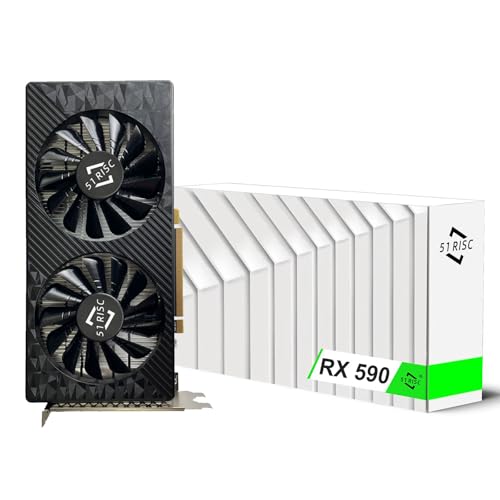
Top 3 picks at a glance
How the Hardware Compares
| Specification | RX 590 | RTX 3050 6GB |
|---|---|---|
| Architecture | GCN 4.0 (Polaris) | Ampere |
| Release date | 15 November 2018 | 2 February 2024 |
| Launch MSRP | $279 | $179 |
| Shaders / CUDA cores | 2304 | 2304 |
| Boost clock | 1545 MHz | 1470 MHz |
| Process | 12 nm | 8 nm |
| Board power | 175 W | 70 W |
| Memory | 8 GB GDDR5 | 6 GB GDDR6 |
| Bus width | 256-bit | 96-bit |
| Bandwidth | 256.0 GB/s | 168.0 GB/s |
| L2 cache | 2 MB | 2 MB |
| Interface | PCIe 3.0 x16 | PCIe 4.0 x8 |
| Power connectors | 1x 8-pin | None (slot powered) |
| Length / width | 241 mm, 2-slot | 242 mm, 2-slot |
| Outputs | 1x HDMI, 3x DisplayPort | 1x HDMI 2.1, 3x DisplayPort 1.4a |
The shader counts happen to be identical at 2304, but the comparison is not apples to apples. Ampere’s CUDA cores are more efficient per clock than Polaris stream processors, while the RX 590 brings far more memory bandwidth from its 256-bit bus. The RTX 3050 6GB is heavily trimmed from the 8 GB RTX 3050: as TechSpot’s review explains, dropping a memory chip narrows the bus to 96-bit and cuts bandwidth by 25% to 168 GB/s.
Gaming Performance at 1080p
In traditional rasterized games, the two cards land in the same performance class. Aggregated comparison data ranges from a near tie to the RTX 3050 6GB being up to about 16% faster, depending on the game selection. TechSpot’s RTX 3050 6GB review shows the card at roughly RX 5500 XT and Arc A580 levels in some titles, and between 14% and 24% slower than the 8 GB RTX 3050 across several demanding games. That positions it right around where a well-cooled RX 590 sits.
In practical terms, both are 1080p cards for medium to high settings in modern games and high settings in older or esports titles. Expect broadly 60 FPS or more in lighter esports games at high settings, and roughly 30-60 FPS in demanding recent AAA releases at medium-to-low settings. These ranges vary with settings, CPU and game patch.
Where each card stumbles
The RX 590 struggles with newer engines optimized for DirectX 12 Ultimate features it simply lacks, including mesh shaders and hardware ray tracing. A growing number of 2025-2026 games list ray-tracing-capable hardware as a minimum requirement, and the RX 590 cannot launch those titles at all. The RTX 3050 6GB has a different weakness: its 6 GB buffer and 96-bit bus can choke on high-resolution textures, so it needs texture quality turned down earlier than the 8 GB RX 590 in memory-heavy games.
Ray Tracing, DLSS and Frame Generation
The RX 590 has no hardware ray tracing and no AI upscaling. It can use FSR 1 and FSR 2-class upscaling in games that support them, which helps frame rates at a cost in image quality. FSR 3 frame generation is also designed to run on a wide range of GPUs, but on a card this slow, the base frame rate is often too low for frame generation to feel good.
The RTX 3050 6GB supports DLSS Super Resolution, including the DLSS 4 transformer model, plus DLSS Ray Reconstruction. It does not support NVIDIA’s DLSS frame generation, which is limited to RTX 40 and RTX 50 cards, but it can use FSR 3 frame generation where games offer it. Ray tracing is technically available, though on a card of this class it is mainly useful for light effects at low settings with DLSS active. DLSS is the bigger practical win: running “Quality” or “Balanced” mode can lift frame rates noticeably in games where the card is otherwise borderline.
VRAM: Does 8 GB Beat 6 GB?
On paper, the RX 590’s 8 GB is a real advantage, and in some older and texture-heavy games it allows higher texture settings without stutter. A rough guide for VRAM at 1080p:
- Esports and older titles: 4-6 GB is enough.
- Modern AAA at medium: 6 GB is tight but usable with sensible texture settings.
- Modern AAA at high textures: 8 GB or more is recommended.
However, extra VRAM only helps if the GPU is fast enough to use high settings in the first place, and neither of these cards is. In practice, the RX 590’s memory advantage is smaller than the spec sheet suggests, and its lack of modern feature support is a bigger long-term limitation than 2 GB of memory.
Power, PSU and Installation
This is the clearest difference between the two. Using the formula of GPU board power plus CPU gaming power plus about 150 W of headroom:
- RX 590: 175 W + ~105 W (typical budget CPU while gaming) + 150 W = about 430 W, so a quality 450-500 W unit with an 8-pin PCIe cable is recommended.
- RTX 3050 6GB: 70 W + ~105 W + 150 W = about 325 W, so most decent 350-400 W units work, including many prebuilt office PC supplies.
Because the RTX 3050 6GB draws all its power from the PCIe slot, it is the natural choice for upgrading prebuilt office desktops that lack PCIe power cables. The RX 590 needs an 8-pin connector. Both reference figures list about 241-242 mm length in a dual-slot design, but RTX 3050 6GB partner models include compact and low-profile versions, which makes it far more flexible for small form factor builds. The 105 W lower power draw also means noticeably less heat and fan noise.
One platform note: the RTX 3050 6GB uses a PCIe 4.0 x8 link. In older PCIe 3.0 systems it runs at x8 Gen 3 bandwidth, which costs a little performance when VRAM overflows. The RX 590 uses a full PCIe 3.0 x16 link and is not affected.
Driver Support and Longevity
AMD moved its Polaris-based RX 400 and RX 500 cards to a separate legacy driver track in 2023. They still receive occasional critical fixes, but no longer get regular game-specific optimizations. The RTX 3050 6GB is on NVIDIA’s current driver branch with ongoing game-ready updates. For anyone planning to play new releases over the next few years, this difference matters as much as raw speed.
Cost Per Performance and Used Prices
Treating the two cards as roughly equal in raster performance, the launch math is simple: $179 for the RTX 3050 6GB versus $279 for the RX 590, so the newer card delivered similar performance for about 36% less money at launch, before counting power savings.
The real-world picture is different, because the RX 590 is now a used-only product. It usually sells for roughly $50-$90 used, while the RTX 3050 6GB typically sits around $120-$170 used. At those prices, the RX 590 can still be a reasonable stopgap for someone on an extreme budget with a capable PSU. Used RX 590s are often several years into heavy use, so check for fan noise, high temperatures and signs of past cryptocurrency mining.
Pick the RX 590 If / Pick the RTX 3050 6GB If
| Scenario | Better choice |
|---|---|
| Upgrading an office PC with no PCIe power cable | RTX 3050 6GB |
| Small form factor or low-profile case | RTX 3050 6GB |
| New games that require ray tracing hardware | RTX 3050 6GB |
| Absolute lowest cost, used card, 500 W PSU already installed | RX 590 |
| Older titles with high-resolution texture mods | RX 590 |
| Long-term driver support | RTX 3050 6GB |
Buyers with a bit more money should also consider stepping up to an RX 6600-class card or a current entry model like the Intel Arc B570 or RTX 5050, all of which are meaningfully faster than either card here.
Frequently Asked Questions
Is the RTX 3050 6GB faster than the RX 590?
In most modern games the two are close, with comparison data ranging from a tie to the RTX 3050 6GB leading by up to about 16%. The RTX 3050 6GB wins more clearly when DLSS is used. The RX 590 can hold its own in older titles that favor its high memory bandwidth.
Can the RTX 3050 6GB run without a PCIe power cable?
Yes. Its 70 W board power is within what the PCIe slot can supply, so it needs no supplementary connector. This makes it a popular upgrade for prebuilt desktops with basic power supplies.
Does the RX 590 support ray tracing or DLSS?
No. The RX 590 has no hardware ray tracing and cannot use DLSS. It can use FSR upscaling in supported games, and some newer titles that require ray tracing hardware will not run on it at all.
What PSU do I need for an RX 590?
A quality 450-500 W power supply with an 8-pin PCIe connector is a safe target for a typical gaming build. The card is rated at 175 W, and older units with weak 12 V rails should be avoided.
Is 6 GB of VRAM enough for 1080p gaming?
For esports titles and many AAA games at medium settings, 6 GB is workable. Some recent releases need texture settings lowered to avoid stutter. Turning on DLSS reduces render resolution and can also help keep memory use under control.
Is a used RX 590 still worth buying?
Only at a very low price and for a specific need, such as older games on a tight budget. AMD’s Polaris cards are on a legacy driver track and lack modern features. For most buyers, a newer card with current driver support is the safer long-term choice.
Related guides
More from Amazon
Programs that pair well with the guide above. Offers and eligibility are set by Amazon and may change.
A free business account with business pricing and bulk-buying tools for work, shop or home office.
Create a business accountFree shipping on eligible items, Prime Video and more. Eligible new members can start with a free trial.
Start a Prime free trialAudiobooks and podcasts to listen to on the go. Eligible new members can start with a free trial.
Try Audible freeAd-free music streaming. Eligible new subscribers can start with a free trial.
Try Music Unlimited freeAs an Amazon Associate we earn from qualifying purchases.