
The best surfboards for beginners are stable foam longboards or wide funboards matched to your body weight, wave size, skill level, and how easily you need to carry and store them.
Top 3 picks at a glance
Quick picks by surfer and wave
| Surfer situation | Best board class | Useful starting specification | Why it works |
|---|---|---|---|
| First lessons on small, weak waves | Soft-top longboard | 8–9 ft, 70–100 L, 22–24 in wide | Maximum stability, easy paddling, forgiving rails |
| Adult beginner who wants one board | Wide funboard or mini-mal | 7–8 ft, 50–75 L, 21–23 in wide | More maneuverable than a longboard without becoming unstable |
| Lightweight beginner or older child | Soft-top funboard | 6–7 ft, 35–55 L, broad outline | Enough flotation without an oversized board that is difficult to control |
| Intermediate surfer in small-to-medium waves | Epoxy funboard or hybrid | 6’8–7’6, roughly 40–65 L | Balances stability, speed, and turning response |
| Powerful, steeper waves | Shortboard or mid-length | Length and volume based on experience, not beginner formulas | Reduced swing weight and narrower rails improve control |
How to choose the best surfboards for your weight
Board volume is the most useful beginner specification because it indicates how much water the board displaces. A larger volume generally means easier paddling and better stability, but too much volume can make a board cumbersome and difficult to turn.
As an Amazon Associate we earn from qualifying purchases at no extra cost to you.

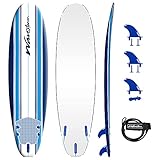


For a first board, use these approximate volume-to-weight ratios:
- Complete beginner: 0.8–1.0 liters per kilogram of body weight.
- Beginner with balance or previous board-sport experience: 0.65–0.8 L/kg.
- Intermediate surfer: 0.45–0.7 L/kg, depending on board shape and wave conditions.
Worked example: choosing volume
Suppose a new surfer weighs 80 kg and wants to learn on mellow beach-break waves. At 0.8–1.0 L/kg, the target is approximately 64–80 liters. A stable 8-foot soft-top in that range is more suitable than a 6-foot shortboard with 35 liters, even if the shorter board looks easier to transport. The shortboard will sit lower in the water, paddle slowly, and feel unstable during takeoff.
For a 60 kg beginner, the same calculation gives approximately 48–60 liters. That surfer may be comfortable on a 7-foot foam funboard rather than needing a full 9-foot longboard. These are starting ranges, not strict rules: width, thickness distribution, rail shape, fitness, and wave power all change how a board feels.
Length, width, and shape matter as much as liters
Longboards: the easiest learning platform
Boards from about 8 to 9 feet are the safest default for an adult learning to catch unbroken waves. Their length helps them glide into waves early, while their wide midsection resists side-to-side tipping. A rounded nose and full rails make them forgiving when your stance is imperfect.
Examples of this category include the Wavestorm 8ft Original, the Softech Roller 7ft in a shorter soft-board format, and comparable 8-foot or 9-foot foam boards from established surf brands. Exact dimensions vary by version, so check the published volume and weight recommendation before buying.
The trade-off is transport. An 8-foot board may fit inside some larger vehicles only with the seats folded, and a 9-foot board usually needs roof transport or a suitable board bag.
Funboards and mini-mals: the best one-board compromise
A funboard, often called a mini-mal or mid-length depending on its outline, typically has a wide nose, generous thickness, and enough length to paddle efficiently. The 7-foot to 8-foot range is a strong choice for an adult who wants to progress beyond whitewater but does not want to replace the board immediately.
The Torq Mod Fun and NSP Elements Funboard are examples of molded or epoxy-style boards in this general category. They are usually more responsive and durable than basic soft-tops, but their harder surfaces require more care around people, rocks, and vehicles.
Shortboards: usually a poor first purchase
A shortboard is not automatically better because it is lighter or more advanced-looking. Its narrow outline, lower volume, pointed or less-rounded nose, and sharper rails demand accurate positioning and stronger paddling. Choose one after you can consistently catch and stand on waves with a larger board, not as a shortcut to progression.
For an intermediate surfer, a hybrid or fish can make sense in small, clean waves. A fish-style board has a wider tail and often uses a swallowtail, producing speed and maneuverability, but it still requires better balance than a beginner longboard.
Foam, epoxy, or fiberglass?
- Soft-top foam: The best safety and learning choice for many beginners. It is forgiving during falls, resists minor knocks, and works well in surf schools. Foam decks can absorb water or become damaged if left in heat, so use a board bag and avoid leaving the board in a hot car.
- Molded epoxy or epoxy sandwich: Lighter and often more durable against everyday dents than traditional fiberglass. These boards are responsive and suitable for progressing surfers, though a hard rail can still injure another person in a crowded lineup.
- Traditional fiberglass and polyurethane: Offers refined flex and feel, especially on performance shapes. It dents and repairs more easily than many epoxy constructions and is rarely the best value for a first board.
Construction should match where you store the board. If it will be carried through a crowded beach, shared with children, or transported frequently, a soft-top often saves repair costs and stress. If weight on the roof rack matters and you already control a board confidently, epoxy can be worth the upgrade.
Match the board to the wave
| Wave conditions | Prefer | Avoid | Reason |
|---|---|---|---|
| Small, weak, slow waves | Long, full, high-volume board | Low-volume shortboard | Extra glide catches waves before they lose energy |
| Clean waist-high waves | 7–8 ft funboard or mid-length | Very wide beginner board once skills improve | Enough stability with more turning control |
| Steep beach break | Moderate-volume board with manageable length | Very long board in crowded, powerful peaks | Shorter swing weight helps positioning and control |
| Reef or point break | Durable mid-length or suitable performance board | Unprotected beginner board in shallow water | Construction, leash, and skill level matter more near obstacles |
Wave height alone is not enough. A small, clean wave can be easier than a larger, messy wave with strong currents. Beginners should prioritize a supervised beach, soft sand, light crowds, and waves that break gently rather than choosing a board solely from a forecast number.
Decision guide for transport and storage
If your board must fit inside a car, measure the actual interior length with seats folded and doors closed. A 7-foot board may still be awkward in a compact vehicle, while an 8-foot board generally requires roof racks or a secure external carrier. Never place a board where it blocks your view or can move during braking.
- Small hatchback: Look at a 6’6–7’6 funboard only if it can be transported safely; otherwise budget for roof racks.
- SUV, wagon, or van: An 8-foot soft-top is practical and gives a beginner more stability.
- Walking or public transport: A 6’6–7′ board in a padded bag is easier to carry, but compensate with enough width and volume.
- Limited storage: Choose a board with durable construction and store it horizontally or on padded wall racks, away from direct sun.
Features worth paying for
Prioritize a reliable leash plug, a leash of the correct length, a grippy deck or traction pad, and fins that are easy to replace. A three-fin setup, known as a thruster, offers predictable turning. A single fin or 2+1 setup suits many longboards and produces a smoother, more stable ride.
Do not overvalue cosmetic graphics, a very light advertised weight, or the shortest board you can carry. For learning, a few extra liters and several inches of width usually produce more useful performance than premium materials.
Frequently asked questions
How should I care for a soft-top surfboard after using it?
Rinse and store a soft-top away from direct heat and sun, and use a board bag when transporting or storing it. Foam decks can absorb water or become damaged if left in heat, so avoid leaving the board in a hot car. Store it horizontally or on padded wall racks when possible.
When should I move from a longboard to a shorter board?
Move to a shorter board after you can consistently catch and stand on waves with a larger board. A shortboard demands accurate positioning and stronger paddling, while a hybrid or fish may suit an intermediate surfer in small, clean waves. Changing boards too early can make progression harder rather than easier.
Can I safely transport a surfboard inside my car?
You can transport a board inside a car only if it fits safely with the seats folded and the doors closed. Never place it where it blocks your view or can move during braking. Measure the actual interior first, because even a board that technically fits may be awkward or unsafe.
Which fin setup is easiest for a beginner to understand?
A three-fin thruster setup offers predictable turning and is a practical choice for learning. A single fin or two-plus-one setup suits many longboards and produces a smoother, more stable ride. The article also recommends prioritizing fins that are easy to replace, rather than focusing on cosmetic graphics or very light advertised weight.
Are larger waves always more difficult for a beginner?
No, wave height alone does not determine difficulty. A small, clean wave can be easier than a larger, messy wave with strong currents. Beginners should prioritize supervised beaches, soft sand, light crowds, and waves that break gently. Small, weak waves also favor longer, fuller, higher-volume boards because they provide more glide.
Bottom line
For most adults starting from scratch, the best surfboards are an 8-foot soft-top around 70–90 liters or a wide 7’–8′ funboard around 50–75 liters. Smaller or lighter surfers can step down in volume, while heavier surfers should prioritize width, thickness, and a stronger weight rating. Once you can paddle into waves, stand consistently, and control your direction, move toward an epoxy funboard or mid-length rather than jumping directly to a low-volume shortboard.


