
The best wall mounted wine racks are the ones that match your bottle count, wall type, available depth, and mounting hardware—not simply the rack with the largest capacity.
Top 3 picks at a glance
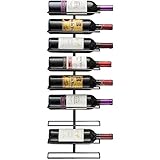

Best Wall Mounted Wine Racks by Room and Storage Need
| Room or situation | Recommended rack type | Typical capacity | Minimum wall space | Best mounting approach |
|---|---|---|---|---|
| Small kitchen or apartment | Compact metal bottle cradle | 3–6 bottles | 30–60 cm wide | Stud, masonry plug, or rated hollow-wall anchors |
| Dining room | Horizontal shelf with bottle dividers | 6–12 bottles | 60–100 cm wide | Two or more fixing points into studs or masonry |
| Dedicated wine corner | Modular grid or multi-level rack | 12–30 bottles | 90–150 cm wide | Multiple studs, masonry anchors, or a reinforced backing board |
| Large collection | Floor-to-ceiling wall system | 30+ bottles | One complete wall section | Professional fixing to structural points |
For most homes, a six- to twelve-bottle rack is the best balance. It keeps the load manageable, leaves room to identify each bottle, and is less likely to dominate a kitchen or dining area. A small rack also gives you more flexibility if you later rearrange furniture or move to another room.
As an Amazon Associate we earn from qualifying purchases at no extra cost to you.


What to Compare Before Buying
Bottle capacity and real-world load
Manufacturers usually quote capacity using standard 750 ml Bordeaux-style bottles. Champagne bottles, Burgundy bottles, magnums, and unusually heavy glass bottles can reduce usable capacity because they are wider or heavier.
A full bottle commonly weighs about 1.2–1.5 kg, including the glass. This creates a useful planning calculation:
12 bottles × 1.4 kg = 16.8 kg of wine and glass.
Add approximately 2–4 kg for the rack itself, and a twelve-bottle installation may place roughly 19–21 kg on the wall. Choose a rack and fixing system with a rated load comfortably above that figure. A practical target is at least 1.5 times the calculated working load, or around 30 kg for this example.
Do not treat the quoted bottle count as a recommendation for every wall. A rack advertised for 12 bottles may be suitable for 12 standard bottles on masonry but require a lower load on plasterboard or stud-free drywall.
Mounting hardware and wall support
Mounting hardware matters as much as the rack frame. The screws supplied with a rack may be appropriate for masonry but unsuitable for plasterboard, lath-and-plaster, tile, or a hollow partition.
- Wood studs: Use structural screws long enough to penetrate the stud by roughly 40–50 mm after passing through the bracket and wall finish. Two separated fixing points are preferable to one central screw.
- Brick or concrete: Use masonry plugs or expansion anchors matched to the wall material and screw diameter. Drill without hammer action when working near fragile tile, then use the appropriate setting for the substrate behind it.
- Plasterboard or drywall: Use load-rated toggle or cavity anchors only when the rack’s fixing holes and load rating support them. A heavy multi-bottle rack should ideally attach to studs or to a backing board fixed across multiple studs.
- Tile: Confirm what is behind the tile before drilling. A tile surface does not provide structural support; the anchor must grip masonry, a stud, or a suitable cavity system behind it.
- Unknown or damaged walls: Reduce the planned bottle count or ask a qualified installer to assess the wall.
Never rely on adhesive strips, ordinary picture hooks, or a single drywall screw for a loaded wine rack. Wine bottles create a sustained, shifting load, especially when bottles are removed from the front.
Material durability
Powder-coated steel is usually the most practical material for kitchens because it resists everyday knocks and is easy to wipe clean. Inspect the coating for chips around screw holes and welded joints, where corrosion can begin if moisture reaches bare metal.
Stainless steel is a strong choice near sinks or humid rooms, although the grade and finish still matter. Brushed surfaces hide fingerprints better than polished surfaces, while lower-quality stainless hardware may stain if exposed to cleaning chemicals or salt-laden moisture.
Solid hardwood suits dining rooms and traditional interiors. It should have smooth, rounded bottle contact points and a protective finish that tolerates occasional spills. Avoid untreated wood in a damp area, where it can swell or develop mildew.
Engineered wood or MDF can work well for a light-duty decorative shelf, but inspect the edge treatment and bracket connection. Repeated moisture exposure or an overloaded shelf can cause sagging or fastener pullout.
Acrylic is visually light and useful for a modern room, but it can scratch and may become brittle with age or direct sunlight. It is best for smaller capacities unless the manufacturer provides a substantial load rating.
Spacing, Access, and Bottle Compatibility
Spacing is more important than it first appears. A rack that fits standard bottles tightly may not accommodate wider bottles or allow you to remove one without disturbing its neighbors.
- Allow roughly 90–100 mm of width per standard bottle as a comfortable planning figure.
- Allow approximately 110–125 mm for wider Burgundy-style or sparkling-wine bottles.
- Leave at least 75–100 mm above or below a bottle opening if your hand must reach around it.
- Keep the rack several centimeters away from a side wall so labels and bottle shoulders do not scrape against paint.
- Check the rack’s depth against cabinet doors, drawers, walking routes, and nearby appliances.
For cork-sealed bottles intended for longer storage, a rack should hold the bottle horizontally or at a slight downward angle toward the cork. This helps keep the cork from drying out. Screw-cap bottles are less dependent on orientation, so a vertical display rack can be acceptable for short-term storage.
Head-to-Head: Which Rack Style Fits Your Room?
Compact individual bottle cradles
These use separate loops, pegs, or saddles for each bottle. They are the best choice for a small kitchen, rental property, or display of a few valuable bottles. Individual cradles use little wall area and can be arranged vertically, but every cradle adds another fixing point, so installation can become tedious. Choose a set with a continuous mounting rail if you want easier alignment.
Horizontal shelf racks
A shelf with dividers offers the easiest everyday access and usually handles mixed bottle shapes better than tightly spaced slots. It is suitable for dining rooms and entertainment areas, but the shelf projects farther from the wall and may require stronger brackets. Look for a front retaining lip or dividers that prevent bottles from rolling forward.
Modular grid racks
Grid systems are the most flexible option for a growing collection. You can begin with six or twelve bottles and add sections later. Their drawbacks are greater visual weight, more complicated load distribution, and a greater need for multiple anchors. Install the complete planned frame rather than assuming a later extension will be supported by the original fixings.
Decorative wall panels
Panel-style racks can make a wine display a focal point, particularly in a dining room or home bar. They may conceal the mounting hardware and distribute force across a wider area. Check whether the decorative panel is structural or merely a cover; the load must ultimately transfer through the bracket and anchors into the wall.
A Practical Selection Matrix
| Your priority | Choose | Avoid | Reason |
|---|---|---|---|
| Small space and low visual impact | 3–6 bottle metal cradle | Floor-to-ceiling grid | Uses less depth and creates a smaller wall load |
| Mixed bottle shapes | Shelf with wide dividers | Narrow fixed slots | Wide bottles need extra clearance |
| Long-term horizontal storage | Angled cradle or enclosed cubby | Open vertical peg | Maintains bottle orientation and reduces rolling risk |
| Rental or uncertain wall | Light rack attached to known studs | Large multi-bottle system | Limits damage and reduces anchor demands |
| Humid kitchen or bar | Powder-coated or stainless steel | Unsealed MDF | Better resistance to spills and humidity |
Installation Checks That Prevent Failures
- Measure the wall, including nearby doors, cabinets, switches, and appliance clearances.
- Locate studs or identify whether the wall is brick, concrete, plasterboard, or a mixed construction.
- Calculate the expected load using the heaviest likely bottle, not the average bottle.
- Compare that load with both the rack rating and the anchor rating. The lower rating controls.
- Use a level to mark every fixing point and pre-drill according to the anchor manufacturer’s instructions.
- Tighten fasteners firmly without crushing a metal bracket, splitting wood, or deforming drywall.
- Test the empty rack for movement, then add bottles gradually. Stop if the wall flexes, the bracket bends, or any anchor rotates.
After installation, inspect the rack again after a few days. Wood can settle, drywall anchors can shift, and a bracket that looked rigid when empty may sag under a full load. Keep bottles away from direct sunlight and strong heat sources; a wall rack is storage furniture, not a temperature-controlled wine cellar.
Frequently asked questions
Can I use a wall-mounted wine rack for Champagne or Burgundy bottles?
Yes, but wider bottles may reduce the rack’s usable capacity and require more clearance. Manufacturers commonly rate racks using standard 750 ml Bordeaux-style bottles, while Champagne and Burgundy bottles are wider. Plan for roughly 110–125 mm of width per wider bottle, compared with 90–100 mm for a standard bottle, and choose a rack with dividers or spacing that allows easy removal.
How much wall space should I leave around a wine rack?
Leave enough clearance for bottle access, nearby furniture, and surrounding surfaces. Allow at least 75–100 mm above or below a bottle opening if your hand must reach around it, and keep the rack several centimeters from a side wall. Also check its depth against cabinet doors, drawers, walking routes, and nearby appliances before installation.
Should wine bottles be stored horizontally in a wall rack?
Cork-sealed bottles intended for longer storage should be held horizontally or at a slight downward angle toward the cork. This helps keep the cork from drying out. Screw-cap bottles are less dependent on orientation, so a vertical display rack can be acceptable for short-term storage. The rack should also prevent bottles from rolling or falling forward.
What should I do if I cannot identify the wall construction?
If the wall is unknown or damaged, reduce the planned bottle count or ask a qualified installer to assess it. A loaded wine rack creates a sustained, shifting load, particularly when bottles are removed. Do not rely on adhesive strips, ordinary picture hooks, or a single drywall screw. The fixing system must transfer the load into suitable structural points.
How can I protect a metal wine rack from moisture?
Choose powder-coated steel for practical resistance to everyday knocks and easy cleaning, or stainless steel near sinks and in humid rooms. Inspect the coating around screw holes and welded joints, where corrosion can begin if moisture reaches bare metal. For stainless steel, consider the grade and finish, since lower-quality hardware may stain when exposed to chemicals or salt-laden moisture.
Final Buying Advice
Choose a compact metal rack for a small kitchen, a divided horizontal shelf for convenient dining-room storage, and a modular anchored system for a larger collection. Prioritize the wall and fixing method before styling, then verify bottle spacing using the widest bottles you actually own. The best wall mounted wine racks combine a conservative load rating, secure attachment to the correct substrate, enough clearance for real bottle shapes, and materials suited to the room’s moisture and traffic.


