
The best back massagers for targeted muscle relief are shiatsu kneading massagers with heat for broad upper and lower back tension, and percussion massagers for deep, pinpoint trigger-point work, with the right choice depending on whether you need hands-free relaxation or active, precise control over intensity and location.
As an Amazon Associate we earn from qualifying purchases at no extra cost to you.


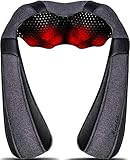
Top 3 picks at a glance
How to Choose by Massage Type
Massage type determines what kind of relief you actually get. For back pain, the mechanism matters more than marketing claims.
Shiatsu Kneading (Nodes/Rollers)
Uses 2 to 4 rotating nodes that mimic thumb pressure in circular motions. Best for sustained, diffuse soreness across the trapezius, rhomboids, and lumbar paraspinals. Typically offers 2-direction rotation and 3D movement where nodes protrude 1-2 inches to dig into muscle. Weakness is lack of precision — you move your body against the nodes rather than moving the device to the spot.
Percussion / Percussive Therapy
Uses a reciprocating head that delivers rapid pulses, usually 1,200 to 3,200 percussions per minute (PPM) with 10-16mm amplitude. Class examples include the Therabody Theragun and Hyperice Hypervolt lines. Best for localized knots, post-workout stiffness, and restoring range of motion. You control the exact spot, angle, and pressure. Weakness is fatigue during use and difficulty reaching mid-back without assistance.
Vibration and Compression
Vibration pads and wrap-around compression massagers use diffuse vibration (20-60 Hz) or airbag inflation. Good for general relaxation and circulation while seated or lying down, but not effective for deep tissue work. Often found in massage chairs and seat-topper cushions.
Rolling Track (Seat/Chair Based)
S-track and L-track rollers travel along a rail conforming to the spine curvature. S-track follows the natural S-shape to the lumbar, L-track extends under the glutes. Provides the most hands-free, consistent coverage from neck to lower back, usually with body-scan calibration.
Coverage, Ergonomics, and Reach
Coverage is where most buyers misjudge. A powerful motor is useless if it cannot reach your pain point.
- Shiatsu pillows/cushions: Coverage area roughly 12 x 8 inches per node cluster. Straps secure it to a chair. You lean and shift to target upper vs. lower back. Excellent ergonomics for passive use while working, but requires a chair with solid back support to get adequate pressure.
- Percussion guns: Reach depends on handle angle. Single-angle handles force wrist flexion to hit the lower back. Multi-grip or 90-degree articulating arms reduce shoulder strain by 30-40%. Weight matters: 1.5-1.8 lb devices are sustainable for two-handed back work; over 2.2 lb causes arm fatigue within 90 seconds.
- Chair toppers and pads: Full-back coverage of 24-30 inches vertical. Best for users who want neck-to-lumbar coverage without repositioning. Requires near-wall clearance of 4-6 inches for recline models.
For chronic mid-back pain between the shoulder blades, prioritize a device you can operate without contorting. For lumbar pain from sitting, a chair-based shiatsu or S-track cushion with adjustable height rollers is more effective than a handheld unit you must constantly hold.
Intensity Controls and Heat That Actually Help
Intensity is not just high vs. low. Look for granularity and control logic.
Speed increments: Percussion devices with 4-5 distinct levels (e.g., 1,700 / 1,900 / 2,200 / 2,700 PPM) are more usable than those with 20 micro-levels you will never adjust mid-reach. Shiatsu devices should offer at least 2 speeds and the ability to reverse direction every 60 seconds to prevent nerve irritation from repetitive motion.
Pressure sensitivity: Higher-end percussion massagers auto-adjust torque when you press harder, maintaining PPM under load. Low-torque motors stall when you apply more than 15-20 lbs of pressure, which makes deep back work impossible.
Heat: Infrared or surface heating elements typically reach 104-113°F (40-45°C) within 2-3 minutes. This is the therapeutic window for muscle relaxation without skin irritation. Heat helps most for stiffness and morning tightness. For acute inflammation or nerve-related pain, heat can worsen discomfort — choose a model where heat can be toggled independently from massage. Look for auto-shutoff for heat at 15 minutes and overheat protection at ~122°F.
Concrete starting settings for targeted relief:
- For upper back tension from desk work: Shiatsu on low speed, heat on, 10-minute session. Let nodes run bidirectionally. Do not press your full body weight into it for the first 2 minutes.
- For post-exercise lumbar tightness: Percussion at 1,900-2,200 PPM, medium amplitude attachment (flat or dampener head), 30 seconds per spot, 2-3 passes. Keep device at a 45-degree angle to the spine, never directly on the spine.
- For chronic knots: Percussion at 1,200-1,700 PPM with bullet or fork attachment around, not on, the trigger point for 45-60 seconds to avoid bruising.
Battery Life and Power Budget: A Worked Calculation
Battery claims are often based on the lowest speed with no load. Real runtime is lower when you apply pressure and use heat.
To estimate true runtime, use usable energy vs. average draw:
Runtime (hours) = (Battery Voltage x Amp-hours x Efficiency Factor) / Average Power Draw
Take a common spec class: a cordless shiatsu pillow with a 14.8V 2600mAh (2.6Ah) lithium-ion pack and a heated shiatsu motor.
- Nominal energy: 14.8V x 2.6Ah = 38.48 Wh
- Usable energy with 85% converter and cutoff efficiency: 38.48 x 0.85 = 32.7 Wh
- Average draw: Motor on low speed ~22W, heat element ~8W, control board ~1W = 31W total
- Estimated runtime: 32.7 Wh / 31W = 1.05 hours, or about 63 minutes
If you turn heat off, draw drops to ~23W and runtime extends to 32.7 / 23 = 1.42 hours (85 minutes). On high speed with heat, draw can reach 36-40W, cutting runtime to 49-54 minutes.
For percussion devices, the math is similar but loads are intermittent. A 16.8V 2500mAh pack (42 Wh, ~35.7 Wh usable) at an average 25W percussion load with stall compensation yields ~85 minutes. At 40W under heavy pressure, expect 53-55 minutes. If a product advertises 4-6 hours on that battery size, it is quoting idle time on the lowest setting with no pressure.
Practical takeaway: For cordless use, prioritize 45W or higher brushless motors with at least 35Wh usable energy if you need daily 15-minute sessions for a week without recharging. For chair toppers and pads, corded power (usually 24-36W AC adapter) eliminates this constraint entirely.
Safety Features You Should Not Skip
Back massagers apply strong mechanical force near the spine and kidneys. Safety systems prevent injury, not just device failure.
- Auto-shutoff timer: 15-minute default is the medical guideline for a single area to prevent petechiae and muscle irritation. Avoid devices without a hard 15-20 minute cutoff.
- Stall/overload protection: Motor should cut or reduce power if jammed against bone or fabric, typically within 3-5 seconds above 35W load.
- Thermal cutoff: Heat models should have NTC sensors that disable heat above 113-122°F and full device shutdown above 140°F internal temperature.
- Housing and strap integrity: For chair-mounted shiatsu, look for reinforced stitching and buckle closures rated to 40+ lbs of leaning force. Thin elastic straps slip and shift pressure to the spine.
- Contraindication warnings: Do not use percussion directly on the spine, front of neck, or over bruised, inflamed, or recently injured tissue. Users with pacemakers, deep vein thrombosis, or severe osteoporosis should use vibration-only modes and consult a clinician first.
Comparison Table: What Each Class Delivers
| Spec Class | Massage Mechanism | Typical Speed / Nodes | Heat Range | Weight | Real Runtime / Power | Noise Level | General Market Range |
|---|---|---|---|---|---|---|---|
| Cordless Shiatsu Pillow | 4x 3D kneading nodes | 2 speeds, ~28-34 RPM, auto-reverse | 104-113°F, toggleable | 3.5-5.5 lb | 50-85 min cordless (30-38 Wh pack) | 48-58 dB | usually $40–$90 |
| Percussion Gun | Reciprocating pulse, 10-16mm amplitude | 1,200-3,200 PPM, 4-5 levels | none (some add warm head) | 1.5-2.5 lb | 55-90 min at 25W avg load | 55-68 dB | usually $80–$250 |
| Chair Topper / Seat Cushion | S-Track or L-Track rollers + vibration | Rollers 15-30 RPM, 2-3 intensity levels | 104-113°F lumbar zone | 12-20 lb (corded) | Corded 24-36W AC, unlimited | 45-55 dB | usually $120–$350 |
| Wrap / Strap Massager | Shiatsu + vibration with handles | 2-3 speeds, ~30 RPM | 102-110°F | 2.5-4.0 lb | 60-100 min cordless | 50-60 dB | usually $50–$120 |
Decision Matrix: Match Your Situation to the Right Type
| Your Primary Need | Best Fit | Why | Key Feature to Demand |
|---|---|---|---|
| Diffuse upper-back stiffness from sitting 6+ hours | Shiatsu pillow or chair topper with heat | Hands-free, broad coverage while seated; heat sustains relaxation | Adjustable node height and independent heat toggle |
| Pinpoint knot between shoulder blades | Percussion gun with multi-grip | Direct control of location and pressure | 10-12mm amplitude minimum, stall-resistant motor 30W+ |
| Post-workout lower back tightness | Percussion or L-track cushion | Deep muscle activation and lumbar extension | Quiet brushless motor under 60 dB, flat head attachment |
| Need relaxation while working, low effort | Chair topper or wrap massager | Passive use, no arm fatigue | 15-min auto-shutoff, corded or 35Wh+ battery |
| Shared household, different heights | S-track/L-track with body scan | Auto-adjusts roller path to spine length | Height memory and width adjustment |
| Sensitive to noise or thin walls | Shiatsu pillow or low-noise percussion | Lower dB than high-RPM percussion | Brushless motor, under 55 dB at low speed |
Buying Checklist Before You Pay
- Test ergonomics against your body: If you are over 6 feet tall or under 5’2″, verify roller travel length (at least 28 inches for full-back) and pillow strap length.
- Verify intensity is usable, not just high: Look for low-speed options under 1,800 PPM or under 30 RPM for shiatsu. Maximum power is rarely the most used setting.
- Confirm heat independence: Ensure heat can run without kneading and vice versa. Integrated-only heat forces you to over-massage to get warmth.
- Check serviceability: Removable, washable covers and available replacement heads / power adapters extend lifespan 2-3 years. Sealed fabric traps sweat and odor.
- Noise in your environment: 65+ dB percussion is intrusive in apartments. If you plan nighttime use, target models rated 45-55 dB at working speed.
FAQ
Can a back massager replace physical therapy for chronic pain?
No. Massagers help with muscular tension and short-term soreness, but they do not address disc, joint, or nerve pathology. If pain radiates down the leg, causes numbness, or lasts more than 2-3 weeks despite rest, seek clinical evaluation.
How long and how often should I use a back massager?
Limit sessions to 15 minutes per area, 1-2 times per day with at least 60 minutes between sessions. For percussion, 30-60 seconds per spot for 2-3 passes is sufficient; prolonged pounding on one point increases bruising risk.
Is heat always better?
Not for acute injuries within the first 48-72 hours, swelling, or inflammatory flare-ups. Use heat-free vibration or low-speed shiatsu in those cases and add heat only for chronic stiffness.


