Our Short List of 3

- Cuff fit: 5.3 to 8.5 inches (13.5 to 21.5 cm), the joint-widest range here
- Memory: 90 readings on the device for one user; unlimited history in the Omron Connect app over Bluetooth
- Positioning and detection: Heart Zone Guidance position sensor, cuff wrap guide, irregular heartbeat detection, body movement alerts, Advanced Averaging across the last three readings taken within ten minutes
- Power: 2 AAA batteries, storage case included
- Cuff fit: 5.5 to 7.75 inches (14 to 19.5 cm) — the narrowest range in this guide
- Memory: 99 readings on the device, with app sync on top
- Measurement: measures during inflation rather than after it, with a colour-coded result indicator and irregular heartbeat detection
- Power: 2 AAA batteries, roughly 170 measurements per set; one-year warranty

- Cuff fit: 5.3 to 7.7 inches
- Memory: 120 readings across 2 users, plus an average of the last 3 readings per user
- Positioning and detection: Smart Measure inflation technology, cuff-fit detection icon, irregular heartbeat detection, result index set against the American Heart Association’s 2017 blood pressure categories
- Power: 2 AAA batteries, storage bag included; HoMedics backs the model with a five-year warranty
All 5 Picks at a Glance
| Product | Specs | Action |
|---|---|---|
| 1. Omron 7 Series Wireless Wrist Blood Pressure Monitor (BP6350) |
| Check price on Amazon |
| 2. iHealth Push Wrist Blood Pressure Monitor (KD-723) |
| Check price on Amazon |
| 3. HoMedics 700 Series Wrist Blood Pressure Monitor (BPW-800BT-WT) |
| Check price on Amazon |
 4. Omron 3 Series Wrist Blood Pressure Monitor (BP6100) |
| Check price on Amazon |
 5. A&D Medical Essential Wrist Blood Pressure Monitor (UB-525) |
| Check price on Amazon |
As an Amazon Associate, we earn from qualifying purchases made through links on this page.
A wrist blood pressure monitor trades the fiddly upper-arm cuff for a unit that wraps around the wrist and inflates at the press of a button. That convenience is the whole point of the category, and it is also its weakness: a wrist reading is taken farther from the heart than an arm reading, so the result depends heavily on holding the wrist at heart level, sitting still and using a cuff that actually fits. Home-monitoring guidance from the American Heart Association favours upper-arm cuffs for most people, and treats wrist devices as an alternative for those who cannot use an arm cuff or who need something small enough to travel with. If a wrist monitor is the format you will genuinely use every day, the five models below are the ones with the strongest paper trail behind them.
Every pick here is a dedicated wrist monitor — no upper-arm machines and no smartwatches with an inflatable band. Each one was checked against its maker’s own documents for three things: the wrist sizes the cuff is built for, the measurement technology and memory it carries, and the validation status the maker publishes. Where a device appears on the Validated Device Listing maintained for the American Medical Association (validatebp.org), that is stated; where validation rests on the maker’s own claim, that is stated too, in those words. Nothing in this guide is a measurement we took ourselves, and no wrist monitor should be treated as a substitute for a clinician’s reading.
Our Top Picks
Top 3 picks at a glance
What to look for
Cuff fit range comes first. A wrist cuff that is too small or too large for your wrist will skew readings before any electronics get involved, and wrist models differ more than you might expect. The widest cuffs here cover wrists from 5.3 to 8.5 inches (13.5 to 21.5 cm). Two of the five stop at roughly 7.7 inches, which quietly rules them out for larger wrists. Measure your wrist with a tape before choosing, and pick a model whose published range puts your wrist comfortably inside the span rather than at its edge.
Validation status is the second filter. The strongest public evidence a home monitor can carry is a listing on the Validated Device Listing, which records devices that have passed a recognised protocol such as ANSI/AAMI/ISO 81060-2. Below that sits the maker’s own statement that a model is clinically validated. Both kinds of claim appear in this guide and they are labelled differently, because they are not the same thing. A model with neither kind of published backing was left out, however long its feature list ran.
Positioning help matters more at the wrist than anywhere else. Because the sensor sits at the end of the arm, a wrist held too low or too high shifts the reading. Some models fight this with hardware: Omron’s Heart Zone Guidance uses a position sensor to tell you when the wrist reaches heart level, and HoMedics builds a cuff-fit icon that flags a wrap that is too loose or too tight. Models without any positioning aid demand more discipline from the user, and that trade-off is noted under each pick.
Memory and user count decide how the device fits a household. On-device storage here runs from 60 to 120 readings. Single-user models keep one person’s history; two-user models keep separate histories for a partner or family member. Bluetooth models move readings into a phone app, which removes the on-device cap and makes it easier to show a longer history at an appointment. Standalone models keep everything on the device, which suits anyone who does not want another account and another app.
Power and running costs are simple but worth checking. Every model here runs on two AAA batteries. Published endurance figures range from roughly 170 measurements per set on the iHealth Push to roughly 300 on the Omron 3 Series, so heavy daily users will swap batteries noticeably more often on some models than others.
The wrist BP monitors, compared
1. Omron 7 Series Wireless Wrist Blood Pressure Monitor (BP6350)
- Cuff fit: 5.3 to 8.5 inches (13.5 to 21.5 cm), the joint-widest range here
- Memory: 90 readings on the device for one user; unlimited history in the Omron Connect app over Bluetooth
- Positioning and detection: Heart Zone Guidance position sensor, cuff wrap guide, irregular heartbeat detection, body movement alerts, Advanced Averaging across the last three readings taken within ten minutes
- Power: 2 AAA batteries, storage case included
See the Omron 7 Series Wireless Wrist on Amazon
The BP6350 is the most fully documented wrist monitor in this guide. It appears on the Validated Device Listing with a validation protocol of ANSI/AAMI/ISO 81060-2:2013 recorded against it, and Omron’s own manual gives the cuff range as wrists from 5.3 to 8.5 inches. It is the pick for buyers who want the strongest published validation behind a wrist device.
The limits are about the ecosystem rather than the measurement hardware. On-device memory serves a single user, so a second person in the household needs the app or a different model. The full history lives behind the Omron Connect app and an account. And like every wrist monitor, it still depends on you sitting still with the wrist raised to heart level — the guidance sensor helps you find that position, but it cannot hold your arm there.
2. iHealth Push Wrist Blood Pressure Monitor (KD-723)
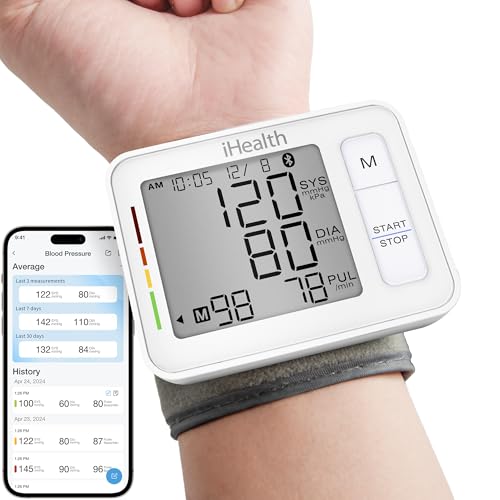
- Cuff fit: 5.5 to 7.75 inches (14 to 19.5 cm) — the narrowest range in this guide
- Memory: 99 readings on the device, with app sync on top
- Measurement: measures during inflation rather than after it, with a colour-coded result indicator and irregular heartbeat detection
- Power: 2 AAA batteries, roughly 170 measurements per set; one-year warranty
See the iHealth Push on Amazon
The Push is the smallest and lightest unit here, built openly around travel: it ships with a hard carrying case, weighs about 4.2 ounces, and syncs over Bluetooth to the iHealth MyVitals app. iHealth describes the model as clinically validated, and its published accuracy figures are a pressure tolerance of plus or minus 3 mmHg and a pulse tolerance of plus or minus 5 percent.
This is the pick for smaller wrists and for anyone who wants a monitor that lives in a bag rather than a bathroom cabinet. The limits follow from the size. A cuff that ends at 7.75 inches excludes a large share of adult wrists, so measure before you commit. Battery endurance per set is the lowest here, and the one-year warranty is the shortest of the five.
3. HoMedics 700 Series Wrist Blood Pressure Monitor (BPW-800BT-WT)
- Cuff fit: 5.3 to 7.7 inches
- Memory: 120 readings across 2 users, plus an average of the last 3 readings per user
- Positioning and detection: Smart Measure inflation technology, cuff-fit detection icon, irregular heartbeat detection, result index set against the American Heart Association’s 2017 blood pressure categories
- Power: 2 AAA batteries, storage bag included; HoMedics backs the model with a five-year warranty
See the HoMedics 700 Series Wrist on Amazon
The 700 Series is the two-user option with an app attached. It stores up to 120 readings split across two users, syncs over Bluetooth to the HoMedics Health+ app, and adds a cuff fitness icon that warns when the wrap is too loose, too tight or simply wrong — a genuinely useful guard on a format where wrap and position cause most bad readings. HoMedics states the model is clinically proven accurate in its own product materials.
It suits a couple or a shared household where both people want their own history and phone sync. The limits: the cuff tops out at 7.7 inches, the narrowest ceiling alongside the iHealth, and the app is part of the package whether you want it or not — the sharing and reminder features live there, not on the device.
4. Omron 3 Series Wrist Blood Pressure Monitor (BP6100)
- Cuff fit: 5.3 to 8.5 inches (13.5 to 21.5 cm)
- Memory: 60 readings for one user, held entirely on the device
- Measurement: one-touch operation, UltraSilent inflation, irregular heartbeat detection
- Power: 2 AAA batteries, roughly 300 measurements per set; storage case included
See the Omron 3 Series Wrist on Amazon
The BP6100 strips the wrist format back to the essentials: one touch, one user, no Bluetooth, no app, no account. It keeps the wide 5.3 to 8.5 inch cuff from the 7 Series, Omron’s UltraSilent inflation, irregular heartbeat detection and a 60-reading memory, and it stretches a set of batteries to roughly 300 measurements — the best endurance figure in this guide.
This is the pick for anyone who wants a wrist monitor that behaves like an appliance rather than a connected gadget, and for buyers who distrust app ecosystems with their health data. The limits are the flip side of that simplicity: there is no positioning sensor to coach your wrist to heart level, no way to export readings beyond reading them off the screen, and no second-user memory.
5. A&D Medical Essential Wrist Blood Pressure Monitor (UB-525)
- Cuff fit: 5.3 to 8.5 inches (13.5 to 21.5 cm)
- Memory: 60 readings for one user
- Measurement: one-button operation, colour-coded pressure category indicator, irregular heartbeat detection
- Power: 2 AAA batteries
See the A&D Medical UB-525 on Amazon
A&D Medical is a measurement-instrument company first and a consumer brand second, and the UB-525 reflects that: a one-button wrist monitor with a 60-reading memory and a colour bar on the display that sorts each result into the World Health Organization’s pressure categories. A&D states the model is clinically validated, and the cuff covers the same wide 5.3 to 8.5 inch span as the two Omron models.
It suits buyers who want the fewest possible steps between sitting down and seeing a number. The limits: no Bluetooth and no app, no positioning guidance of any kind, and a single-user memory. Of the five models here, this is also the one whose current Amazon US availability rests on the oldest tracker evidence, so check the listing carefully before relying on it.
Comparison table
| Model | Wrist range | Memory | Bluetooth | Positioning help |
|---|---|---|---|---|
| Omron 7 Series Wireless Wrist (BP6350) | 5.3–8.5 in | 90 readings, 1 user | Yes | Heart Zone Guidance sensor, cuff wrap guide |
| iHealth Push (KD-723) | 5.5–7.75 in | 99 readings | Yes | None built in |
| HoMedics 700 Series (BPW-800BT-WT) | 5.3–7.7 in | 120 readings, 2 users | Yes | Cuff-fit detection icon |
| Omron 3 Series Wrist (BP6100) | 5.3–8.5 in | 60 readings, 1 user | No | None built in |
| A&D Medical UB-525 | 5.3–8.5 in | 60 readings, 1 user | No | None built in |
Frequently asked questions
Are wrist monitors as accurate as upper-arm monitors?
Home-monitoring guidance from the American Heart Association generally favours upper-arm cuffs, because the wrist sits farther from the heart and its readings move with arm position. A validated wrist model used exactly as its manual directs — seated, back supported, feet flat, wrist held at heart level — is the reasonable compromise for people who cannot use an arm cuff or who travel constantly. If your clinician is tracking a condition closely, ask which format they want your home numbers to come from.
Why do two readings in a row come out different?
Blood pressure itself fluctuates minute to minute, and wrist devices add their own sensitivities: a wrist below heart level reads high, a wrist above it reads low, and talking or shifting during inflation disturbs the result. Makers such as Omron build averaging features into their monitors for exactly this reason. Sitting quietly for a few minutes first, then taking two or three readings a minute apart and looking at the average, gives a steadier picture than any single number.
What wrist sizes do these monitors fit?
The Omron BP6350, Omron BP6100 and A&D UB-525 cover wrists from 5.3 to 8.5 inches. The iHealth Push covers 5.5 to 7.75 inches and the HoMedics 700 Series covers 5.3 to 7.7 inches. If your wrist measures above 7.75 inches, only the three wide-range models fit as their makers intend, and using a cuff outside its published range undermines the reading.
Can I use one of these without a smartphone?
Yes. The Omron BP6100 and A&D UB-525 are fully standalone — every feature works on the device itself. The Bluetooth models (Omron BP6350, iHealth Push, HoMedics 700 Series) also measure and store readings without a phone; the app only becomes necessary when you want a longer history, graphs or an easy way to show results to someone else.
How many readings does a set of batteries last?
Published figures vary by model: roughly 170 measurements per set for the iHealth Push and roughly 300 for the Omron 3 Series, with the others falling between. Someone measuring twice a day will replace batteries a few times a year at most; someone measuring several times a day for two people should expect the shorter end of those spans.
Conclusion
For most buyers who have settled on the wrist format, the Omron BP6350 is the strongest documented choice: it carries a Validated Device Listing entry, the joint-widest cuff range, a positioning sensor that addresses the format’s biggest weakness, and app sync for long histories. The iHealth Push serves smaller wrists and travellers, the HoMedics 700 Series covers two-user households, and the Omron BP6100 and A&D UB-525 keep things deliberately simple for anyone who wants no app involved. Whichever you choose, the discipline matters more than the device: same time of day, same seated position, wrist at heart level, every time.
Related guides
More from Amazon
Programs that pair well with the guide above. Offers and eligibility are set by Amazon and may change.
A free business account with business pricing and bulk-buying tools for work, shop or home office.
Create a business accountFree shipping on eligible items, Prime Video and more. Eligible new members can start with a free trial.
Start a Prime free trialAudiobooks and podcasts to listen to on the go. Eligible new members can start with a free trial.
Try Audible freeAd-free music streaming. Eligible new subscribers can start with a free trial.
Try Music Unlimited freeAs an Amazon Associate we earn from qualifying purchases.