
The Short Answer
It depends on whether you already own a spare drive or can buy one cheap. If you have an unused NVMe or 2.5-inch SATA SSD sitting in a drawer, or you can grab a quality 1TB NVMe for $55 to $75 and pair it with a $12 to $20 enclosure, a DIY portable SSD is absolutely worth it and will match or beat a prebuilt on speed and value. If you are buying both the drive and the enclosure at full retail with no spare parts to reuse, just buy a prebuilt portable SSD on sale — it is simpler, usually more compact, and often costs the same once you add everything up.
What You Actually Get
A portable SSD enclosure is a small aluminum or plastic case with a bridge board inside that turns an internal SSD into a USB drive. You supply the SSD, slide it into the M.2 slot or 2.5-inch bay, secure it with a screw or tool-free clip, and close the case. The enclosure then connects to your laptop, desktop, console, or phone over USB.
As an Amazon Associate we earn from qualifying purchases at no extra cost to you. Product prices and availability are accurate as of the date shown and are subject to change.

Most enclosures you will see today fall into two categories. M.2 NVMe enclosures, like the UGREEN USB-C M.2 NVMe SSD Enclosure, accept a 2280, 2260, or 2242 size NVMe drive and use USB 3.2 Gen 2 for up to 10Gbps of theoretical bandwidth. That translates to a real-world ceiling around 950 to 1,050 MB/s over USB, which is the limit of the 10Gbps interface, not the drive itself. A typical unit measures about 4.3 x 1.4 x 0.5 inches and weighs 1.8 to 2.5 ounces empty, and draws 2.5 to 4.5 watts under load from the USB port, so no external power is needed.
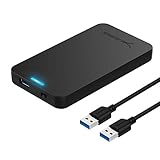
2.5-inch SATA enclosures, like the SABRENT 2.5in SATA to USB 3.0 Tool-Free SSD/HDD Enclosure, accept any 7mm or 9.5mm 2.5-inch SATA SSD or HDD. They are limited to about 5Gbps over USB 3.0, which means a practical cap of 430 to 550 MB/s — essentially saturating what SATA can do. These are slightly larger, roughly 5.0 x 3.1 x 0.6 inches and 2.5 to 3.5 ounces empty, but they are ideal for repurposing an old laptop drive after an upgrade.
By comparison, a prebuilt portable SSD such as a Samsung T7, SanDisk Extreme, or Crucial X9 comes with the drive and bridge board already integrated, sealed, and often with hardware encryption, IP water resistance, and a 3-year warranty that covers the whole unit. Prebuilts in the 1TB size typically measure 3.3 to 3.9 inches long, weigh 1.6 to 2.2 ounces, and deliver 1,000 MB/s over 10Gbps USB or up to 2,000 MB/s if they use a 20Gbps USB 3.2 Gen 2×2 interface. You pay for that integration and polish: expect $75 to $110 for 1TB and $135 to $180 for 2TB when at regular price in 2026, with frequent dips $15 to $30 lower during sales.
Performance aside, the experience is different. An enclosure build feels modular. You can swap drives in under a minute, reuse the enclosure for the next drive you upgrade, and choose the exact SSD model you want, including DRAM-equipped drives for sustained writes. A prebuilt feels like an appliance. You plug it in and forget it, with no screws, thermal pads, or compatibility checks to think about.
Pros
- Lower cost if you have a spare drive: A good NVMe enclosure costs $16.99 for a 10Gbps model like the UGREEN, and a basic SATA enclosure costs as little as $11.99 like the SABRENT. If you already own a 500GB or 1TB SSD from a laptop upgrade, your total cost for a portable drive is under $20. Even buying new, a 1TB NVMe at $55 to $75 plus a $17 enclosure totals $72 to $92, often $10 to $25 less than a comparable 1TB prebuilt at full price.
- Drive choice and upgrade path: You control the SSD inside. You can pick a drive with better endurance (600 to 1,200 TBW for 1TB TLC models), a DRAM cache for steadier large file transfers, or a specific brand you trust. When you outgrow the capacity, you just swap the SSD and keep the enclosure.
- Speed parity at 10Gbps: With a decent NVMe and a 10Gbps enclosure on a USB 3.2 Gen 2 or Thunderbolt 3/4 port, you will get essentially the same 900 to 1,050 MB/s that a mainstream 10Gbps prebuilt delivers. For photo libraries, video editing off the drive, or game storage, the difference is negligible.
- Great for repurposing and recovery: Enclosures give a second life to SATA SSDs pulled from old laptops and desktops. Instead of letting a 256GB or 512GB drive collect dust, you get a reliable backup or media drive for about $12.
- Easy repair and reuse: If the SSD fails, you replace just the SSD. If the bridge board fails, you replace just the $17 enclosure. With a prebuilt, the whole sealed unit typically has to be warrantied or replaced.
- Broad compatibility: Both types work with Windows, macOS, Linux, ChromeOS, PlayStation, Xbox, and Android via USB-C or USB-A with an adapter. No drivers needed.
Cons
- Assembly and compatibility homework: You have to match the enclosure to the drive. NVMe enclosures do not work with SATA M.2 drives, and vice versa. You also need to check M.2 keying (M-key for NVMe), length support, and whether your laptop port is actually 10Gbps. Many PCs still have 5Gbps ports, which will cap any 10Gbps enclosure at about 450 to 550 MB/s.
- Bigger and less polished than prebuilts: An M.2 enclosure with a drive is usually a half-inch longer and a little heavier than a purpose-built portable SSD, and it lacks the rubber bumpers, IP65 water resistance, and drop ratings that many prebuilts offer up to 6 to 9 feet.
- Heat and throttling under sustained load: Thin aluminum enclosures dissipate heat well for bursts, but a 20 to 50GB continuous write can push the drive to 55 to 68 degrees Celsius. Without a thick thermal pad and good contact, some drives will throttle sooner than a prebuilt that was thermally tuned as a system.
- No unified warranty or encryption: The enclosure and SSD are warrantied separately, usually 1 year for the enclosure and 3 to 5 years for the SSD. You also rarely get hardware encryption, password protection apps, or bundled backup software that prebuilts include.
- Not always cheaper when buying everything new: Once you add a $65 to $85 quality 1TB NVMe, a $17 enclosure, and possibly a $8 to $12 USB-C to C/A cable if one is not included, you are at $90 to $114. At that point a prebuilt on sale for $79 to $99 is the same price with less hassle.
- Potential for knockoff bridge chips: Cheap no-name enclosures may use older RTL9210 or JMS583 chips with outdated firmware that can cause disconnects or slower speeds. Sticking to known brands helps, but it is a variable prebuilts do not have.
Who Should Buy It
An enclosure is the smart buy if you already have a spare M.2 NVMe or 2.5-inch SATA SSD from a recent PC build or laptop upgrade. It is also ideal if you like to shop for specific SSD models, want the ability to swap capacities later, or need multiple portable drives for different clients or projects without buying multiple prebuilts.
Creators who keep a large Lightroom catalog or 4K footage on an external drive will appreciate being able to choose a high-endurance TLC drive with DRAM, and IT folks who clone drives often will value the modularity. If you are comfortable using a small screwdriver and a thermal pad, the five-minute assembly is trivial.
Who Should Skip It
Skip the DIY route if you want the smallest, most rugged, most foolproof option and you do not have a spare drive. Students, travelers, and anyone who wants to toss a drive in a backpack and not think about screws, firmware, or thermals will be happier with a prebuilt.
Also skip it if your computer only has 5Gbps USB-A ports. You will not see the benefit of a 10Gbps NVMe enclosure, and a budget SATA build will feel no faster than a mainstream prebuilt while being bulkier. In that case, buy the prebuilt that matches your port speed or save money with one of the alternatives below.
Cheaper Alternatives
| Option | Cost | Trade-off |
|---|---|---|
| Repurpose old 2.5-inch SATA SSD + $11.99 tool-free enclosure | $12 to $15 total if you own the drive | Limited to ~500 MB/s; larger case than M.2; but cheapest way to get a reliable portable drive |
| Budget prebuilt 500GB portable SSD on sale | $55 to $75 | Smaller and sealed with full warranty; less storage per dollar than a 1TB DIY build |
| High-capacity USB 3.2 flash drive 256GB to 512GB | $18 to $45 | Ultra-compact and no cable needed; much slower sustained writes and lower endurance than an SSD |
| Portable HDD 1TB to 2TB | $50 to $75 | Cheapest per terabyte for cold backups; 110 to 140 MB/s, fragile, needs careful handling |
FAQ
Is a DIY enclosure as fast as a prebuilt portable SSD?
Yes, when the interfaces match. A quality NVMe SSD in a 10Gbps USB 3.2 Gen 2 enclosure will deliver about 900 to 1,050 MB/s, the same as most 10Gbps prebuilts. The limit is the 10Gbps USB bus. You will only see a difference if you compare to a 20Gbps prebuilt at around 1,800 to 2,000 MB/s, which requires both a 20Gbps enclosure and a 20Gbps port that many computers lack.
Will any M.2 SSD work in any M.2 enclosure?
No. You need to match the protocol. NVMe PCIe drives need an NVMe enclosure and SATA M.2 drives need a SATA or dual-protocol enclosure. Also check the length, typically 2280 is standard, and the key notch. Most NVMe enclosures take M-key 2280/2260/2242 drives. When in doubt, check your SSD label for NVMe or SATA and PCIe before ordering.
Do portable SSD enclosures get hot and is that normal?
Warm to the touch is normal. Aluminum cases are designed to act as a heatsink. Expect 38 to 45 degrees Celsius during light use and 55 to 68 degrees during long writes. If the enclosure becomes uncomfortable to hold or disconnects, improve contact with the included thermal pad, avoid covering it with fabric while transferring, and keep it out of direct sun.
What is actually cheaper overall, enclosure or prebuilt?
If you can reuse a drive you own, the enclosure wins by a wide margin at $12 to $20 total. If you must buy a new 1TB drive and enclosure at full retail, the total is usually $72 to $114, which is similar to a prebuilt at $75 to $110. Watch for sales. Prebuilts drop to $60 to $85 for 1TB during promotions, at which point they are often the better value unless you specifically want drive choice and swappability.
