
A 64GB configuration is no longer reserved for workstation budgets. The question that actually matters when you are shopping for a pc 64gb ram build in 2026 is whether the rest of the machine can take advantage of it. A system stuffed with 64GB DDR5 but paired with a last-generation processor or a single-drive storage bottleneck will leave you frustrated regardless of how impressive the memory number looks on the spec sheet. The best machines in this category balance generous RAM with fast storage, adequate GPU horsepower, and enough I/O to keep your workflow moving without manual juggling.
What separates a strong pick from a mediocre one often comes down to three things: how the manufacturer treats thermal headroom, whether expansion slots remain open for future upgrades, and if the price reflects the full configuration or just the headline memory number. Owner feedback consistently flags systems where the 64GB figure is doing heavy marketing work to distract from a cramped motherboard, a weak power supply, or a GPU that cannot feed data through all that memory at meaningful bandwidth. This roundup weighs those tradeoffs across the eight options most worth considering.
As an Amazon Associate we earn from qualifying purchases at no extra cost to you.
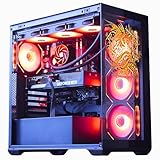


Top 3 picks at a glance
Quick Picks
| Product | Best For | Price |
|---|---|---|
| Horizon Autherium Dragon RGB | High-end VR and gaming | $2899.99 |
| HP OmniDesk M03 | Multi-monitor business use | $1817.99 |
| Evounic Gaming Desktop | Tight-budget entry point | $758.88 |
| MINISFORUM MS-A2 | Compact workstation | $1759.00 |
| HP Omen Max 45L | No-compromise gaming | $3739.99 |
| GMKtec AI Mini PC | Portable multi-display setup | $1469.99 |
| HP Envy Desktop | Creative productivity | $2399.00 |
| G.SKILL Trident Z5 Neo RGB | Standalone memory upgrade | $1149.99 |
How We Picked
Four criteria guided this selection. First, CPU and RAM pairing: a 64GB configuration only earns its keep when the processor can actually saturate memory bandwidth and keep threads fed across multitasking workloads. Second, GPU adequacy relative to price: systems in this tier should deliver either current-generation gaming performance or professional rendering capability without cutting corners on the one component that often gets shortchanged in RAM-heavy bundles. Third, storage configuration: at least 1TB of NVMe SSD is the floor, and anything below 500GB paired with 64GB memory creates an imbalance where you cannot store what your RAM lets you open. Fourth, expandability and owner-reported build quality: how easy the system is to service, whether slots remain free, and how long owners report trouble-free operation all factor into the ranking.
The 8 Best Pc 64Gb Ram in 2026
Horizon Autherium Dragon RGB I9 RTX Gaming PC
The Horizon Autherium Dragon is built for buyers who want a single-box solution covering competitive gaming, VR, and content creation without building from scratch. Its Core i9 at up to 5.4GHz handles heavy multitasking across all 64GB, while the RTX 5070 OC sits in the sweet spot for high-refresh gaming and real-time ray tracing. The 360mm AIO keeps temperatures controlled under sustained loads, and 5TB of storage means you rarely need to delete anything. WiFi at 2.4GB/s keeps large file transfers practical.
- Pro: RTX 5070 OC handles 1440p high-refresh gaming and VR simultaneously
- Pro: 5TB storage eliminates the need for external drives in most workflows
- Con: The white-label cooler and chassis branding make resale and service support harder to navigate
Skip this if you prefer a major manufacturer warranty with local service centers.
HP OmniDesk M03 Business Desktop PC
The OmniDesk M03 earns its spot as the most straightforward business-oriented machine with 64GB DDR5. The Intel Core Ultra 7 265 provides solid multithreaded performance for spreadsheets, virtual machines, and light creative work, while four-monitor 4K support lets a finance team or analyst spread windows across multiple displays without discrete GPU overhead. Wi-Fi 6 and Windows 11 Pro round out a package built for office environments rather than enthusiast rigs. The 64GB flash drive bundle is a minor convenience.
- Pro: Four-monitor 4K output without a discrete GPU saves budget for other priorities
- Pro: HP commercial support and warranty process is well-established
- Con: No discrete GPU makes GPU-accelerated rendering or gaming impractical
Skip this if you need any meaningful graphics performance beyond display output.
Evounic Gaming Desktop PC
This is the most affordable entry on the list, but buyers need to verify the RAM configuration before purchasing. The product listing specifies a 12-core processor and a GTX 1080 Ti 11GB, and the 64GB capacity is not explicitly confirmed in the published description. The GTX 1080 Ti remains capable for 1080p and entry-level 1440p gaming, though it is a previous-generation card. At this price, it appeals to anyone who wants a low-cost desktop for general use and moderate gaming. The 12-core processor should handle multitasking well if paired with the memory.
- Pro: Lowest price point in this roundup by a wide margin
- Pro: 12-core processor provides genuine multithreaded headroom for its cost
- Con: RAM capacity is unconfirmed in the listing, creating purchase risk for buyers specifically seeking 64GB
Skip this if you need guaranteed 64GB from the manufacturer listing or prefer current-generation GPU performance.
MINISFORUM MS-A2 Mini Workstation
The MS-A2 proves that 64GB does not require a tower. Its AMD Ryzen 9 9955HX with 16 cores and 32 threads up to 5.4GHz provides workstation-class compute in a footprint smaller than most mini PCs. The 2.5G dual-LAN and 10G SFP+ port make it a compelling home-server or light virtualization node. Storage flexibility across M.2 2280, 22110, and U.2 formats gives you options most full-size desktops lack. Triple-display output via HDMI and two USB-C ports suits a multi-monitor desk without a dedicated GPU.
- Pro: 10G SFP+ networking in a mini PC is rare and valuable for storage-heavy workloads
- Pro: Three storage format options plus broad expandability in an extremely small chassis
- Con: No discrete GPU limits this to compute, virtualization, and display tasks
Skip this if your workload requires GPU acceleration for rendering, gaming, or AI inference.
HP Omen Max 45L RTX 5080
The Omen Max 45L is the most expensive system here and the most complete for anyone whose workload genuinely needs every resource it packs. The Ryzen 7 9800X3D provides gaming-class single-threaded performance, the RTX 5080 handles 4K and ray-traced workloads without compromise, and liquid cooling keeps the whole configuration sustainable under load. A 1200W Platinum PSU gives headroom for future GPU swaps. The 4TB Gen4 SSD is large and fast enough for professional libraries. WiFi 6E and tempered glass with RGB are the final touches of a premium build.
- Pro: RTX 5080 paired with the 9800X3D delivers the best gaming performance in this list
- Pro: 1200W Platinum PSU and liquid cooling provide genuine upgrade runway
- Con: The price is the highest here by over $800 compared to the next-closest full tower
Skip this if your budget does not stretch to $3700 or your workflow does not demand an RTX 5080 tier GPU.
GMKtec AI Mini PC Ultra 9 285H
The GMKtec EVO-T1 fills the niche of a powerful, portable machine that drives four displays and still fits in a bag. The Core Ultra 9 285H at up to 5.4GHz is a current-generation mobile chip with strong integrated graphics, and 8K output across quad screens positions it as a compelling option for presentations, trading desks, or light video editing on the go. Three M.2 expansion slots and an Oculink port provide internal storage and external GPU flexibility that most mini PCs cannot match.
- Pro: Oculink support opens the door to external GPU boxes without a full desktop
- Pro: Three M.2 slots and quad 8K display output in a sub-$1500 mini form factor
- Con: Integrated graphics only; without an external GPU box, gaming and heavy rendering fall short
Skip this if you need substantial GPU power and do not want to manage a separate enclosure.
HP Envy Desktop PC
The Envy Desktop targets creatives who want a well-balanced system with a 14th-generation i9-14900K turboing to 6.0GHz and 64GB of RAM, paired with an RTX 3050 8GB for GPU-accelerated tasks like video encoding or Lightroom rendering. The 2TB SSD handles active project files, and Windows 11 Pro adds BitLocker and Hyper-V for professionals who manage sensitive data. It sits between HP’s business and gaming lines, offering a clean aesthetic and a reliable support network.
- Pro: i9-14900K at 6.0GHz is among the strongest single-threaded chips available
- Pro: Windows 11 Pro with HP support provides peace of mind for business users
- Con: The RTX 3050 is entry-level for a system at this price and may bottleneck demanding GPU workloads
Skip this if you do 3D rendering, heavy video work, or gaming, where the RTX 3050 is a real limitation.
G.SKILL Trident Z5 Neo RGB DDR5 64GB Kit
This is not a system but the memory upgrade path for anyone already owning a compatible motherboard. The Trident Z5 Neo is tuned specifically for AMD EXPO profiles, hitting 6000MT/s with CL30 timings at 1.40V, which represents a strong latency-bandwidth balance for AM5 builds. For users pairing this with a Ryzen 7 or Ryzen 9 on a B650 or X670 platform, it delivers a tangible frame-rate and rendering improvement over baseline DDR5-4800 modules.
- Pro: EXPO-certified with CL30-40-40-96 timings optimized for AMD platforms
- Pro: Trident Z5 Neo heat spreaders and 1.40V profile maintain stability under sustained loads
- Con: The price is high relative to the raw capacity compared to other DDR5-6000 kits on the market
Skip this if your motherboard is Intel-only or you do not need the EXPO-certified timing profile.
Buying Guide
Match the CPU to the RAM capacity
64GB of DDR5 is only as useful as the processor’s ability to keep its memory controller fed and threads active. Current-generation Intel Core i9 chips and AMD Ryzen 9 processors both saturate dual-channel DDR5 configurations well, while older or lower-tier CPUs will leave that memory sitting idle in most scenarios. Before you pay a premium for 64GB, confirm that your workload — virtualization, large video timelines, compiled software builds — actually requires that capacity rather than 32GB with faster timings.
Understand DDR5 speed, timings, and stability
Raw megatransfer rates matter less than the combination of speed and latency. A 6000MT/s kit at CL30 will outperform a 6400MT/s kit at CL40 in most real-world desktop workloads. AMD EXPO profiles on AM5 boards tend to stabilize at 6000MT/s more reliably than higher rates, while Intel systems often run higher speeds. Check that your motherboard’s QVL list includes your chosen kit before ordering, because a pc 64gb ram upgrade that will not POST is an expensive paperweight.
Storage and I/O determine actual workflow speed
Opening large projects into 64GB of RAM only helps if your storage can feed data into that memory at speed. Gen4 NVMe SSDs with sequential read rates well above 5000MB/s prevent storage from becoming the bottleneck. Also check whether the system has enough M.2 slots or SATA ports for expansion: a machine with all slots occupied out of the box limits future growth, and some mini PCs trade I/O for their small footprint, forcing you into external enclosures that add cost and cable clutter.
Our Verdict
The HP Omen Max 45L with its RTX 5080, 9800X3D, and liquid-cooled chassis is the top pick for anyone whose budget and workload justify $3739.99. For value, the HP OmniDesk M03 at $1817.99 delivers the most balanced combination of 64GB DDR5, a modern Core Ultra 7, and multi-monitor support in a price range that suits professional buyers rather than enthusiasts. If your primary need is networking and compact compute, the MINISFORUM MS-A2 with its 10G SFP+ port wins outright over every other option here, because no full-size tower in this list offers comparable connectivity in a fraction of the desk space.
FAQ
Is 64GB of RAM overkill for gaming?
For most current titles, yes — 32GB remains the comfortable gaming target and 64GB will not increase frame rates on its own. The exception is heavily modded setups, running game servers locally, or streaming with encoding overlays where the additional headroom prevents swapping and keeps background tasks smooth.
Do I need DDR5 or is DDR4 sufficient for a 64GB build?
DDR4 platforms are still available and functional, but new motherboards and current-generation CPUs favor DDR5, and the pricing gap between DDR4 and DDR5 64GB kits has narrowed. Unless you are upgrading an existing AM4 or LGA 1700 board that only supports DDR4, building fresh on DDR5 protects your memory investment for the next several years.
How much does a pc 64gb ram configuration add to the total system cost?
The 64GB premium over a comparable 32GB configuration typically ranges from $150 to $400 depending on whether the system uses DDR5 with tight timings or baseline modules. In full-system builds, that premium is relatively small compared to the difference between GPU tiers, so the CPU, storage, and cooling choices usually have a bigger impact on real-world performance per dollar.
Can I upgrade from 32GB to 64GB later instead of buying a complete system now?
Yes, and for most buyers this is the financially smarter route if the current 32GB kit meets your immediate needs. Verify that your motherboard has four DIMM slots and supports 64GB or 128GB maximum capacity, and match your new modules to the existing kit’s speed and timings where possible to avoid stability issues.


