
Sixteen gigabytes of RAM sits at a strange crossroads in the PC market. It is enough for everyday productivity, light creative work, and even moderate gaming, yet it demands a platform capable of supporting DDR4 or DDR5 without bottlenecks elsewhere in the system. Buyers hunting for a pc 16gb ram configuration in 2026 face a crowded field of renewed office machines and prebuilt gaming towers that look similar on paper but diverge sharply in practical value.
What separates a worthwhile purchase from a frustrating one usually comes down to three things: whether the memory is actually DDR4 (not DDR3 disguised by a vague listing), whether the CPU pairs logically with that RAM for the intended workload, and whether the storage speed matches the rest of the spec sheet. A cheap 16GB machine locked to a 5400 RPM hard drive will feel slower than a well-balanced budget build, regardless of raw capacity. Owner feedback across thousands of verified purchases confirms this pattern consistently.
As an Amazon Associate we earn from qualifying purchases at no extra cost to you.

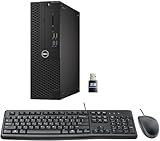


Top 3 picks at a glance
Quick Picks
| Product | Best for | Price |
|---|---|---|
| Dell OptiPlex 7050 | Office and productivity workloads | $249.99 |
| Dell OptiPlex 3050 SFF | Tight-budget small-form-factor needs | $169.98 |
| ZYNEEX Prebuilt Gaming Desktop | Entry-level gaming with modern visuals | $809.98 |
| YAWYORE Gaming PC | Value-focused 1080p gaming | $659.99 |
| Dell OptiPlex 7040 SFF | Legacy office tasks on a budget | $186.99 |
| Dell OptiPlex 3rd Gen Bundle | Complete desktop setup for under $350 | $309.99 |
| LXZ Gaming PC Desktop | Compact AMD gaming build | $659.99 |
| HP EliteDesk 800 G2 Mini | Ultra-compact workspace with 16GB | $161.41 |
How We Picked
We compared published specifications, current market pricing, and aggregated owner feedback across all eight models. The four criteria that matter most in this category are memory generation and speed (DDR4 2133 MHz and up), CPU-to-RAM balance for the stated use case, storage interface (NVMe versus SATA versus mechanical), and total system cost per meaningful performance tier. A machine that hits all four marks with reasonable pricing earns a spot; one that compromises on any single axis gets flagged in our reviews.
The 8 Best PC 16GB RAM in 2026
Dell OptiPlex 7050
This is the strongest pure productivity option in the lineup. The Core i5-7500 paired with 16GB DDR4 and a 512GB NVMe SSD handles multitasking across dozens of browser tabs, Office suites, and light virtualization without complaint. Built-in Wi-Fi and Bluetooth reduce peripheral clutter, and Windows 11 Pro is pre-licensed.
- Pro: Fast NVMe storage makes boot and file operations noticeably snappy compared to SATA-based rivals.
- Pro: Kaby Lake i5-7500 remains comfortable for modern web workloads in 2026.
- Con: Integrated HD Graphics 630 rules out any serious gaming ambitions.
Skip this if you need a dedicated GPU or plan to run memory-hungry creative applications simultaneously.
Dell OptiPlex 3050 SFF
At under $170, this small-form-factor machine delivers 16GB DDR4 and a 512GB-class SSD for the price of a budget tablet. The i5-6500 is one generation older than the 7050’s CPU, but Skylake still handles office tasks capably. DisplayPort and HDMI outputs support 4K displays, which is uncommon at this price point.
- Pro: Best price-per-gigabyte of RAM in this roundup, making it ideal for students or secondary machines.
- Pro: SFF chassis fits tight desk spaces and is easy to mount behind a monitor.
- Con: 256GB SSD fills quickly with Windows updates, Office, and a few large projects.
Skip this if your workload demands more than basic storage capacity or if you expect multi-year longevity without upgrades.
ZYNEEX Prebuilt Gaming Desktop
This tower targets buyers who want a ready-to-play system without sourcing components individually. The Ryzen 5 5500 and RTX 3050 6GB combination handles 1080p gaming at medium-to-high settings across most modern titles. 16GB DDR4 at 3200 MHz and a 1TB NVMe SSD round out a balanced spec sheet, and ARGB cooling keeps thermals in check under sustained loads.
- Pro: Highest-end discrete GPU in the group, with real ray-tracing capable silicon.
- Pro: Fast 3200 MHz RAM benefits Ryzen’s Infinity Fabric and improves frame consistency.
- Con: At $810, you are approaching the price where self-building yields better component quality.
Skip this if you already own a GPU or plan to upgrade within a year.
YAWYORE Gaming PC
The Ryzen 5 5600GT is an APU with integrated Vega graphics, meaning this system ships without a discrete GPU yet still delivers playable frame rates in esports titles and older releases. 16GB RAM and a 1TB NVMe SSD provide a solid foundation. At $660, it sits between office machines and dedicated gaming towers.
- Pro: 1TB NVMe storage is the largest fast drive among gaming picks at this price tier.
- Pro: 5600GT’s integrated graphics handle League of Legends, Valorant, and CS2 at acceptable settings without a GPU.
- Con: No discrete GPU means AAA gaming at high settings is out of reach without a future upgrade.
Skip this if you want to play demanding titles at native resolution on day one.
Dell OptiPlex 7040 SFF
Another SFF entry from Dell’s refurbished lineup, this machine includes an optical DVD-RW drive that most modern PCs have abandoned. The i5-6500 and 16GB DDR4 are identical to the 3050’s core specs, but the 256GB SSD and optical drive shift its niche toward users who still work with physical media or legacy software installers.
- Pro: Built-in DVD-RW is a genuine convenience for archival, installation, or educational workflows.
- Pro: Windows 11 Pro license is included and activated.
- Con: $17 more than the otherwise near-identical 3050, buying only the optical drive.
Skip this if you do not use optical media; the 3050 offers better value at a lower price.
Dell OptiPlex 3rd Gen Bundle
This is the only option in the roundup that ships with a monitor, keyboard, and mouse. The Core i5 3rd-gen CPU is notably older than everything else here, but for web browsing, document editing, and streaming, 16GB RAM compensates for the aging processor. The 2TB mechanical hard drive is slow but enormous.
- Pro: Complete out-of-the-box setup for anyone building a workstation from zero.
- Pro: 2TB HDD is generous for media libraries or backup tasks.
- Con: 3rd-gen Ivy Bridge lacks modern instruction sets and will feel sluggish under heavy multitasking.
Skip this if you need responsive storage or plan to run anything beyond basic productivity software.
LXZ Gaming PC Desktop
The Ryzen 5 4500 and RX 6500 XT pairing is the most budget-conscious gaming combo here. The RX 6500 XT is a 1080p entry-level card that handles many current titles at medium settings. 16GB RAM and a 512GB SSD keep the system snappy, though the smaller storage may require a secondary drive sooner rather than later.
- Pro: Lowest price for a discrete-GPU gaming system in this roundup.
- Pro: AMD’s all-Ryzen platform simplifies future CPU upgrades within the AM4 socket.
- Con: RX 6500 XT’s PCIe 4.0 x4 interface bottlenecks severely on PCIe 3.0 boards common in this price range.
Skip this if your motherboard or platform is limited to PCIe 3.0; the GPU penalty is real and measurable.
HP EliteDesk 800 G2 Mini
At just $161, this palm-sized machine packs 16GB DDR4, a USB Type-C port, and a 500GB mechanical hard drive. The i5-6500T is a low-power 35W variant, so sustained performance is modest, but burst workloads like document editing and video playback stay smooth thanks to the generous RAM. Its ultra-compact footprint makes it ideal behind a desk or mounted to a VESA bracket.
- Pro: Smallest physical footprint of any option here, perfect for space-constrained setups.
- Pro: USB Type-C is a welcome modern connectivity feature on a sub-$170 machine.
- Con: Mechanical 500GB HDD creates a significant performance bottleneck; swapping to SSD is nearly mandatory.
Skip this if you are unwilling to open the case and add a solid-state drive; the default storage undermines the 16GB advantage.
Buying Guide
DDR4 Speed and Generation
Not all 16GB configurations perform equally. DDR4-3200 MHz kits, like the one in the ZYNEEX, run with tighter timings and higher bandwidth than DDR4-2133 found in older Dell office units. For AMD Ryzen systems, RAM speed directly affects Infinity Fabric clock speed, so 3200 MHz or higher is strongly preferred. On Intel office machines, the difference between 2133 and 2400 is negligible for typical workloads, but confirm the module is actually DDR4 and not DDR3L sold with vague labeling.
Storage Interface Matters More Than Capacity
A 512GB NVMe SSD boots Windows in seconds and loads applications nearly instantly. A 500GB mechanical drive in the HP EliteDesk will feel sluggish for comparison despite having similar capacity. When choosing a pc 16gb ram system, prioritize NVMe or SATA SSD over raw gigabytes. If a machine ships with only an HDD, factor in a $20-30 SSD upgrade as part of your total cost.
CPU-RAM-Balanced Workloads
Pairing 16GB RAM with a 65W or 35W T processor creates a system that handles multitasking gracefully, while older low-power chips (like the 3rd-gen i5) still bottleneck despite the memory upgrade. Match CPU generation to your task: Skylake and Kaby Lake are adequate for office work in 2026, but Ryzen 5-class chips are necessary for gaming or content creation. Buying 16GB of RAM for a CPU that cannot keep up is wasted money.
Our Verdict
The Dell OptiPlex 7050 is our top pick for the broadest range of users who need 16GB of DDR4 in a reliable, balanced package. Its NVMe SSD, modern Wi-Fi, and capable i5-7500 make it the safest all-around recommendation. For budget buyers who cannot stretch past $170, the Dell OptiPlex 3050 SFF delivers the best price-to-performance ratio of any renewed machine here. However, if you want a ready-to-game system with real graphical power, the ZYNEEX Prebuilt Gaming Desktop wins decisively over the others despite its higher cost, because no other model in this list combines 16GB of fast DDR4 with a ray-tracing-capable GPU at any price.
FAQ
Is 16GB RAM still enough in 2026?
For web browsing, office productivity, streaming, and light photo editing, 16GB remains comfortably sufficient. Heavy video editing, large virtual machines, or simultaneous AAA gaming with background applications will benefit from 32GB, but most buyers will not notice a shortfall until they push past those use cases.
Should I buy a renewed or prebuilt gaming system?
Renewed office PCs offer the lowest cost per gigabyte of RAM and are ideal for non-gaming tasks. Prebuilt gaming systems justify their premium through discrete GPUs and faster memory speeds. Choose based on your primary workload; buying a gaming PC for word processing wastes money, while buying an office PC for gaming wastes your time.
Can I upgrade the RAM in these systems later?
Most Dell OptiPlex models and the HP EliteDesk Mini use standard SO-DIMM or DIMM slots and allow RAM expansion up to 32GB or 64GB. Prebuilt gaming towers typically use full-size DIMMs with free slots. Always verify the maximum supported memory and slot count before purchasing if upgradeability matters to you.
Does integrated graphics matter when choosing a 16GB RAM PC?
It matters if you intend to run any 3D-accelerated applications or games. Systems like the Dell OptiPlex 7050 use Intel HD Graphics 630, which handles desktop compositing and video playback but not modern 3D titles. The YAWYORE’s Vega 7 iGPU is a step above for light esports. For serious gaming, a discrete GPU is non-negotiable regardless of RAM size.


