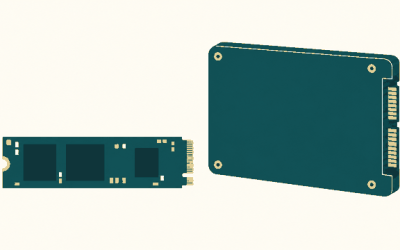
The OWC Aura Pro X2 SSD is a PCIe 3.0 x4 NVMe blade replacement designed specifically for 2013-2017 Macs with Apple’s proprietary 12+16 pin connector, delivering up to 3211 MB/s read and 2411 MB/s write to effectively double the speed of most factory Apple SSDs from that era.
As an Amazon Associate we earn from qualifying purchases at no extra cost to you.


Top 3 picks at a glance
Real-World Speed: What the Aura Pro X2 Actually Delivers
On paper, OWC rates the Aura Pro X2 around 3200 MB/s sequential read and 2400 MB/s sequential write, but those peak numbers depend on capacity. The smaller drives use fewer NAND dies and can’t fully saturate the controller, so performance scales with size. This is typical for NVMe designs and matches independent benchmarks from 2023-2025 that consistently show the 1TB and 2TB models hitting their rated speeds while the 240GB and 480GB models run 15-30% slower.
| OWC Aura Pro X2 Capacity | Sequential Read (Up To) | Sequential Write (Up To) | Random Read/Write (4K IOPS) | Endurance (TBW) |
|---|---|---|---|---|
| 240GB | 1867 MB/s | 1299 MB/s | ~250,000 / 240,000 | 150 TBW |
| 480GB | 2740 MB/s | 2415 MB/s | ~290,000 / 285,000 | 300 TBW |
| 1TB | 3192 MB/s | 2482 MB/s | ~340,000 / 320,000 | 600 TBW |
| 2TB | 3211 MB/s | 2411 MB/s | ~360,000 / 330,000 | 1200 TBW |
For context, the stock Apple SSDs shipped in these Macs typically benchmarks at 1200-2000 MB/s read and 900-1500 MB/s write depending on year and capacity. Upgrading a 2015 MacBook Pro that originally did 1400 MB/s to an Aura Pro X2 1TB moves it into the 3000+ MB/s range, which is at the practical limit of the PCIe 3.0 x4 bus these Macs use.
Worked Calculation: How Much Time Does That Speed Actually Save?
The bandwidth difference is not just a synthetic number. Here is what it means for large transfers that creative users do often:
A PCIe 3.0 x4 slot has a theoretical bandwidth of 3.94 GB/s (8 GT/s x 4 lanes x 128b/130b encoding). The Aura Pro X2 1TB at 3.19 GB/s uses about 81% of that theoretical maximum, leaving very little headroom – the bus itself becomes the limiter, not the NAND.
Take a real workload: migrating a 500GB photo library or Final Cut Pro library:
- On a stock 2015 MacBook Pro SSD at ~1400 MB/s: 500,000 MB / 1400 MB/s = ~357 seconds, or about 5 minutes 57 seconds under ideal sequential conditions.
- On an Aura Pro X2 1TB at ~3192 MB/s: 500,000 MB / 3192 MB/s = ~157 seconds, or about 2 minutes 37 seconds.
- Time saved: ~200 seconds, or over 3 minutes per 500GB. Over a 1TB migration, you save nearly 7 minutes.
For random workloads like booting macOS, launching Logic Pro or Photoshop, and searching large Lightroom catalogs, expect a 20-40% improvement in responsiveness rather than a 2x jump, because random 4K performance and macOS overhead do not scale linearly with sequential speed.
Full Compatibility List: Which Macs the Aura Pro X2 Fits
The OWC Aura Pro X2 SSD uses Apple’s custom 12+16 pin blade connector, not a standard M.2 2280. It only fits Macs that shipped with a removable PCIe blade. It does not fit any Mac with soldered storage (all MacBook Air/Pro from 2018 onward, all Apple Silicon Macs) and it does not fit 2.5-inch SATA bays.
Compatible models require macOS 10.13 High Sierra or later before installation, because the firmware update in High Sierra adds NVMe boot support for aftermarket blades.
| Mac Family | Compatible Models (Specific Identifiers) | Notes |
|---|---|---|
| MacBook Air | 11-inch Mid 2013 (6,1), Early 2014 (6,1), Early 2015 (7,1), 2017 (7,2) and 13-inch Mid 2013 (6,2), Early 2014 (6,2), Early 2015 (7,2), 2017 (7,2) | All PCIe models with removable blade. Check for 12+16 pin connector. |
| MacBook Pro Retina | 13-inch Late 2013 (11,1), Mid 2014 (11,1), Early 2015 (12,1), 2016 Non-Touch (13,1), 2017 Non-Touch (14,1) and 15-inch Late 2013 (11,2 / 11,3), Mid 2014 (11,2 / 11,3), Mid 2015 (11,4 / 11,5) | 2016-2017 Touch Bar models are NOT compatible – storage is soldered. |
| Mac mini | Late 2014 (7,1) | Only the PCIe blade slot. SATA bay remains separate if present. |
| Mac Pro | Late 2013 Cylinder (6,1) | Single blade slot. Requires deep disassembly. |
| iMac | 27-inch Late 2013 (14,2), Late 2014 and Mid 2015 Retina, 21.5-inch Late 2013 (14,1 / 14,3) and select 2017-2019 27-inch models with Fusion Drive blade slot | Blade slot often empty on Fusion Drive models. Installation requires removing display adhesive. |
If your Mac uses a standard NVMe M.2 drive or has soldered NAND, you need a different solution. All MacBook Air and MacBook Pro with Apple Silicon (M1, M2, M3, M4 generations) are incompatible.
Key Specs Beyond Speed
- Interface: PCIe 3.0 x4 / PCIe 3.1 x4, NVMe 1.3, AHCI not required
- Form Factor: Custom Apple 12+16 pin blade, 89mm x 22mm, single-sided
- NAND: 3D TLC with SLC caching
- Controller: Silicon Motion SM2262EN-based with OWC firmware
- Power: Typically 3.3V, averages 4.2W-4.8W active, under 0.5W idle, supports APST and ASPM low-power states
- TRIM: Native macOS TRIM support when running macOS 10.13 or later
- Encryption: No hardware T2-style encryption. Relies on macOS FileVault software encryption (AES-NI accelerated, minimal performance impact on Intel CPUs from this era)
- Warranty: Usually offered with a 5-year limited warranty through OWC when purchased new
For MacBook Air and 13-inch Pro users, power and thermals matter. The Aura Pro X2 draws slightly more peak power than the original Apple Samsung or SanDisk blade, but idle power is very low, so battery life impact during light web browsing is typically under 30 minutes difference per full charge. Under sustained writes like video exports, the drive can run warmer; macOS will throttle write speeds to around 1200-1500 MB/s after 60-90 seconds of continuous full-speed writing to manage temperature, which is normal behavior.
Aura Pro X2 vs OWC’s Cheaper Options: Which Should You Choose?
OWC sells three distinct tiers for this connector. Choosing the wrong one is the most common buying mistake – people overpay for speed they will not notice, or buy too slow and regret it on a Mac they plan to keep for years.
| Model | Interface / Protocol | Max Sequential Speed | Best For | General Market Range (2026) |
|---|---|---|---|---|
| OWC Aura N | PCIe 3.0 x2, AHCI / NVMe bridge | ~845 MB/s read, ~760 MB/s write | Budget repair for 2013-2014 Macs where any working drive is the goal | Usually $80 – $150 |
| OWC Aura N2 | PCIe 3.0 x4, NVMe | ~1560 MB/s read, ~1350 MB/s write | Everyday use, web and office work, cost-conscious upgrades | Usually $90 – $200 |
| OWC Aura Pro X2 | PCIe 3.0 x4, NVMe | ~3211 MB/s read, ~2482 MB/s write | 4K video editing, large RAW photo libraries, developers needing fast I/O | Usually $120 – $350 |
Decision Matrix: Match Your Situation to the Right Drive
- Choose Aura N if: You are reviving a 2013-2014 MacBook Air for basic tasks and want the lowest cost to make it bootable. Accept that it will be slower than the original Apple SSD in many configs.
- Choose Aura N2 if: Your Mac is a 2013-2017 daily driver for browsing, Office, and light photo editing, and you want a noticeable but affordable speed bump with better endurance than Aura N. This is the best value for most users who do not regularly move 100GB+ files.
- Choose Aura Pro X2 if: You work with 4K timelines in Final Cut or Premiere, compile large Xcode projects, or keep your Mac as a primary machine for 2+ more years. The 1TB and 2TB models offer the full speed and much higher TBW, which matters for heavy writes.
- Choose 1TB over 480GB if: You are within $30-50 of the next capacity. The 1TB not only doubles space but also jumps from ~2740 MB/s to ~3192 MB/s read and doubles endurance from 300 TBW to 600 TBW.
Installation and Setup Considerations
Compatibility is not just physical fit. Two software steps prevent a non-booting drive:
1. Update macOS before you swap. Boot from the original Apple SSD and upgrade to at least macOS 10.13 High Sierra, then run all firmware updates. Verify in System Information that Boot ROM version is updated. Without this, the Mac cannot see NVMe drives at boot.
2. Prepare a bootable installer. After installing the Aura Pro X2, the drive is blank. Use a USB installer for macOS or Internet Recovery (Option-Command-R) to format as APFS with GUID Partition Map and install macOS. Enable TRIM with the command “sudo trimforce enable” and reboot if TRIM is not reported as Yes in System Information under NVMExpress.
OWC generally includes an Envoy Pro enclosure or similar external case with many Aura Pro X2 kits sold as upgrade kits. That enclosure lets you clone the old drive via Carbon Copy Cloner or SuperDuper and reuse the old Apple blade as a fast USB 3.1 external drive afterward.
Limitations to Know Before You Buy
- No Boot Camp acceleration benefit on unsupported Windows versions – speed benefits are primarily in macOS.
- FileVault encryption is software-based, so initial encryption of a 1TB drive may take 40-80 minutes on a 2015 dual-core Mac, during which performance will be reduced.
- Hibernation and sleep: Some 2013-2014 Macs show a slightly longer wake-from-deep-sleep (2-4 seconds) with aftermarket NVMe blades compared to Apple original blades. Disabling hibernatemode or resetting NVRAM after install often resolves it.
- For iMacs, installation difficulty is high – the display is held with adhesive strips that must be cut and replaced. Many users should factor in professional installation cost.
FAQ
Will the Aura Pro X2 work in a 2018 or newer MacBook Pro with Touch Bar?
No. All Touch Bar MacBook Pros from 2016-2017 15-inch and 2018 onward use soldered NAND that cannot be removed or upgraded. Only the 2016-2017 13-inch non-Touch Bar models are supported.
Do I need a Sintech adapter with the Aura Pro X2?
No. The Aura Pro X2 has the Apple 12+16 pin connector built in. Adapters are only needed if you try to use a standard M.2 NVMe drive like a Samsung 970 EVO in a Mac, which requires separate compatibility research and often breaks sleep/hibernation.
Is the Aura Pro X2 faster than a modern external Thunderbolt SSD?
Internally, the Aura Pro X2 at 3200 MB/s is faster than most external Thunderbolt 3 SATA enclosures (500 MB/s) and comparable to premium Thunderbolt 3 NVMe enclosures (2500-2800 MB/s). For OS and app performance, the internal blade will still feel faster due to lower latency.
What capacity should I get to avoid slowdowns?
Keep at least 15-20% free space on any TLC drive. A 480GB drive with only 30GB free will slow down more noticeably than a 1TB drive with 200GB free because the SLC cache has less room to operate. If you regularly work with video, 1TB is the practical minimum in 2026.