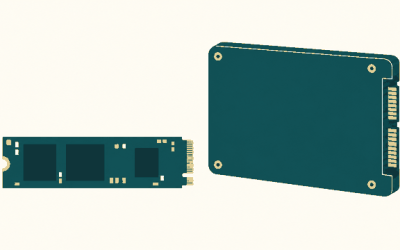
The Kingston Fury Renegade PCIe 4.0 NVMe M.2 SSD remains a strong buy for gaming rigs and PS5 expansion in 2026, but only at the right price — its 7,300MB/s reads deliver almost nothing extra over cheaper drives once you’re past the spec sheet, because real game loads are bottlenecked elsewhere. Here’s what the numbers actually mean, where the drive still earns its premium, and when you should spend less.
As an Amazon Associate we earn from qualifying purchases at no extra cost to you.


Top 3 picks at a glance
Specs at a glance
The Fury Renegade is built on the Phison E18 controller paired with Micron 176-layer TLC NAND and a dedicated LPDDR4 DRAM cache — the same hardware family that powered most of the flagship Gen4 drives of its generation. That DRAM cache is the key differentiator from budget Gen4 drives, which are DRAM-less and lose performance in random workloads.
| Spec | 500GB | 1TB | 2TB | 4TB |
|---|---|---|---|---|
| Sequential read | 7,300MB/s | 7,300MB/s | 7,300MB/s | 7,300MB/s |
| Sequential write | 3,900MB/s | 6,000MB/s | 7,000MB/s | 6,000MB/s |
| Random 4K IOPS | Up to ~1,000,000 IOPS (varies by capacity) | |||
| Endurance (TBW) | 500TB | 1,000TB | 2,000TB | 4,000TB |
| Warranty | 5 years | |||
| Form factor / interface | M.2 2280, PCIe 4.0 x4, NVMe 1.4 | |||
Two things jump out: the 500GB model writes at barely half the speed of the 2TB model (fewer NAND dies to write across), and the 2TB is the only capacity hitting the full 7,000MB/s write rating. If you’re buying this drive, the 2TB is the sweet spot.
Do 7,300MB/s reads actually matter for gaming?
Less than the marketing suggests. Raw sequential throughput describes how fast the drive can move one enormous contiguous file — which is almost never what games do. Games issue thousands of small random reads, then spend most of “load time” on CPU decompression, shader compilation, and engine initialization, none of which touch the SSD.
The useful way to think about it: at 7,300MB/s, the drive can deliver roughly 60MB of data inside a single 8.3ms frame budget at 120fps (7,300MB/s × 0.0083s ≈ 60.6MB). That’s more than enough for on-demand texture and geometry streaming. A Gen3 drive at 3,500MB/s still delivers ~29MB per frame — which is why real-world load time differences between Gen3 and Gen4 consistently land in the 1–3 second range on 20–30 second loads, and why Gen4-to-Gen5 jumps are often under a second.
Where bandwidth does matter:
- DirectStorage titles with GPU decompression, which shift the bottleneck back toward the drive
- Open-world asset streaming on PC ports built around the PS5’s 5.5GB/s pipeline
- Moving large files — game backups, video project files, VM images
Where it doesn’t: frame rates. An SSD has zero effect on FPS. If a listing implies otherwise, it’s marketing.
TBW endurance: doing the math
TBW (terabytes written) is the warranty write limit, and the Renegade’s ratings are generous — roughly 1TB of endurance per GB of capacity. But numbers mean little without context, so:
2TB model: 2,000 TBW ÷ 5-year warranty ÷ 365 days ≈ 1.1TB of writes allowed every single day.
A realistic gamer workload — two 150GB game installs plus ~30GB of updates and patches per week — averages under 50GB/day. That’s ~91TB over the entire warranty period, or roughly 4.5% of the rated endurance. Even a heavy user reinstalling a 150GB game daily for five years writes ~274TB — under 14% of the rating. Unless you’re writing hundreds of gigabytes daily for video production, endurance is a non-issue, and the drive will almost certainly outlive its warranty by years.
One caveat: sustained writes rely on a dynamic SLC cache. Very long writes (hundreds of GB at once) can exhaust it and drop speeds into the ~1.5–2GB/s native-TLC range. Irrelevant for gaming; relevant if this will be a video scratch disk.
PS5 compatibility and the heatsink question
Sony requires a PCIe 4.0 M.2 SSD with at least 5,500MB/s sequential reads, sizes from 2230 to 22110, capacities between 250GB and 8TB, and a total installed thickness under 11.25mm — heatsink included. The Fury Renegade clears the speed bar comfortably, and Kingston sells a heatsink-equipped SKU specifically dimensioned for the PS5’s expansion slot. Buy that version for a console; the standard model’s graphene heat spreader alone isn’t adequate for sustained PS5 use in that enclosed bay.
Installation is five minutes:
- Update the PS5’s system software first, then power down fully and remove the side panel
- Open the M.2 expansion cover, move the screw/spacer to the 80mm (2280) position
- Insert the drive at a slight angle, secure it, and leave the metal slot cover off if it doesn’t sit flush
- Boot and accept the format prompt — the console will report the drive’s measured speed, typically mid-6,000MB/s for this class
For PC builds, the opposite applies: skip the heatsink SKU if your motherboard ships with M.2 thermal armor, since stacking coolers doesn’t help. The Phison E18 platform draws roughly 9–10W under sustained write load, so some passive cooling is worthwhile on desktop — a motherboard heatsink or modest case airflow is plenty.
Should you buy it? A decision matrix
| Your situation | Verdict | Why |
|---|---|---|
| PS5 storage expansion | Yes — heatsink SKU, 1TB+ | Exceeds Sony’s 5,500MB/s floor; heatsink fits the 11.25mm limit |
| Gen4 motherboard, gaming-focused build | Yes, if priced competitively | Flagship-tier Gen4 with DRAM; games can’t use more than this anyway |
| Gen3-only slot | Wait or buy cheaper | Link caps at ~3,500MB/s; you’d pay for bandwidth you can’t use unless a board upgrade is imminent |
| Laptop upgrade | Check clearance first | Heatsink model won’t fit; high-capacity models may be double-sided; thin chassis can throttle it |
| Video editing scratch / heavy daily writes | Capable, but compare options | TBW is ample, but post-cache sustained writes matter more than peak numbers here |
| Already running a Gen5 platform and chasing benchmarks | Look at Gen5 instead | Kingston’s own Fury Renegade G5 roughly doubles sequential throughput |
Where it sits in 2026
The Gen4 TLC-with-DRAM field is crowded: Samsung’s 990 Pro, WD’s Black SN850X, Crucial’s T500, and Seagate’s FireCuda 530 (a sibling E18 design) all deliver gaming performance within a hair of the Renegade. In real terms they’re interchangeable — the right buy is whichever flagship Gen4 drive is cheapest in your capacity that week. The 2TB Renegade typically sits in the $130–$180 range; if it undercuts rivals by $15 or more, it’s the obvious pick. The 1TB model usually lands around $80–$110.
The only reason to spend meaningfully more is Gen5, where drives like the Fury Renegade G5 and Crucial T705 push past 14GB/s — a jump that matters for workstation file transfers, not for loading into a match faster.
FAQ
Does the Fury Renegade need a heatsink on PC?
For gaming workloads, the built-in graphene spreader plus normal case airflow is adequate. Use a motherboard M.2 heatsink if your board has one — sustained writes are where the E18 controller gets warm.
Will it work in a PCIe 3.0 or 5.0 slot?
Yes, NVMe is fully backward and forward compatible. In a Gen3 slot it runs at ~3,500MB/s; in a Gen5 slot it still runs at its own 7,300MB/s ceiling — the slot doesn’t make the drive faster.
What capacity should I get for PS5?
1TB is the practical minimum for modern libraries (several titles exceed 150GB), and 2TB is the sweet spot that also unlocks the full 7,000MB/s write rating.
Verdict
The Kingston Fury Renegade PCIe 4.0 NVMe M.2 SSD is a top-tier Gen4 drive with genuinely excellent endurance ratings, full-speed DRAM-backed performance, and a hassle-free PS5 path via the heatsink model. Its only real enemy in 2026 is its own price tag: buy it when it matches or undercuts the SN850X, 990 Pro, or T500 — and grab the 2TB, which is the only capacity that gets the full write speed it’s famous for.