
Choosing an external solid-state drive (SSD) for your MacBook workspace is no longer just about buying the model with the largest capacity on the box. For creative professionals, editors, and digital designers, the external drive is a direct extension of the laptop’s logic board. It is where raw footage is scrubbed, timeline caches are written, and massive project files are rendered in real time.
The most common mistake buyers make is purchasing a drive based solely on advertised “burst” speeds—often labeled as “up to 1050MB/s” or “up to 2000MB/s.” In reality, these speeds represent best-case scenario read times under laboratory conditions. Once you begin exporting a sustained 50GB ProRes 422 stream, cheap drives quickly overheat, run out of cache, and throttle down to speeds slower than an old spinning hard drive. Understanding how to choose an external ssd for macbook editing requires looking past the marketing stickers and evaluating the thermal construction, controller protocols, and actual bus limitations of macOS hardware.
As an Amazon Associate we earn from qualifying purchases at no extra cost to you. Product prices and availability are accurate as of the date shown and are subject to change.


Top 3 picks at a glance
Decide These 3 Things First
Before diving into spec sheets and price tags, you must define the parameters of your specific editing environment. Answering these three foundational questions will instantly narrow your search and prevent costly compatibility mistakes.
- Your Primary Codec and Resolution: Are you cutting highly compressed 1080p H.264 footage for social media, or are you scrubbing through multi-cam 4K ProRes or 8K RAW timelines? High-resolution, uncompressed files require massive sustained write speeds (minimum 1000MB/s), whereas compressed formats can run comfortably on slower, more affordable SATA-based external drives.
- Your Mobility vs. Desktop Station Habits: Will this drive spend its life velcroed to the back of your MacBook lid at a coffee shop, or will it sit permanently on a walnut standing desk connected to a Studio Display? Heavy, metal-housed desktop enclosures offer superior thermal dissipation but require external power bricks. Ultra-light, bus-powered portable drives fit in a pocket but run hotter during sustained rendering.
- Your Mac’s Bus Architecture: Apple’s modern Apple Silicon (M1, M2, M3, and M4 family) chips handle USB and Thunderbolt protocols uniquely. For example, macOS does not natively support USB 3.2 Gen 2×2 (20Gbps) signaling at full speed; it will fall back to standard USB 3.2 Gen 2 (10Gbps). Knowing your Mac’s port limitations determines whether you should buy a standard USB-C drive or invest in a true Thunderbolt 3/4 or USB4 device.
Physical Size, Footprint, and Desk Integration
The physical footprint of your external drive dictates how cleanly it integrates into your creative workspace. For mobile editors, every fraction of an inch and ounce matters. Portable external SSDs generally fall into two physical categories: ultra-compact “mini” drives and standard pocket-sized enclosures.
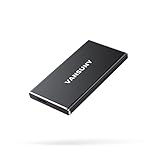
Ultra-compact models, such as the Vansuny 500GB Portable SSD, feature tiny footprints of roughly 2.7 inches by 1.1 inches by 0.4 inches, weighing a mere 1.4 ounces. These are ideal for throwing into a camera bag or dangling from a short cable without straining your MacBook’s USB-C port. However, standard high-performance portable drives—such as the SanDisk Extreme or SSK 1TB Portable SSD—typically measure around 3.9 inches by 2.2 inches by 0.4 inches and weigh between 2.5 and 3.5 ounces. This slightly larger footprint is necessary to accommodate larger flash controller boards and internal cooling materials. If you plan to mount your drive directly to your MacBook screen using adhesive sleeves, prioritize a drive under 3 ounces to prevent screen wobble.
Material, Heat Dissipation, and Thermal Throttling
Video editing is one of the most write-intensive tasks a computer can perform. When an SSD writes data continuously, the internal NAND flash memory chips and the controller generate immense heat. If this heat cannot escape, the drive triggers “thermal throttling”—deliberately cutting its transfer speed by 50% or more to prevent physical damage.
This is where enclosure material becomes critical. Cheap plastic enclosures act as insulators, trapping heat inside and causing rapid performance drops. Professional-grade drives utilize anodized aluminum or magnesium alloy shells. Aluminum acts as a giant passive heatsink, pulling heat away from the internal silicon and radiating it into the surrounding air. When choosing a drive, look for metal construction (such as the metal-bodied SSK or Vansuny models). Do not be alarmed if a metal drive feels hot to the touch during a heavy export; this indicates that the metal shell is successfully doing its job of drawing heat away from the sensitive internal components.
Construction, Ruggedness, and IP Ratings
If you edit on location, on set, or while traveling, physical durability is just as important as speed. A single drop from a desk can shatter a plastic drive housing or crack an internal solder joint. Look for drives built with structural shock absorption.
Many rugged drives feature an internal aluminum frame surrounded by a protective silicone elastomer bumper. This design allows the drive to survive drops from up to 6.5 feet onto concrete. Additionally, look for an Ingress Protection (IP) rating if you work in dusty or damp environments. An IP55 rating means the drive can withstand limited dust ingress and low-pressure water sprays (like light rain). Premium ruggedized drives carry IP67 ratings, meaning they are completely dust-tight and can be fully submerged in water up to 3.3 feet deep for 30 minutes. If your drive sits permanently on a clean home office desk, these ratings are unnecessary; however, for field editors, they are cheap insurance for priceless footage.
Performance, Bus Power, and Workspace Comfort
When evaluating performance, you must understand the interface protocols. Drives interface via USB 3.1 Gen 2 (up to 10Gbps or roughly 1050MB/s), USB 3.2 Gen 2×2 (up to 20Gbps), or Thunderbolt 3/4 / USB4 (up to 40Gbps or roughly 3000MB/s).
As we approach 2026, the shift toward ultra-high-resolution production means that interface mismatching is a common bottleneck. For instance, the SSK 500GB Portable SSD utilizes a high-speed USB 3.2 Gen 2×2 interface capable of 20Gbps. However, because MacBooks do not support the specific lane-bridging technology of Gen 2×2, this drive will run at Gen 2 speeds (10Gbps, or about 1000MB/s) on any Mac. If you require speeds faster than 1050MB/s on a MacBook, you must bypass standard USB drives entirely and buy a true Thunderbolt 3/4 or USB4 drive.
Furthermore, consider power draw. High-performance external drives are bus-powered, drawing wattage directly from your MacBook’s battery. Standard USB-C SSDs draw between 2.5W and 4.5W under load. Thunderbolt drives can draw up to 8.5W. If you edit on the go without a wall charger, a higher-performance drive will drain your MacBook’s battery significantly faster.
Price Tiers and Capacity-to-Cost Ratios
The external SSD market is divided into three distinct price-to-performance tiers. Understanding where your workflow fits will prevent you from overpaying for speed you cannot use, or underpaying for a drive that stalls your timeline.
- Budget Tier ($60 – $100): Typically offers 500GB to 1TB of capacity with speeds ranging from 450MB/s to 800MB/s. Examples include entry-level metal drives like the Vansuny 500GB ($70.99). These are excellent for 1080p editing, audio production, and general file storage, but will struggle with heavy 4K rendering.
- Mid-Range Tier ($110 – $220): Offers 1TB to 2TB of capacity with nominal speeds up to 1050MB/s (using USB 3.2 Gen 2). This is the sweet spot for most independent video editors. Drives like the SSK 1TB ($172.99) provide enough bandwidth for smooth 4K editing while remaining highly portable.
- Premium/Pro Tier ($230 – $500+): Offers 2TB to 4TB+ capacities or utilizes Thunderbolt 3/4 interfaces to achieve speeds between 2500MB/s and 3200MB/s. These are professional production drives designed for high-end color grading, multi-cam 8K workflows, and high-budget studio environments.
Warranty, Reliability, and Data Lifecycle
SSDs have a finite lifespan determined by how much data you write to them, measured in Terabytes Written (TBW). Video editing, which involves constant reading, writing, caching, and deleting of massive files, exhausts this limit much faster than office work.
When selecting a drive, look beyond the simple storage capacity and check the manufacturer’s TBW rating and warranty terms. A consumer-grade drive might offer a 3-year warranty with a low TBW rating, meaning the warranty could void early if you write hundreds of terabytes of video cache. Professional-grade drives generally offer a 5-year limited warranty and significantly higher TBW thresholds. Always ensure your editing drive is backed up daily to a secondary, high-capacity mechanical hard drive or cloud system, as SSD failure is sudden and data recovery from dead flash chips is incredibly difficult and expensive.
Out-of-Box Setup, Formatting, and Port Compatibility
How a drive arrives at your door impacts how quickly you can get to work. Most external drives are pre-formatted in exFAT to ensure compatibility with both Windows and macOS out of the box. However, editing on a Mac using an exFAT-formatted drive is a recipe for slow performance and potential database corruption in software like Final Cut Pro or DaVinci Resolve.
For the best performance, stability, and speed, you should immediately reformat your new SSD to Apple File System (APFS) using macOS Disk Utility. Additionally, check the included accessories. High-quality drives include high-bandwidth, shielded USB-C to USB-C cables certified for the drive’s maximum speed. Using a cheap, thin USB-C charging cable (like the one that comes with your iPad) will limit your transfer speeds to slow USB 2.0 speeds (48mbps/40MBs), regardless of how fast your external SSD is.
Spec Checklist
Use this quick-reference table to match your specific editing needs with the appropriate drive specifications:
| Specification | Budget Tier | Mid-Range Tier | Premium/Pro Tier |
|---|---|---|---|
| Sustained Read Speed | 400MB/s – 550MB/s | 950MB/s – 1050MB/s | 2400MB/s – 3000MB/s+ |
| Interface Protocol | USB 3.1 Gen 1 / Gen 2 | USB 3.2 Gen 2 (10Gbps) | Thunderbolt 3 / 4 or USB4 |
| Enclosure Material | Plastic or Thin Metal | Anodized Aluminum | Heavy Aluminum with Heat Sinks |
| IP Rating | None | IP55 (Dust/Water Splash) | IP67 (Dust-tight/Immersion) |
| Ideal Editing Codecs | 1080p H.264, Audio Timelines | 4K H.264 / HEVC, 4K ProRes Proxy | 4K/8K ProRes 422/4444, RAW |
| Target Price Range | $50 – $100 | $110 – $220 | $230 – $500+ |
Red Flags
When shopping for an external editing drive, avoid these common industry traps:
- “Up to 2000MB/s” Speed Claims on Non-Thunderbolt Drives: If a drive claims 2000MB/s using USB 3.2 Gen 2×2, remember that your MacBook will only run it at 1000MB/s. Do not pay a premium for speed your Apple hardware cannot negotiate.
- Plastic Housings with No Heat Vents: If a drive is completely sealed in cheap plastic, avoid it for video editing. It will overheat within minutes of continuous writing, causing severe lag on your timeline.
- No Mention of “DRAM” or “Sustained” Performance: Budget drives often omit a DRAM cache. Without DRAM, once you write more than a few gigabytes of data, transfer speeds can plummet to double-digit megabytes per second.
- Unbranded, Ultra-Cheap High Capacity Drives: If you see a generic 4TB external SSD online for $40, it is a scam. These devices contain cheap, slow SD cards or hacked firmware that overrides storage readouts, resulting in immediate data loss.
FAQ
Can I edit 4K video directly off a budget $70 external SSD?
Yes, but it depends on your codec. If you are editing highly compressed 4K footage (such as H.264 or HEVC files shot on an iPhone or mirrorless camera), a budget drive with speeds around 450MB/s to 500MB/s can handle the playback. However, if you are working with uncompressed edit-ready codecs like ProRes 422, a budget drive will struggle with lag, dropped frames, and slow rendering times.
Why does my 20Gbps external SSD only run at 10Gbps on my MacBook Pro?
This is due to a protocol mismatch. Many high-speed drives utilize the USB 3.2 Gen 2×2 protocol to achieve 20Gbps speeds by sending data over two lanes of 10Gbps. Apple’s USB-C ports do not support this dual-lane USB protocol. Instead, macOS drops the connection back to a single 10Gbps lane, capping your actual speed at roughly 1000MB/s. To get speeds faster than this on a Mac, you must use a drive that supports Thunderbolt or USB4.
What formatting system should I choose for macOS video editing?
You should format your editing SSD to APFS (Apple File System). While exFAT is convenient if you share drives between Windows and Mac computers, it lacks journaling features and performs poorly under the heavy read/write demands of video editing software on macOS. Formatting to APFS ensures maximum speed, lower latency, and protection against file corruption.
Does the length of the USB-C cable affect my editing transfer speeds?
Yes. High-speed data protocols like Thunderbolt and USB4 require incredibly high-frequency signals that degrade quickly over distance. Passive cables longer than 1.6 feet (0.5 meters) that are not specifically certified can drop your transfer speeds significantly or cause connection drops. If you need a longer cable to route behind your desk monitor arm, make sure to purchase an “active” Thunderbolt cable certified for 40Gbps.


