
The best rugged laptops for field work and travel are the Panasonic Toughbook 55 for balanced portability, the Dell Latitude 7330 Rugged Extreme for severe outdoor conditions, and the Getac S410 G5 for a practical middle ground between protection, repairability, and cost.
As an Amazon Associate we earn from qualifying purchases at no extra cost to you.

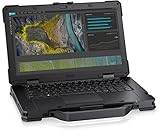

Top 3 picks at a glance
Quick comparison
| Model | Protection | Display and visibility | Battery approach | Approximate weight | Typical market range |
|---|---|---|---|---|---|
| Panasonic Toughbook 55 | Rugged business design; MIL-STD-810H configurations | 14-inch Full HD, optional high-brightness touchscreen | Removable battery; optional second battery on some configurations | About 4.2–4.8 lb | Usually $1,300–$2,800 |
| Dell Latitude 7330 Rugged Extreme | IP65; MIL-STD-810H; designed for extreme environments | 13.3-inch Full HD, high-brightness outdoor options | Dual hot-swappable battery design | About 8.2 lb before accessories | Usually $2,500–$5,000 |
| Getac S410 G5 | IP53; MIL-STD-810H; semi-rugged construction | 14-inch Full HD, optional high-brightness touchscreen | Removable battery; optional second battery depending on configuration | About 4.8–5.1 lb | Usually $1,500–$3,500 |
| Panasonic Toughbook 40 | IP66; MIL-STD-810H; fully rugged design | 14-inch Full HD, sunlight-readable configurations | Dual hot-swappable batteries | About 7.4 lb | Usually $3,000–$6,000 |
| Durabook Z14I | IP65; MIL-STD-810H; fully rugged design | 14-inch Full HD, high-brightness touchscreen options | Removable or extended battery options vary | About 5.1–5.7 lb | Usually $2,000–$4,500 |
Weights, ports, brightness, processors, and battery capacities vary substantially by configuration. Treat the figures above as buying ranges rather than exact specifications.
What “rugged” actually means
Military testing and ingress protection are different things. MIL-STD-810H indicates that a manufacturer has evaluated a device against selected environmental stresses such as drops, vibration, temperature changes, humidity, altitude, and shock. It does not mean every laptop has passed every test in the standard, so check the manufacturer’s test methods when a contract requires a specific certification.
IP ratings focus on dust and water. The first digit measures solids protection and the second measures water protection. IP53 offers limited dust protection and resistance to sprayed water. IP65 provides a dust-tight enclosure and protection from water jets. IP66 adds stronger water-jet protection. None of these ratings automatically means the laptop can be submerged, and protective port covers must be closed for the rating to apply.
Head-to-head: which rugged laptop fits your work?
Best balance: Panasonic Toughbook 55
The Toughbook 55 is the most sensible choice when your laptop spends part of the day in a vehicle, warehouse, workshop, or construction office rather than permanently outdoors. Its magnesium-alloy chassis, reinforced corners, spill-resistant design, removable battery, and modular components give it more serviceability than a typical consumer notebook without the bulk of a fully rugged machine.
Choose a high-brightness display if the laptop will be used beside windows or outdoors. The Toughbook 55 is also easier to carry than the Toughbook 40 or Dell 7330 Rugged Extreme. Its limitation is protection: it is not the ideal choice for repeated rain exposure, heavy mud, or frequent drops onto rough ground.
Best for severe weather: Dell Latitude 7330 Rugged Extreme
The Latitude 7330 Rugged Extreme is built for field technicians, emergency services, utilities, and industrial teams that need stronger water and impact protection. Its sealed design, reinforced chassis, glove-friendly controls, and hot-swappable battery system are more valuable than a thin profile in these environments.
The trade-off is weight. At roughly twice the mass of many business laptops, it is tiring to carry during long inspections. It also costs considerably more, particularly with a high-capacity battery, cellular modem, dedicated graphics, or legacy ports. Buy it when environmental risk is expensive—not simply because the product looks durable.
Best semi-rugged option: Getac S410 G5
The Getac S410 G5 occupies the useful middle ground. It is more protected and serviceable than an ordinary office laptop, yet substantially easier to carry than a fully rugged model. It suits field surveys, manufacturing floors, transport operations, and maintenance work where the main hazards are vibration, occasional drops, dust, and spills.
Its IP53 rating is the key limitation. If the computer will regularly encounter hose spray or heavy rain, move up to an IP65 or IP66 model. For controlled industrial sites, however, the S410’s removable battery, accessible components, and optional high-brightness screen can be a better use of the budget than maximum sealing.
Best for repairability and long shifts: Panasonic Toughbook 40
The Toughbook 40 is a strong choice when uptime matters more than backpack weight. Its fully rugged enclosure, IP66 protection, modular expansion areas, and dual hot-swappable batteries are designed around field replacement rather than desk convenience. A technician can carry a charged spare and replace a battery without shutting down, depending on the installed configuration and operating procedure.
It is overkill for occasional travel. The chassis is thick and heavy, and the purchase price is high. It makes more sense for organizations that maintain fleets, need legacy connectivity, or cannot afford to return a laptop to a depot for a simple component replacement.
Best alternative design: Durabook Z14I
The Z14I provides a fully rugged 14-inch format with IP65 protection, a bright display option, and business-oriented connectivity. It is worth considering when you need a conventional clamshell layout but want stronger sealing and impact resistance than a standard enterprise notebook.
Check the exact service manual and configuration before ordering. Rugged laptops often offer several battery, keyboard, port, and modem combinations, and the lightest advertised weight may exclude the larger battery, handle, or optical drive.
Decision matrix: match the hazard to the laptop
| Your situation | Minimum useful specification | Best-fit class | Why |
|---|---|---|---|
| Indoor workshop, occasional travel | MIL-STD-810H evaluation, spill resistance, replaceable SSD | Toughbook 55 or Getac S410 | Good durability without extreme weight |
| Construction site in rain and dust | IP65 or better, sealed ports, 700-nit-or-brighter display | Dell 7330 Rugged Extreme, Toughbook 40, or Z14I | Better protection against water and outdoor glare |
| Long vehicle or utility shifts | Hot-swappable batteries, vehicle dock, cellular option | Toughbook 40 or Latitude 7330 Rugged Extreme | Power and connectivity can be changed in the field |
| Frequent walking with a small kit | Under 5.5 lb, matte high-brightness display, USB-C charging | Toughbook 55, Getac S410, or Z14I | Reduces carrying fatigue while retaining useful protection |
| Cold, dusty, or remote deployment | Wide operating-temperature specification, dual batteries, serviceable parts | Fully rugged model | Spare power and field repair matter more than thinness |
Battery life: calculate the requirement instead of trusting the claim
Manufacturers usually quote best-case runtime. A more useful estimate is:
Runtime in hours = usable battery watt-hours × inverter and system efficiency ÷ average laptop power draw.
For example, a 56-Wh battery running a laptop that averages 12 watts, with 85% usable system efficiency, provides approximately 56 × 0.85 ÷ 12 = 4 hours. A second identical battery raises that theoretical total to about 8 hours, although screen brightness, cellular radios, storage activity, cold weather, and battery age reduce it.
For an eight-hour shift, do not automatically buy the biggest internal battery. A hot-swappable design may be more practical: two 60-Wh batteries can provide roughly 8.5 hours at a 12-watt average draw while allowing one battery to be replaced during operation. If the laptop averages 25 watts while running mapping software, video processing, or heavy databases, the same pair drops to about 4.1 hours.
Screen visibility is a field specification
A 1,000-nit display is much easier to read in direct sun than a 300-nit office panel, but brightness alone does not solve every problem. Look for a matte or anti-reflective surface, an optical-bonded panel, glove-capable touch input, physical brightness controls, and a display that remains usable when viewed off-center.
Touchscreens can be valuable for maps and inspection forms, but they consume more power and can be awkward with wet fingers. A non-touch configuration is often preferable when the primary input is a keyboard, barcode scanner, or vehicle-mounted pointing device.
Repairability and ownership cost
Before buying, confirm that the memory, SSD, wireless card, keyboard, and battery are replaceable. Also check whether the service documentation lists separate part numbers and whether the manufacturer offers extended support in your country. A rugged laptop with a replaceable keyboard can be cheaper to operate than a sealed consumer model even when its purchase price is higher.
Prioritize ports according to the job. Serial connectivity can still matter for industrial equipment, while Ethernet, a full-size HDMI port, multiple USB-A ports, and a docking connector may eliminate fragile adapters. If you need cellular connectivity, order it from the start; retrofitting antennas and modem hardware is not always possible.
Buying recommendation
Choose the Panasonic Toughbook 55 or Getac S410 G5 for most field professionals who need durability without carrying a heavy case. Choose the Dell Latitude 7330 Rugged Extreme or Panasonic Toughbook 40 when rain, dust, drops, and long unsupported shifts are normal operating conditions. Choose the Durabook Z14I when you want fully rugged protection in a more conventional 14-inch format.
The best rugged laptop is not the one with the highest certification number. It is the lightest model that safely covers your actual hazards, has enough screen brightness for the worksite, and can be repaired or powered through the entire shift.
Frequently asked questions
Can a rugged laptop be used in heavy rain or with water spray?
Choose a model with IP65 or IP66 protection for regular rain, dust, or water-jet exposure. The Getac S410 G5 has an IP53 rating, which is more limited and better suited to controlled industrial sites. Protective port covers must be closed for the rating to apply, and none of these ratings automatically means the laptop can be submerged.
Are rugged laptops difficult to carry during long field days?
Some are, especially fully rugged models. The Dell Latitude 7330 Rugged Extreme weighs about 8.2 lb before accessories, while the Panasonic Toughbook 40 weighs about 7.4 lb. The Toughbook 55 and Getac S410 G5 weigh about 4.2–4.8 lb and 4.8–5.1 lb, respectively, making them easier choices for frequent walking.
Should I choose a touchscreen for field work?
Choose a touchscreen when glove-friendly controls or direct interaction is useful, but verify the exact configuration before ordering. The Toughbook 55, Getac S410 G5, and Durabook Z14I offer touchscreen options, while high-brightness displays matter more when working beside windows or outdoors. Display brightness and touchscreen availability can vary substantially by configuration.
What should I check before ordering a rugged laptop?
Check the exact battery, keyboard, port, modem, display, and weight configuration before ordering. Rugged laptops can have several combinations, and the lightest advertised weight may exclude a larger battery, handle, or optical drive. Also verify the service manual and manufacturer’s test methods when a contract requires a specific certification or environmental protection.
Can a rugged laptop be repaired in the field?
Some models are designed to be more serviceable than ordinary notebooks. The Toughbook 40 has modular expansion areas, dual hot-swappable batteries, and field-replacement features, while the Toughbook 55 and Getac S410 G5 offer removable batteries and accessible components. A fleet that cannot afford depot service may benefit more from repairability than from the lowest weight.


