
Every build I have ever troubleshooted had the same unglamorous root cause: a cheap power supply that couldn’t hold voltage under sustained load. A GPU stuttering at the edge of its boost clock, random shutdowns that leave you hunting for a kernel error that isn’t there, drives dropping offline under heavy I/O — these are the fingerprints of a PSU running outside its design envelope. Sorting through the best pc power supplies amazon has to offer means separating units that deliver clean, stable rails from those that merely list a wattage on the label.
What separates good from bad in this category is narrower than most buyers expect. Efficiency certification tells you how little waste heat the unit produces, but it says nothing about transient response on the 12V rail. Modular cabling is a quality-of-life feature, not a performance one. The specs that actually matter are capacitor temperature ratings, whether the unit carries ATX 3.1 certification for high GPU transient loads, and whether the native 12V-2×6 connector is present if you run current-generation graphics cards. Beyond the units themselves, cables and testers round out the list because they solve adjacent problems: a too-short stock cord or a failing PSU you need to confirm before ordering a replacement.
As an Amazon Associate we earn from qualifying purchases at no extra cost to you.




Top 3 picks at a glance
Quick Picks
| Product | Best for | Price |
|---|---|---|
| Thermaltake Smart 600W | Entry-level office and media builds | $42.99 |
| MSI MAG A750GL | Compact gaming builds needing ATX 3.1 | $94.99 |
| Thermaltake Toughpower GT 850W | High-end GPUs on a standard ATX budget | $79.99 |
| CORSAIR RM750e | Silence-focused mid-range gaming | $89.99 |
| Amazon Basics 6 ft Power Cable | Replacing a short or damaged AC cord | $6.94 |
| Amazon Basics 12 ft Power Cable | Desk setups with the tower far from the outlet | $6.99 |
| Auotac 1000W Fully Modular | Multi-GPU or heavy workstation loads | $99.99 |
| Fuhengli PSU Tester | Diagnosing suspected power supply failures | $15.99 |
How We Picked
We evaluated every unit on four criteria. First, ATX 3.1 compliance and native 12V-2×6 support, because modern GPUs draw multi-hundred-watt transient spikes that older connectors and rail designs handle poorly. Second, capacitor quality and temperature rating, since long-term reliability tracks directly with the thermal headroom of the components on the PCB. Third, warranty length as a proxy for the manufacturer’s confidence in its own build. Fourth, value relative to listed wattage and modularity — a unit priced per watt matters more to most buyers than an arbitrary efficiency tier.
The 8 Best Pc Power Supplies Amazon in 2026
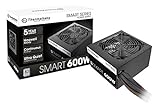
Thermaltake Smart 600W
This is the default answer when a build needs reliable power and nothing else. Office workstations, home theater PCs, and student rigs that will never see a discrete GPU beyond a low-profile card run perfectly well on 600W, and Thermaltake’s 80 Plus certification keeps heat and electricity costs low. At $42.99 it is the cheapest proper PSU on this list and still carries active PFC for clean power factor correction. Build it into a compact case and the unit fits without fuss.
- Pro: Lowest cost of entry for a certified, active-PFC unit.
- Pro: 600W headroom covers dual-drive, single-slot GPU configurations comfortably.
- Con: Non-modular cabling makes cable management tedious in small form-factor cases.
Skip this if you plan to install a high-end GPU with a 12V-2×6 requirement or need ATX 3.1 transient tolerance.
MSI MAG A750GL
The A750GL is the most feature-dense 750W unit on this list. ATX 3.1 and PCIe 5.1 readiness means it handles current and near-future GPU transient loads without adapter cables, and the fully modular design keeps airflow clear in compact chassis. MSI backs it with a 10-year warranty, which is the strongest signal of long-term reliability among the group. The dual-color 12V-2×6 connector is a practical safety feature: it visually warns if the cable is not fully seated.
- Pro: Native PCIe 5.1 connector eliminates adapter-related voltage drop.
- Pro: Ten-year warranty exceeds every other unit here.
- Con: Priced near $95, it costs more than the Toughpower GT despite carrying 100W less rated output.
Skip this if your GPU uses an 8-pin connector and you do not expect an upgrade cycle within the warranty window.
Thermaltake Toughpower GT 850W
At $79.99 this is the best price-per-watt for a Gold-certified, ATX 3.1 unit on the list. The native 450W PCIe 5.1 connector handles flagship cards without adapters, and the Smart Zero Fan keeps the unit silent during light loads — ideal for users who idling on the desktop should not sound like a hair dryer. Five years of warranty is a fair but shorter commitment than MSI offers.
- Pro: 850W at under $80 with ATX 3.1 certification is a strong value ratio.
- Pro: Smart Zero Fan provides semi-passive operation for near-silent idle.
- Con: Five-year warranty is half of what the MSI MAG A750GL provides at a similar price tier.
Skip this if you need fully modular cabling; this is a standard (fixed-cable) unit, which matters in SFF or custom-loop builds.
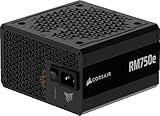
CORSAIR RM750e
Corsair’s RM750e leans into its reputation for quiet operation. The 750W Gold-rated design is compact enough for most ATX cases, and ATX 3.1 plus PCIe 5.1 readiness future-proofs it for high-transient GPUs. At $89.99 it sits between the Toughpower GT and the MSI in price, and Corsair’s ecosystem means cable replacements and firmware tools are readily available. For a user who values brand consistency across their build, this fits naturally.
- Pro: Corsair’s cable ecosystem makes future replacements straightforward.
- Pro: Compact housing fits cases where the Toughpower GT would be tight.
- Con: No native 12V-2×6 connector listed, so high-end GPU setups may require an adapter.
Skip this if your next GPU upgrade will demand a 450W-class connector and you want to avoid adapters.
Amazon Basics 6 ft Power Cable
Not a power supply, but a problem-solver that belongs on this roundup because it addresses a universal frustration: the stock AC cord is too short, or the original cracked after years of tight bends behind a desk. At $6.94 for six feet of 18 AWG, UL-listed copper, this is the cheapest way to eliminate that annoyance. The three-prong grounded connector and NEMA 5-15P to IEC320C13 pairing cover virtually every desktop PSU and monitor on the market.
- Pro: UL Listed construction at a price that undercuts most third-party alternatives.
- Pro: Six-foot length fits the typical desk-to-wall-socket run without excess slack.
- Con: Not suitable for high-current peripherals or rack-mount equipment requiring 16 AWG or thicker.
Skip this if your cable run exceeds six feet; choose the 12-foot variant instead.
Amazon Basics 12 ft Power Cable
The longer sibling solves the same problem with more reach. Twelve feet covers setups where the PC tower sits on the floor across the room from a wall outlet or a power strip that has finally failed. Same 18 AWG, same UL listing, same three-prong safety grounding. At $6.99 the cost difference from the six-foot version is negligible, so if you are uncertain about your run length, buying the longer cord is the rational default.
- Pro: Twelve feet of reach eliminates the need for extension cords in most living-room and office layouts.
- Pro: Identical UL certification to the shorter model with no downgrade in build quality.
- Con: Excess cable length behind a small desk creates trip hazards if not bundled.
Skip this if you need a right-angle or braided connector for tight clearance behind furniture.
Auotac 1000W Fully Modular
One thousand watts of 80 Plus Gold output with ATX 3.1 compliance, a native 12V-2×6 cable, and 105°C-rated capacitors — all under $100. For workstation builds with multiple GPUs, heavy storage arrays, or sustained multi-core loads, this is the wattage class you need, and the fully modular design keeps thermals manageable. The RGB fan is cosmetic and irrelevant to performance; what matters is the thermal rating of the capacitors, which is the highest on this list.
- Pro: 105°C-rated capacitors suggest a longer service life than units rated only to 85°C.
- Pro: Highest rated wattage on this list, with a native dual-color 12V-2×6 connector included.
- Con: Brand recognition and warranty documentation are less established than MSI or Corsair.
Skip this if your build draws under 750W; the extra headroom will run at lower efficiency and generate more heat than necessary.
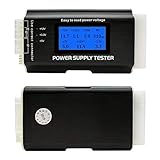
Fuhengli PSU Tester
A $15.99 diagnostic tool that replaces the guesswork of troubleshooting. If your system is shutting down randomly or failing to POST, this tester checks all rails — 3.3V, 5V, 12V, 5VSB — and gives you a binary pass or fail before you spend money on a replacement. It also verifies whether a PSU can hold voltage under load with its built-in resistor test. For anyone who has thrown a working unit in the trash because a dead drive looked like a dead PSU, this tool pays for itself on the first correct diagnosis.
- Pro: Eliminates false-positive troubleshooting that leads to unnecessary part purchases.
- Pro: Under $16 — cheaper than a single incorrect replacement cable.
- Con: Does not measure ripple, transient response, or load regulation; it only confirms the PSU is not completely dead.
Skip this if you already own a multimeter and are comfortable measuring rail voltages under load manually.
Buying Guide
ATX 3.1 and the 12V-2×6 Connector
Modern GPUs can draw transient power spikes of two to three times their rated TDP for brief intervals. ATX 3.1 certification means the PSU’s 12V rail is designed to absorb those spikes without triggering over-current protection. The 12V-2×6 connector replaced the older 12VHPWR design by moving the sense pins off the primary housing, reducing the risk of melted connectors from incomplete seating. If you own or plan to buy a current-generation discrete GPU, prioritize a PSU that lists both ATX 3.1 compliance and a native 12V-2×6 cable. Adapter cables add resistance and introduce a failure point.
Capacitor Temperature Rating
Electrolytic capacitors degrade with heat. A unit using 85°C-rated capacitors operating inside a case where internal temps reach 50°C has only 35°C of thermal margin. A unit rated for 105°C has 55°C. Over years of operation, that margin difference determines whether the PSU holds its voltage tolerances or drifts toward instability. When comparing units at similar wattage and price, check the capacitor rating. It is rarely listed in marketing copy but often appears on the unit’s spec sheet or internal component photos in longer reviews.
Modularity and Warranty as Value Signals
Fully modular units cost more because they use internal connectors and individual cable runs rather than a single bundled harness. That cost is justified in compact cases or builds with many SATA devices. Non-modular units remain the right choice for open-air test benches or office builds where cable routing is simple. Warranty length is the manufacturer’s own confidence metric: ten years signals that the designer expects the unit to last beyond a full hardware upgrade cycle. Anything under five years at the Gold tier or above warrants scrutiny.
Our Verdict
Top pick: the MSI MAG A750GL. Native ATX 3.1 and PCIe 5.1 compliance, a ten-year warranty, a dual-color connector for seating verification, and fully modular cabling make it the most complete unit on this list for a gaming build that will be upgraded within the warranty window. Budget pick: the Thermaltake Toughpower GT 850W delivers Gold efficiency, ATX 3.1, and a 450W PCIe 5.1 connector under $80. If you need maximum wattage under $100 for a workstation or multi-drive build, the Auotac 1000W is the clear choice on raw capacity.
FAQ
Do I need ATX 3.1 if my GPU uses an 8-pin connector?
No. ATX 3.1 certification matters for GPUs that draw 300W or more from a single connector, which means current and future flagship cards. If your GPU uses two 8-pin PCIe connectors, the older ATX standard already handles those loads within safe margins.
Is 80 Plus Gold worth paying for over 80 Plus Standard?
At typical US electricity rates, the difference between Gold (around 90% efficiency) and Standard (around 80%) saves a handful of dollars per year in energy cost. The real benefit is less waste heat, which means the PSU fan runs slower and your case interior stays cooler during sustained loads.
Can a PSU tester confirm a power supply is healthy?
It confirms the unit is not dead. A tester checks whether each rail outputs voltage within spec and whether the power-good signal activates. It does not measure ripple, voltage droop under dynamic load, or transient response. A PSU can pass a tester and still fail under real GPU load, so treat a pass as a screening step, not a full diagnosis.
What happens if I pair a 12-foot cable with a PSU that expects a six-foot cord?
Nothing. The AC cord carries line voltage from the wall to the PSU’s input connector. Length affects voltage drop only negligibly at 18 AWG over twelve feet at typical PC loads. The only practical concerns are physical routing and aesthetics, not electrical performance.


