An outdoor speaker with bass has to pass two separate tests, and most models only pass one. The first is survival: a stated waterproof rating on the listing, because a speaker that lives by a pool or on a patio will get rained on, splashed and knocked into wet grass. The second is low-end hardware: a subwoofer, passive bass radiators or a dedicated bass boost mode named on the product page, because open air swallows bass that sounds full indoors, and a small driver with no bass hardware simply cannot replace it.

The three picks below meet both criteria on their Amazon US listings, and they cover three different sizes of gathering: a boombox built for a crowd, a mid-size cylinder for a patio table, and a compact speaker that travels in a bag. Indoor-only speakers and models whose listings promise bass in adjectives rather than hardware were left out. The sections after the picks explain how to read waterproof ratings, driver layouts and playtime claims before you order.
Quick Picks
As an Amazon Associate we earn from qualifying purchases.
| Product | Best for | Key spec from title |
|---|---|---|
| Soundcore Boom 2 Plus | Large outdoor gatherings that need maximum bass output | 140W max with BassUp 2.0, IPX7 waterproof and floatable |
| JBL Charge 5 (Black) | Patio and poolside listening in a mid-size body | IP67 waterproof, dual bass radiators, 20 hours playtime |
| JBL Flip 6 (Black) | A compact speaker that still leads with bass | IP67 waterproof, deep bass, 12 hours playtime |
How to Choose
Read the waterproof rating, not the word waterproof
Listings use waterproof loosely, so the IP code is the part to trust. IPX7 means the speaker can be submerged in shallow water for a limited time, which covers drops in a pool and heavy rain; IP67 adds a dustproof rating on top of the same immersion protection, which matters at the beach and on job sites where sand and grit get into ports. A speaker with no IP code in its listing, or one described only as splash resistant, is not built for the same treatment. Check whether the rating appears in the product title or spec table, not just in lifestyle photos of the speaker sitting near water.
Bass outdoors comes from hardware, not EQ presets
In a living room, walls reflect low frequencies back at you and a small speaker can sound bassy. Outdoors that reinforcement disappears, so the listing has to show real bass hardware: a dedicated woofer or subwoofer, passive radiators that move air without drawing power, or a bass boost mode that raises output, ideally with wattage figures for each state. The picks here were chosen because their pages name that hardware outright. If a listing leans on phrases like powerful sound without naming a driver arrangement or a bass feature, expect the low end to thin out the moment you step outside.
Match output and size to the space
A speaker for two people on a deck and a speaker for thirty people around a fire pit are different products. Boombox formats carry larger drivers and higher wattage, and their listings state maximum output figures that make the comparison easy. Compact cylinders trade that output for a body that fits a bike cage or a daypack. Weight is the honest signal of which class a speaker belongs to: the boombox in this guide weighs over eight pounds, the compact pick a fraction of that. Decide where the speaker will actually live most weekends, then buy the size that fits that place rather than the largest battery of features.
Playtime claims assume moderate volume
Every playtime figure on a listing is measured under gentle conditions, typically around half volume with extra features switched off. Bass boost modes, light shows and maximum volume all shorten the real number, sometimes by hours. Treat the stated playtime as a ceiling and think about your longest typical session: a speaker rated for twenty hours will comfortably cover a full day outside even with the bass mode running, while a twelve-hour rating suits an afternoon but leaves less margin for an evening that runs long. A built-in power bank, listed on two of the picks here, also draws from the same battery when it charges your phone.
The 3 Best Options
Soundcore Boom 2 Plus
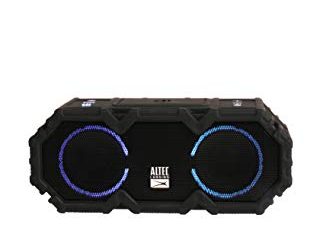
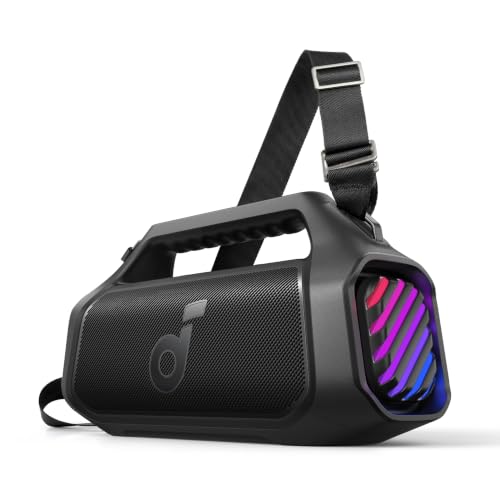
The Boom 2 Plus is the maximum-bass route: a boombox whose listing states 140W maximum output with its BassUp 2.0 mode engaged, from dual 50W woofers and dual 20W tweeters, with a frequency reach down to 40Hz. That driver count is what separates it from single-woofer boomboxes, because two woofers move enough air to keep bass present across a yard rather than just beside the speaker. It is rated IPX7 and floats, so a knock into the pool is a retrieval job instead of a replacement, and the shoulder strap and handle suit a body of this size.
Specs
- Model: A3134
- Output: 140W max with BassUp 2.0, 100W standard
- Drivers: dual 50W woofers, dual 20W tweeters
- Water resistance: IPX7 waterproof, floatable
- Playtime: up to 20 hours
- Bluetooth: 5.3
- Connections: AUX input, USB-C charging, power bank charge-out
- Dimensions: 17.4 x 5.94 x 8.98 inches
- Weight: 8.38 pounds
Best for: beach days, tailgates and backyard gatherings where the speaker has to cover a crowd.
Watch out for: at 8.38 pounds this is a carry-to-the-spot speaker, not a toss-in-a-bag one, and the rated playtime drops when BassUp and the lights stay on.
JBL Charge 5 (Black)
The Charge 5 is the balanced pick, a mid-size cylinder whose listing pairs an IP67 waterproof and dustproof rating with dual JBL bass radiators, the passive radiators that give this format its low-end weight without a separate subwoofer. JBL lists an optimized long excursion driver and a separate tweeter alongside them, a two-part arrangement that keeps vocals clear while the radiators handle the bass. Twenty hours of stated playtime and a built-in power bank with USB charge-out make it the practical patio option: it plays all day and can top up a phone from the same battery.
Specs
- Model name: JBL Charge 5 – Black
- Water and dust resistance: IP67 waterproof and dustproof
- Playtime: up to 20 hours
- Drivers: long excursion driver, separate tweeter, dual JBL bass radiators
- Pairing: PartyBoost for linking compatible JBL speakers
- Extra feature: built-in power bank with USB charge out
Best for: poolside and patio listening where one mid-size speaker has to do everything.
Watch out for: PartyBoost only links with other PartyBoost JBL models, so check the feature name on any second speaker you plan to pair with it.
JBL Flip 6 (Black)
The Flip 6 is the compact end of this guide, and it earns its place because its listing still leads with bass: the title promises powerful sound and deep bass, delivered by a two-way speaker system with dual passive radiators in a body small enough to carry anywhere. It carries the same IP67 waterproof and dustproof rating as the Charge 5, so the smaller size does not cost it any weather protection. Twelve hours of stated playtime covers a day trip or a long afternoon, and PartyBoost pairing means two of them can split into a wider setup when one is not enough.
Specs
- Model: JBLFLIP6BLKAM
- Water and dust resistance: IP67 waterproof and dustproof
- Playtime: up to 12 hours
- Sound: 2-way speaker system with dual passive radiators for deep bass
- Pairing: PartyBoost for linking compatible JBL speakers
- Bluetooth: 5.1
Best for: hikes, bike rides and small groups that need real bass from a speaker that travels light.
Watch out for: a compact body has physical limits, so expect strong bass for its size rather than room-filling low end at a large gathering.
Which One Fits Your Situation
You host big outdoor gatherings
Choose the Soundcore Boom 2 Plus. Dual woofers and the highest stated output in this guide give it the headroom a crowd absorbs, and the BassUp 2.0 mode exists for exactly the moment a playlist has to reach the far end of a yard. Its IPX7 rating and floating body also fit the pools and lakes that big gatherings tend to happen near, and the strap makes the weight manageable between the car and the spot.
You want one speaker for the patio and pool
Choose the JBL Charge 5. Its IP67 rating covers dust as well as water, which suits a speaker that lives outside on a table, and the twenty-hour playtime plus phone charging from the built-in power bank remove the two errands that interrupt a long day outside. The dual bass radiators give it enough low end for a patio without the size and weight of a boombox.
You carry your speaker everywhere
Choose the JBL Flip 6. It is the pick that fits a bag, a bike bottle cage or a coat pocket’s larger neighbors, and it keeps the IP67 rating and a bass-led sound while doing so. For a campsite for two, a beach towel setup or a hotel balcony, its output is sized to the space. If the group grows, a second Flip 6 over PartyBoost is the planned upgrade path rather than a replacement.
Bass matters more than anything else
Choose between the Boom 2 Plus and the Charge 5 by distance. Close up, the Charge 5’s radiators deliver satisfying weight at the volumes a small group listens at. Across a yard, only the boombox’s twin woofers and higher output keep the bass present at the listener. The Flip 6 is the honest third choice here: excellent bass for its class, but physics caps what a compact cylinder can push into open air.
Common Mistakes
- Buying a speaker described as waterproof without an IP rating anywhere in its listing specs.
- Judging bass from an indoor demo or a bedroom test, where walls inflate the low end of any speaker.
- Comparing playtime figures without noticing that bass modes and lights shorten them in real use.
- Assuming two speakers from the same brand will pair, when pairing systems differ between model generations.
- Leaving a rated speaker in standing water or direct sun for days, when the rating covers immersion events, not storage.
Frequently Asked Questions
What is the difference between IPX7 and IP67?
The second digit describes water protection and matches here: both ratings cover immersion in shallow water for a limited time. The 6 in IP67 adds a dust-tight rating, which the X in IPX7 leaves untested. For a speaker that will see sand, soil and patio dust as well as rain, IP67 is the more complete rating; for pool and rain use alone, IPX7 is enough.
Why does bass sound weaker outdoors than indoors?
Rooms reinforce bass. Walls and corners reflect low frequencies back toward the listener, so a speaker can sound full indoors on modest hardware. Outside, that reflected energy is gone and the low end has to come entirely from the drivers and radiators. This is why this guide required bass hardware named on the listing rather than accepting general claims about powerful sound.
Can I pair two different speakers for stereo sound?
Only within a shared pairing system. The two JBL picks here use PartyBoost, so a Charge 5 and a Flip 6 can join the same PartyBoost group, while the Soundcore pairs through its own system with compatible Soundcore models. Listings name the pairing feature explicitly, so match that name on both speakers before planning a two-speaker setup.
Does a bass boost mode drain the battery faster?
Yes. The Boom 2 Plus raises its output substantially when BassUp 2.0 is engaged, and higher output draws more power, so the rated twenty hours assumes the mode and lights are off at moderate volume. Expect a shorter day with the bass mode running throughout, and treat the stated playtime on any speaker as a best-case figure rather than a guarantee.
Related guides
More from Amazon
Programs that pair well with the guide above. Offers and eligibility are set by Amazon and may change.
A free business account with business pricing and bulk-buying tools for work, shop or home office.
Create a business accountFree shipping on eligible items, Prime Video and more. Eligible new members can start with a free trial.
Start a Prime free trialAudiobooks and podcasts to listen to on the go. Eligible new members can start with a free trial.
Try Audible freeAd-free music streaming. Eligible new subscribers can start with a free trial.
Try Music Unlimited freeAs an Amazon Associate we earn from qualifying purchases.