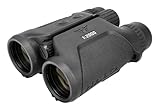
The best binoculars rangefinder combo for most buyers is a 10×42 laser rangefinding binocular with a built-in ballistic solver, such as the Vortex Fury HD 5000 AB or the Sig Sauer KILO3000BDX. Choose the Bushnell Fusion X if you want a lower entry price, and step up to the Leica Geovid Pro, Zeiss Victory RF or Swarovski EL Range only if glass quality and low-light performance justify a premium budget. Optics matter as much as the laser, because a rangefinder you can’t hold steady or see through at dusk is a poor tool.
As an Amazon Associate we earn from qualifying purchases at no extra cost to you.


Top 3 picks at a glance
Quick comparison of the top picks
Specs below follow each manufacturer’s published sheets as I understand them. Ranges are “class” figures, and you should confirm exact numbers for the current model revision before buying.
| Pick | Best for | Key specs | Budget tier |
|---|---|---|---|
| Vortex Fury HD 5000 AB | Best overall for hunters and long-range shooters | 10×42, roughly 2,000-yard ranging class, Applied Ballistics solver, wind and angle-compensated holds | Upper mid-range |
| Sig Sauer KILO3000BDX | Best for app-connected ballistics | 10×42, Bluetooth link to a phone app and compatible Sig scopes, ballistic solver | Upper mid-range |
| Bushnell Fusion X | Best value | 10×42, roughly one-mile ranging class, ballistic modes, angle compensation | Mid-range |
| Leupold BX-4 Range HD TBR/W | Best for lightweight, simple field use | 10×42, True Ballistic Range with wind data, compact rangefinding binocular | Mid-range to upper mid-range |
| Leica Geovid Pro | Best premium for ballistic accuracy | 10×32 and 10×42 versions, integrated ballistic computation, high-end glass | Premium |
| Zeiss Victory RF | Best premium for optical clarity | Premium 10×42 class (larger variants exist), rangefinding with a bright image | Premium |
| Swarovski EL Range | Best for ergonomics and edge-to-edge sharpness | 10×42 class, balanced design, rangefinder built into a wide-field binocular | Premium |
Best overall: Vortex Fury HD 5000 AB
The Fury HD 5000 AB pairs a 10×42 binocular with a laser and the Applied Ballistics solver. You enter your cartridge data once, and the unit returns a hold or dial value after each ranging press. It suits hunters who glass for a long time and want a single device on the chest harness.
Trade-off: It is heavier and bulkier than a 10×32 and costs more than a standalone binocular plus a separate rangefinder. If you rarely shoot past 600 yards, you are paying for capability you won’t use.
Best for app-connected ballistics: Sig Sauer KILO3000BDX
This 10×42 uses Sig’s BDX system. It talks to a phone app and to compatible BDX riflescopes, so the range and holdover can travel from binocular to optic without manual entry. That removes a common source of error: typing a number wrong in cold hands.
Trade-off: The full benefit only appears if you are in the Sig ecosystem or happy to use the app. As a plain binocular it is competent but not at the level of the premium European glass.
Best value: Bushnell Fusion X
The Fusion line has long been the entry point to rangefinding binoculars. The Fusion X offers a 10×42 layout, ballistic modes and angle compensation without a premium price. It is the sensible choice for a first combo or for someone who ranges mostly inside 500 yards.
Trade-off: Expect less light transmission at dusk and a smaller sweet spot than in the premium models. Its ballistic engine is also less customizable than the Applied Ballistics-based units.
Best lightweight option: Leupold BX-4 Range HD TBR/W
Leupold’s BX-4 Range HD TBR/W is a 10×42 aimed at hunters who want a compact, straightforward tool. Its True Ballistic Range function gives an adjusted shot distance, and the wind-capable version adds a holdover estimate for crosswinds.
Trade-off: Reflective-target performance is good, but the ballistic profiles are simpler than a full Applied Ballistics workflow. Serious precision shooters will want more.
Best premium picks: Leica Geovid Pro, Zeiss Victory RF and Swarovski EL Range
Leica Geovid Pro
The Geovid Pro is built around ballistic accuracy, and it comes in a compact 10×32 as well as a 10×42. It suits shooters who value consistent ranging and strong optics in the same housing.
Zeiss Victory RF
The Victory RF is the choice when the image itself is the priority. Its glass is bright and neutral, which helps in the last half hour of legal shooting light.
Swarovski EL Range
The EL Range keeps the balance and wide field of view that the EL family is known for, with a laser built in. Many users find it the most comfortable to hold for long glassing sessions.
Trade-off for all three: Cost. The laser and solver may become dated in a few years, while the glass keeps its value. You are paying for the optics and the long life of the housing.
How to choose: the criteria that actually matter
1. Magnification and objective size
10×42 is the standard because it balances detail with hand stability. Exit pupil is objective diameter divided by magnification: 42 ÷ 10 = 4.2 mm. That is bright enough for dawn and dusk and fits comfortably within a human pupil in low light. A 10×32 gives 3.2 mm, which is noticeably dimmer late in the day but saves weight. A 12×50 gives 4.2 mm as well, but its added shake is difficult to hold without support.
2. Real ranging distance versus the box number
Maximum ranges are quoted on highly reflective targets. As a rule of thumb, animals and brush return a fraction of that. A binocular rated to 2,000 yards on a reflective target might reliably range a deer-sized animal at about 800 to 1,200 yards, depending on light, rain and angle. Pick a model whose rated range is at least double your realistic maximum shot.
3. Worked example: why ranging error matters
Say you shoot a 6.5 Creedmoor at 800 yards. For a typical load, drop changes by very roughly 0.4 to 0.5 MOA for every 10 yards of range error in that region (this varies with the cartridge, velocity and atmosphere). At 800 yards, 1 MOA is about 8.4 inches.
- A 1% ranging error at 800 yards is 8 yards.
- 8 yards is about 0.35 MOA of drop error, or roughly 3 inches at the target.
- A 5-yard error is about 0.2 MOA, around 1.7 inches.
A hunting-sized vital zone is about 8 to 10 inches wide. A few inches of error is acceptable, but pairing it with a wind miscalculation or a shaky hold can push a shot out of the zone. This is why a ballistic solver and consistent ranging beat raw maximum range.
4. Field of view
One degree is about 52.4 feet at 1,000 yards. A binocular listing a 330-foot field at 1,000 yards covers roughly 6.3 degrees. Wider fields make it easier to pick out animals on a hillside, and they matter more than magnification when glassing open country.
5. Ballistic solver and software
Check how you enter data. Apps and Bluetooth are convenient, but a binocular that stores several ballistic profiles on the device lets you switch rifles without a phone. Applied Ballistics-based systems generally provide more custom options, such as drag curves and spin drift.
6. Battery
Most units use a CR2 lithium cell. Check cold-weather behavior: lithium cells hold up much better than alkaline ones below freezing. Carry a spare, and keep it in an inside pocket so that it stays warm.
Decision matrix: match your situation to a pick
| Your situation | Typical shot distance | Recommended class | Why |
|---|---|---|---|
| Whitetail or timber hunting | Under 300 yards | Bushnell Fusion X or a 10×32 compact | Light weight matters more than a long-range solver |
| Western mule deer, elk or sheep | 300–700 yards | Vortex Fury HD 5000 AB or Leupold BX-4 TBR/W | Ballistic holdovers and wind help across open basins |
| Long-range steel and PRS practice | 600–1,200 yards | Sig KILO3000BDX or Vortex Fury HD 5000 AB | Data transfer and profile control reduce entry errors |
| Dawn and dusk glassing | Varies | Zeiss Victory RF or Swarovski EL Range | Better light transmission and a bigger sweet spot |
| Backpack hunts where weight counts | Varies | Leica Geovid Pro 10×32 | Compact housing with premium optics |
| Birding, boating and general use | Under 500 yards | Any 10×42 with simple range-only mode | A ballistic solver adds little |
Common mistakes to avoid
- Buying on maximum range alone. Optical quality and a reliable solver matter more in practice.
- Ignoring weight. A 10×42 rangefinding binocular is heavier than a regular one, and you wear it all day. Try it on a harness before committing.
- Skipping eye relief and IPD checks. If you wear glasses, confirm the eye relief is long enough to see the full field.
- Not verifying range. Check the laser against known distances such as a surveyed fence line or a measured field before the season.
Frequently Asked Questions
Is a binocular rangefinder combo better than separate binoculars and a rangefinder?
It is better for speed and carrying fewer items, because you glass and range without swapping devices. Separate units cost less for equivalent optics, and a dedicated rangefinder is often easier to use on small targets. If you hunt open country, the combo is usually worth it.
What magnification should I choose?
10x is the standard for rangefinding binoculars because it balances detail and steadiness. 8x is easier to hold and has a wider field, while 12x gets difficult to hold without support. Most buyers should pick a 10×42.
How far can I realistically range an animal?
Rated distances are for reflective targets, so a deer-sized animal is often ranged at about half or less of the box number. Weather, light angle and target color all affect the result. Choose a unit rated well beyond your longest shot.
Do I need Bluetooth or app connectivity?
Not necessarily. It helps if you want to transfer profiles or sync with a compatible scope. If you shoot one rifle and know your holds, an on-device solver is simpler and doesn’t depend on a phone battery.
Are premium models like Leica, Zeiss and Swarovski worth the price?
They are worth it if you glass for hours, hunt in low light or want optics that remain relevant for many years. The gain in ranging itself is smaller than the gain in image quality. On a tighter budget, a mid-range model with a good solver covers most shooting needs.
How accurate are binocular rangefinders?
Manufacturers commonly quote accuracy of about one yard at moderate distances and a larger tolerance beyond that. Accuracy varies with target and conditions. Test your unit on known distances so you understand its behavior before relying on it in the field.
Related guides
More from Amazon
Programs that pair well with the guide above. Offers and eligibility are set by Amazon and may change.
A free business account with business pricing and bulk-buying tools for work, shop or home office.
Create a business accountFree shipping on eligible items, Prime Video and more. Eligible new members can start with a free trial.
Start a Prime free trialAudiobooks and podcasts to listen to on the go. Eligible new members can start with a free trial.
Try Audible freeAd-free music streaming. Eligible new subscribers can start with a free trial.
Try Music Unlimited freeAs an Amazon Associate we earn from qualifying purchases.