
At 1080p the RX 6600 and RTX 2070 perform almost identically. TechPowerUp’s launch review found them exactly matched across 25 games. So the choice comes down to everything else. The RX 6600 uses about 40 W less, is shorter and is newer. The RTX 2070 holds up better at 1440p, has stronger ray tracing and supports DLSS upscaling. Buy whichever is cheaper for 1080p. Choose the RTX 2070 if you play at 1440p or rely on upscaling. Choose the RX 6600 for small, quiet or low-wattage builds.
The RTX 2070 launched in October 2018 at $499 as one of Nvidia’s first RTX cards. The RX 6600 followed in October 2021 at $329, positioned by AMD as a 1080p card. Neither is current. The RTX 50 series, Radeon RX 9000 and Intel Arc B570/B580 make up today’s lineups. On the used market, though, these two often sit side by side at similar prices.
As an Amazon Associate we earn from qualifying purchases at no extra cost to you.


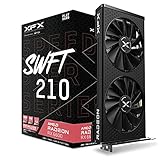
Top 3 picks at a glance
Hardware Comparison
| Specification | GeForce RTX 2070 | Radeon RX 6600 |
|---|---|---|
| Architecture | Turing, 12 nm | RDNA 2.0, 7 nm |
| Released | 17 October 2018 | 13 October 2021 |
| Launch MSRP | $499 | $329 |
| Shader units | 2304 CUDA cores | 1792 stream processors |
| Boost clock | 1620 MHz | 2491 MHz |
| Memory | 8 GB GDDR6, 256-bit | 8 GB GDDR6, 128-bit |
| Bandwidth | 448.0 GB/s | 224.0 GB/s |
| Cache | 4 MB L2 | 2 MB L2 + 32 MB Infinity Cache |
| Interface | PCIe 3.0 x16 | PCIe 4.0 x8 |
| Board power | 175 W | 132 W |
| Power connector | 1x 8-pin | 1x 8-pin |
| Size | 229 mm, 2-slot | 190 mm, 2-slot |
| Outputs | 1x DVI, 1x HDMI 2.0, 2x DP 1.4a, 1x USB-C | 1x HDMI, 3x DisplayPort |
The RTX 2070 has twice the memory bandwidth. The RX 6600 relies on 2.5 GHz clocks and a 32 MB on-die cache. At 1080p the cache covers most memory traffic and the two cards end up level. At 1440p and 4K more requests miss the cache, and the RTX 2070’s wider bus starts to show.
Frame Rates at 1080p and 1440p
TechPowerUp’s RX 6600 launch review was explicit: across its 25-game suite, the RX 6600 matched the RTX 2070 and RX 5700 at 1080p, and the RTX 2060 trailed by about 13%. The same review noted that the RX 6600 loses ground to competitors at 1440p and 4K because of its small Infinity Cache. TechSpot’s review called it RTX 2070-level at 1080p and still close at 1440p in its game selection.
- 1080p: effectively a tie. Individual games swing up to 10-15% either way.
- 1440p: the RTX 2070 generally pulls ahead by a modest margin, roughly 5-10% depending on the review and game mix.
- 4K: neither is a 4K card, but the RTX 2070 degrades more gracefully.
In current demanding games at 1080p with medium-high settings, both typically run around 50-75 FPS. Esports titles easily exceed 144 FPS. These figures vary with settings, CPU and game patch.
Ray Tracing and Upscalers
With ray tracing enabled, the RTX 2070 usually leads. Its first-generation RT cores handle heavier workloads better than the RX 6600’s ray accelerators. On both cards, ray tracing at 1080p realistically needs upscaling, and path-traced modes are out of reach.
Upscaling is where the RTX 2070 gains the most. It supports DLSS Super Resolution, including the DLSS 4 transformer model that Nvidia made available on RTX 20 series GPUs. At 1080p output, where upscalers have little data to work with, DLSS generally looks noticeably sharper and more stable than FSR 2/3. The RTX 2070 does not get DLSS Frame Generation, which requires RTX 40 or newer.
The RX 6600 uses FSR 3.1 with frame generation in supported titles, plus AMD Fluid Motion Frames 2, which adds driver-level frame generation to many DirectX 11 and 12 games. FSR 4 is officially reserved for RDNA 4 cards. If you want smoother motion in single-player games, the RX 6600’s frame generation options are a genuine plus. If you want the best image quality at a given frame rate, DLSS gives the RTX 2070 the edge.
8 GB on Both: Where It Bites
Both cards have 8 GB, so neither has a VRAM advantage. How they behave when memory runs out does differ. The RX 6600 uses a PCIe 4.0 x8 link. On a PCIe 3.0 motherboard, common with Intel 9th/10th-gen and AMD B450 systems, the link is halved, so when a game exceeds 8 GB the RX 6600 tends to stutter more than the full-x16 RTX 2070. On a PCIe 4.0 or 5.0 board this matters much less.
General VRAM guidance for 2026 games: 8 GB is adequate at 1080p with high textures in most titles, and some need one step lower. At 1440p, 10-12 GB or more avoids most compromises. For new purchases aimed at 1440p, current 16 GB cards such as the RX 9060 XT 16 GB or RTX 5060 Ti 16 GB are worth the extra money.
Running Cost, PSU and Size
The RX 6600 is the more efficient card, at 132 W against 175 W. Both use a single 8-pin connector. PSU sizing with GPU + CPU + about 150 W headroom:
- RTX 2070 with a 105 W CPU: 175 + 105 + 150 = 430 W, so a quality 500-550 W unit
- RX 6600 with a 105 W CPU: 132 + 105 + 150 = 387 W, so a quality 450 W unit is enough
That 43 W difference amounts to about 45 kWh a year at 20 gaming hours a week. The cost is small, but the lower heat output makes a difference in compact cases. The RX 6600’s 190 mm length (and many short single- or dual-fan partner models) fits most mini-ITX cases. The RTX 2070 reference length is 229 mm, and triple-fan partner versions can be considerably longer.
Output choice can matter too. The RTX 2070’s DVI port helps if you still use an older DVI-only monitor. The RX 6600’s three DisplayPorts suit multi-monitor setups with modern displays.
Value Math
Launch MSRP cost per performance at 1080p, with the cards treated as equal (both = 100):
- RTX 2070: $499 / 100 = $4.99 per point
- RX 6600: $329 / 100 = $3.29 per point
The RX 6600 launched with about 34% lower cost per frame for the same performance. In 2026 both are mostly bought used. The RX 6600 usually sells in the $120-$170 range and the RTX 2070 around $130-$190, depending on condition and model. With performance this even, the cheaper listing in good condition is usually the right one. Pay a small premium for the RTX 2070 only if DLSS or 1440p matters to you.
Used Buying Checklist
- RTX 2070 cards are now six to eight years old, so check fan bearings and temperatures under load.
- Both models were used for mining. That is not automatically bad, but look for signs of heat damage or dried thermal pads.
- Confirm you are buying a plain RTX 2070, not an RTX 2070 Super, which is faster and usually priced higher. Likewise, check RX 6600 versus RX 6600 XT.
Quick Verdict Table
| Scenario | Pick |
|---|---|
| 1080p, lowest price wins | Whichever is cheaper |
| 1440p gaming | RTX 2070 |
| Upscaling image quality (DLSS 4) | RTX 2070 |
| Frame generation in many games | RX 6600 (FSR 3.1 + AFMF 2) |
| Mini-ITX or 450 W PSU | RX 6600 |
| PCIe 3.0 motherboard | RTX 2070 |
This matchup is a draw in frame rate and a choice of ecosystem. The RTX 2070 is the better-rounded card for 1440p and upscaling. The RX 6600 is the better fit for compact, efficient 1080p builds.
Frequently Asked Questions
Is the RX 6600 as fast as the RTX 2070?
At 1080p, yes. TechPowerUp’s launch review found the RX 6600 matched the RTX 2070 exactly across its 25-game test suite. At 1440p and 4K the RTX 2070 tends to pull slightly ahead because of its wider memory bus.
Which card is better for ray tracing?
The RTX 2070 generally performs better with ray tracing enabled, and DLSS helps it recover frame rate. The RX 6600 supports ray tracing but with weaker hardware. On both cards, RT at 1080p usually requires upscaling to stay playable.
Can the RX 6600 run on a 450 W power supply?
Yes. With a typical gaming CPU, a quality 450 W unit gives enough headroom for the RX 6600’s 132 W board power. It needs a single 8-pin PCIe connector, as does the RTX 2070, which is better paired with a 500-550 W unit.
Does the RX 6600 lose performance on PCIe 3.0?
In most games the loss is small, typically a few percent. It grows when a game exceeds the 8 GB of VRAM, because the card’s x8 link runs at half speed on PCIe 3.0. Lowering texture quality usually avoids the problem.
Should I buy one of these or a current budget card?
If used prices are low, either card is a sensible 1080p option. Current cards such as the Intel Arc B570/B580, RTX 5050 or RX 9060 XT offer newer features, more VRAM on some models and longer driver support. Compare total cost before deciding.

