The best college student desk for most people is a sturdy fixed-height desk about 47 to 55 inches wide and 24 to 30 inches deep, with a solid frame that does not wobble. Choose a compact 36 to 40 inch desk if your dorm is tight, and an electric sit-stand desk only if you have a permanent off-campus spot and the budget. Measure your room, your bed and your monitor setup before you buy, because most bad desk purchases fail on size, not style.
As an Amazon Associate we earn from qualifying purchases at no extra cost to you.



Our Top Picks
Top 3 picks at a glance
Quick comparison of the best desk types for students
These are spec classes rather than single models, because dorm furniture changes by retailer every semester. Price bands are general market ranges.
| Pick | Best for | Key specs | Price range |
|---|---|---|---|
| Best overall: standard workstation desk | Laptop plus one monitor, off-campus apartments | 47–55 in wide, 24–30 in deep, about 29–30 in tall, 100+ lb load rating | Mid-range |
| Best budget: compact writing desk | Tight dorms, laptop-only study | 36–40 in wide, 20–24 in deep, 60–100 lb load rating | Budget |
| Best for small rooms: wall-mounted or fold-down desk | Shared rooms, studio apartments | 30–40 in wide, 16–22 in deep, wall studs required | Budget to mid-range |
| Best for gaming and multi-monitor: large desk | Desktop PC, two monitors, off-campus | 55–63 in wide, 27–30 in deep, 150+ lb load rating | Mid-range to premium |
| Best adjustable: electric sit-stand desk | Long study sessions, shared use, multi-year ownership | Lift range about 25–50 in, 150–300 lb capacity, memory presets | Mid-range to premium |
Best overall: the standard workstation desk
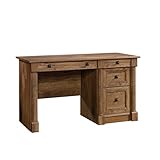
A desk around 48 inches wide and 24 to 30 inches deep is the most useful size for a student. It fits a laptop, a 24 to 27 inch monitor, a notebook and a lamp without crowding. Look for a steel or thick-board frame, a leveling foot on each leg, and a tabletop at least 0.7 inches thick so it does not flex under typing.
Who it suits: students in apartments or larger dorm rooms who study mostly at the desk. Trade-off: it takes 4 to 5 square feet of floor and is often too wide for a standard dorm, so check your room dimensions first.
Best budget: the compact writing desk
A 36 to 40 inch desk with a 20 to 24 inch depth covers a laptop and notes for the least money. Many include a small shelf or one drawer. Check the stated load rating in the manufacturer’s spec sheet: a 60 lb rating is fine for a laptop but poor for a desktop monitor plus speakers.
Who it suits: first-year students in furnished dorms who want a second surface or a backup. Trade-off: a 20 inch depth puts a monitor too close to your eyes, so it works best with a laptop only.
Best for small rooms: wall-mounted and fold-down desks
Fold-down desks free the floor when you are not working. They need wall studs, and most dorms prohibit drilling, so they mainly suit off-campus rentals where the landlord allows it. Free-standing alternatives include slim console-style desks and bed-side rolling tables, which are cheaper and need no installation.
Trade-off: weight limits are usually lower and the depth is shallow, so treat these as laptop desks, not full workstations.
Best for gaming and multi-monitor setups: the large desk
If you bring a desktop PC, two monitors or a gaming laptop with a cooling pad, go for 55 inches wide or more and 27 inches deep or more. This size lets you keep a monitor 24 to 30 inches from your eyes and still have room for a keyboard and mouse pad. Our gaming desk guides cover heat and cable routing in more depth, but the core need is the same: width, depth and a frame that does not shake your monitor when you type.
Trade-off: a large desk can swallow a dorm room. In a 12 by 14 foot double room, a 60 inch desk leaves little walking space.
Best adjustable: electric sit-stand desks
Electric sit-stand desks such as the FlexiSpot E7 and the UPLIFT V2 are examples of the class. They run on a motorized frame with memory presets, and the better ones use dual motors for stability. Check the lift range: you want the lowest setting to match your seated elbow height and the highest to match your standing elbow height.
Who it suits: students who stay in one place for several years, or who share a desk with a roommate of a different height. Trade-off: it costs several times more than a basic desk, needs a power outlet, and is heavy to move at the end of the year.
How to choose: the numbers that matter
1. Do the floor-space math first
A standard extra-long twin dorm bed is about 38 by 80 inches, per most university housing guidelines. In a typical 12 by 14 foot room (144 by 168 inches), each roommate usually gets a bed, a wardrobe and a desk. Here is a worked example for one side of a double room:
- Room width: 144 in. Bed: 38 in. Wardrobe: about 24 in.
- Remaining: 144 − 38 − 24 = 82 in, split between two roommates if the desks share a wall.
- Walking path you want: at least 30 in. That leaves about 52 in, so a 48 in desk fits with little to spare and a 60 in desk does not.
Always confirm your actual room’s layout and whether furniture is bolted or provided before buying anything.
2. Match desk height to your body
Your forearms should be roughly level with the desk when your shoulders are relaxed. A rough guide for fixed desks, based on common ergonomic recommendations:
| Your height | Seated desk height | Standing desk height (approx. 0.63 × height) |
|---|---|---|
| 5 ft 2 in (62 in) | 26–28 in | about 39 in |
| 5 ft 6 in (66 in) | 27–29 in | about 42 in |
| 5 ft 10 in (70 in) | 28–30 in | about 44 in |
| 6 ft 2 in (74 in) | 29–31 in | about 47 in |
Most fixed desks are about 29 to 30 inches tall, which suits people around 5 ft 8 in to 6 ft. Shorter users should use an adjustable chair with a footrest, and taller users may want leg risers if the desk is not adjustable. These figures are estimates and vary with chair height and arm length.
3. Check the power budget
Most student setups draw far less than a power strip can handle, but dorm rules often cap what you can plug in. A typical load:
- Laptop charger: 65 W (a gaming laptop can need 180–240 W)
- 27-inch monitor: about 30 W
- Desk lamp (LED): 10 W
- Phone charger: 20 W
- Sit-stand motors (while moving): about 100 W, near zero at rest
With a standard laptop, that totals about 125 W. With a gaming laptop it is about 300 W. A common 15 A, 120 V strip is rated for about 1,800 W, but many dorms require surge protectors with a built-in breaker and ban daisy-chaining. Choose a desk with a grommet hole or cable tray, because a dorm outlet may be 4 to 6 feet away.
4. Decision matrix: your situation to the right desk
| Your situation | Choose | Why |
|---|---|---|
| Small dorm, laptop only | 36–40 in compact desk | Fits the 52 in space budget with room to walk |
| Double room, one monitor | 47–48 in standard desk | 24 in depth fits a 24 in monitor at a workable distance |
| Off-campus apartment, desktop PC | 55–63 in large desk | Space for two monitors and a tower beside the desk |
| Back or neck pain, long study hours | Electric sit-stand desk | Lets you alternate positions across the day |
| Short lease, frequent moves | Lightweight flat-pack desk | Easier to disassemble and carry |
| Landlord allows drilling, studio apartment | Fold-down wall desk | Frees floor space when not in use |
5. Stability and materials
Wobble is the most common complaint with cheap desks. A steel frame with a crossbar and adjustable feet handles uneven floors and typing vibration better than particleboard legs. Thicker tops (0.7 to 1 inch) resist sagging under monitors. If the listing gives a load rating, divide it by your gear weight: a laptop (about 4 lb), monitor (about 10 lb), speakers and books easily reach 30 to 40 lb, so a 100 lb rating leaves a comfortable margin.
6. Storage and extras worth paying for
- Cable management: a grommet or tray prevents tangles and accidental unplugging.
- Drawer or shelf: useful if your dorm provides little storage, but avoid a drawer that cuts legroom below about 24 inches of clearance.
- Legroom: at least 24 inches of knee space width and 25 inches of height.
- Surface finish: matte surfaces hide scratches and reduce glare better than glossy ones.
Frequently Asked Questions
What size desk is best for a college dorm?
A desk 36 to 48 inches wide and 20 to 24 inches deep fits most dorm rooms. If you use a monitor, aim for at least 24 inches of depth so the screen sits a comfortable distance from your eyes. Measure your layout first, since beds, wardrobes and bolted furniture reduce the usable wall space.
Is a standing desk worth it for a college student?
It can be, if you will stay in the same place for several years and spend long hours at your desk. It is harder to justify for a single dorm year because of cost, weight and the need for a power outlet. A basic fixed desk plus a good chair is a better value for most first-year students.
Can I use my own desk in a dorm?
Often yes, but check your housing rules first. Many universities provide a built-in or standard desk and may ask you not to remove it, and some limit furniture size or prohibit lofting or modifying existing pieces. If the dorm desk is not removable, a small add-on surface or a desktop riser is a safer option.
How deep should a student desk be for a monitor?
A depth of 24 to 30 inches works for most 24 to 27 inch monitors. This places the screen roughly 20 to 28 inches from your eyes, which is the range commonly recommended for comfortable viewing. A 20 inch depth works with a laptop but is tight with a desktop monitor.
What is the best desk for a student with a gaming laptop?
Pick a desk at least 48 inches wide and 24 inches deep, with a sturdy frame and a cable path, because gaming laptops use heavy 180 to 240 W chargers and run warm. Leave room on the desk for a laptop stand or cooling pad and for an external mouse. Avoid very thin tops that flex or glossy finishes that glare under bright lighting.
Should I buy a desk with a hutch or shelves?
Only if floor space is the main constraint and you need to stack storage vertically. Hutches reduce monitor placement flexibility and add weight and wobble risk. A simple desk with a wall shelf or a separate shelving unit is often easier to rearrange and move.
Related guides
More from Amazon
Programs that pair well with the guide above. Offers and eligibility are set by Amazon and may change.
A free business account with business pricing and bulk-buying tools for work, shop or home office.
Create a business accountFree shipping on eligible items, Prime Video and more. Eligible new members can start with a free trial.
Start a Prime free trialAudiobooks and podcasts to listen to on the go. Eligible new members can start with a free trial.
Try Audible freeAd-free music streaming. Eligible new subscribers can start with a free trial.
Try Music Unlimited freeAs an Amazon Associate we earn from qualifying purchases.