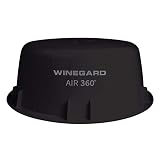
For over-the-air TV, the best antenna for most campers is a roof-mounted omnidirectional unit such as the Winegard Air 360+ or the Winegard Batwing. They pick up stations from every direction without cranking or aiming at each campsite. If you mostly camp near cities, a King Jack-style directional antenna with an LTE filter or a simple indoor Mohu Leaf can cover you for less money. If your real problem is cell data or internet, a TV antenna won’t help, and you need a cellular booster such as the weBoost Drive Reach RV or a portable satellite dish such as Starlink Mini.
“Antenna for a camper” covers three different jobs: broadcast TV, cell signal and Wi-Fi/internet. This guide ranks picks for each and explains how to choose with numbers rather than manufacturer range claims.
As an Amazon Associate we earn from qualifying purchases at no extra cost to you.


Our Top Picks
Top 3 picks at a glance
Quick comparison of the picks
| Pick | Best for | Type / key specs | Price range |
|---|---|---|---|
| Winegard Air 360+ | Best overall TV antenna | Omnidirectional, roof or pole mount, built-in amplified output, VHF + UHF | Mid-range |
| Winegard Batwing | Best for fringe areas and rough roads | Omnidirectional “batwing” design, powered by a 12V amplifier, VHF + UHF | Mid-range |
| King Jack | Best for cell-tower interference | Directional, built-in booster, LTE filter, manual rotation | Mid-range |
| Mohu Leaf (indoor flat antenna) | Best budget / weekend trips | Passive flat panel, window or wall mount, no power needed | Budget |
| weBoost Drive Reach RV | Best cell signal booster | Vehicle booster kit with outside antenna, inside antenna and amplifier | Premium |
| Starlink Mini | Best for no-cell-coverage camping | Portable satellite dish, typically 20–40 W draw per Starlink’s published figures | Premium, plus monthly plan |
| Wi-Fi extender with roof antenna (Winegard ConnecT class) | Best for campground Wi-Fi | Roof-mounted Wi-Fi receiver that rebroadcasts inside the RV | Mid-range to premium |
Best overall: Winegard Air 360+
The Air 360+ is a low-profile omnidirectional antenna. It suits campers who move every few days and don’t want to crank a mast or point a dish at a tower. You mount it once, run coax to your TV or signal-splitter, and rescan channels at each new site. Winegard’s spec sheet describes it as a VHF and UHF design with a built-in amplifier.
Trade-off: An omnidirectional antenna listens to everything, including noise and multipath reflections. A good directional antenna can beat it on a single distant station. In weak-signal areas, omnidirectional models also lose margin because their gain is lower than a directional design.
Best for fringe areas: Winegard Batwing
The Batwing is a long-running roof antenna with a distinctive two-wing shape. It is built for campers who regularly park well outside city limits. It pairs a 360-degree pattern with a powered amplifier, which helps when the coax run is long or you split the signal to a bedroom TV. Its fixed mounting is sturdy for washboard roads.
Trade-off: It needs 12V power for the amplifier and wiring access. If the amplifier loses power, the signal usually drops. It is also a larger roof fixture than a flat antenna.
Best near cell towers: King Jack
The King Jack is a directional antenna with a built-in booster, and it includes LTE filtering. That matters because 4G and 5G cell signals sit close to TV frequencies and can overload an amplified antenna near a tower. If you camp in busy suburban areas and see pixelation on strong stations, an LTE filter is often more useful than extra gain.
Trade-off: You have to aim it. In a campground where TV towers are in different directions, you’ll spend time rotating and rescanning.
Best budget: indoor flat antenna such as the Mohu Leaf
For short trips near a city, a flat indoor antenna taped to a window is enough. It needs no roof work and no power, and you can take it home. Place it as high as possible, and facing the towers if you know where they are.
Trade-off: Metal RV walls and insulated windows can heavily attenuate the signal. Indoor antennas work best on fiberglass campers with plenty of window area and a strong local signal.
Best for cell coverage: weBoost Drive Reach RV
A cellular booster is the right answer if work calls or streaming are your priority. The Drive Reach RV class of booster uses an outside antenna, an amplifier and an inside antenna, so it improves coverage for phones and hotspots inside the camper. Per the manufacturer’s information, boosters in this class are designed for vehicle use and boost multiple carriers at once.
Trade-off: A booster amplifies an existing signal. It can’t create service where there’s none. Keep the inside and outside antennas well separated to avoid oscillation, which will shut the booster down.
Best for remote camping: Starlink Mini
If you camp where there is neither TV nor cell coverage, a portable satellite dish is the practical option. Starlink Mini is small enough to carry in a bag, and Starlink’s published figures put typical power draw at roughly 20–40 W, which a camper’s battery system can handle. You need a clear view of the sky and a roaming or mobile plan.
Trade-off: It is the most expensive route, it is not a TV antenna, and trees ruin it. Check your plan’s portability terms before you rely on it.
Best for campground Wi-Fi: roof Wi-Fi extender
Campground Wi-Fi is usually weak at your pitch because the router is far away. A roof-mounted Wi-Fi receiver, such as the Winegard ConnecT class, picks up the signal outside and rebroadcasts it inside through your own router. This can turn an unusable connection into a stable one. It is a good match for people who stay for weeks at managed sites.
Trade-off: It can only extend what the campground provides. If the campground’s backhaul is slow or congested, you’re improving the link to a bad connection.
How to choose: decision matrix
| Your situation | Choose | Why |
|---|---|---|
| Moving every 1–3 days, mixed locations, want free TV | Omnidirectional roof antenna (Air 360+) | No aiming, rescan only |
| Parked in rural areas, stations 40+ miles away | Batwing or a directional antenna on a mast | Better gain and amplifier headroom |
| Parked near cities with cell-tower pixelation | LTE-filtered antenna (King Jack) | Filters out cellular overload |
| Weekend trips, strong local stations | Indoor flat antenna | Cheapest, no installation |
| Remote work, weak but present cell signal | Cell booster (weBoost Drive Reach RV) | Improves existing bars |
| No cell, no Wi-Fi, remote locations | Starlink Mini | Independent of ground infrastructure |
| Long stays at managed sites | Roof Wi-Fi extender | Gets campground Wi-Fi to your seat |
Worked example: will your antenna reach the tower?
TV signals travel roughly in line of sight. A common approximation for the radio horizon in miles is 1.23 × (√antenna height in feet + √tower height in feet).
- Antenna on a camper roof at 12 ft: √12 ≈ 3.5
- Broadcast tower at 1,000 ft: √1,000 ≈ 31.6
- Horizon: 1.23 × (3.5 + 31.6) ≈ 43 miles
Raising the antenna to 30 ft on a mast adds only a few miles: √30 ≈ 5.5, so 1.23 × (5.5 + 31.6) ≈ 46 miles. Hills, trees and the camper’s own metal body cost far more than extra height. A 43-mile horizon is an upper bound, not a promise of reception.
Cable loss and splitters
Every foot of coax and every splitter eats signal. Typical RG6 loses about 5–6 dB per 100 ft at UHF frequencies, a figure commonly quoted by cable manufacturers. A 25 ft run costs about 1.5 dB. A two-way splitter costs about 3.5 dB, and a three-way about 5–7 dB. If your antenna delivers a marginal signal and you split to two TVs, the lost 3.5 dB can push a station from stable to broken. This is why a powered amplifier matters if you feed multiple TVs.
Battery runtime for powered gear
Power draw is easy to underestimate. A 12V battery rated 100 Ah holds about 1,200 Wh. LiFePO4 can usually use around 1,000 Wh of that. A Starlink Mini drawing about 30 W would run about 33 hours (1,000 ÷ 30). A TV antenna amplifier draws only a few watts at most, so it is negligible on a camper battery. A cellular booster typically draws well below the dish.
Mistakes that make a good antenna perform badly
- Skipping the rescan. Channel lists don’t update themselves. Run a fresh scan at every site.
- Buying a UHF-only antenna. Many US stations still use VHF channels 7–13. An antenna that ignores VHF will miss some of them.
- Ignoring the tuner. Some stations now broadcast ATSC 3.0 (NextGen TV). Older tuners can’t decode all of it. Check what your TV supports.
- Mounting next to metal. Air conditioners and vent pipes cause reflections. Keep the antenna clear if possible.
- Wrong tool for the problem. No TV antenna will fix slow internet, and a cell booster won’t improve TV.
Frequently Asked Questions
What is the best TV antenna for an RV or camper?
For most owners, a roof-mounted omnidirectional antenna like the Winegard Air 360+ is the easiest to live with because it needs no aiming. For rural locations, the Winegard Batwing or a directional mast antenna provides more margin. Pick based on how far you usually are from towers.
Do I need an amplified antenna for a camper?
You need an amplifier if your signal is weak, your coax run is long or you split to several TVs. Near towers, an amplifier can overload the tuner and make reception worse, so choose an antenna with a switchable or LTE-filtered amplifier. If your signal is strong, skip the extra gain.
Will a TV antenna help with internet or cell service?
No. TV antennas receive broadcast signals only. For cell service, you need a booster such as the weBoost Drive Reach RV, and for places without coverage, a satellite option like Starlink Mini. For campground Wi-Fi, use a roof-mounted Wi-Fi extender.
Is an indoor antenna good enough for camping?
It can be, if you camp near cities in a fiberglass or wood-framed camper with large windows. Metal siding and thermal glass reduce signal strength noticeably. If you get few channels, move it higher or to another window before buying anything else.
How far can a camper antenna pick up TV stations?
Manufacturers often quote ranges of 30–50 miles or more, but real reception depends on terrain and obstacles. Line-of-sight physics puts the practical limit for a roof antenna at roughly 40–45 miles for a tall tower. Treat claimed ranges as best-case numbers.
Can I use a booster and a Starlink dish together?
Yes, they handle different jobs. A booster improves cellular service for phones, while a satellite dish provides separate internet access through its own link. Many full-time campers carry both so that one covers for the other.
Related guides
More from Amazon
Programs that pair well with the guide above. Offers and eligibility are set by Amazon and may change.
A free business account with business pricing and bulk-buying tools for work, shop or home office.
Create a business accountFree shipping on eligible items, Prime Video and more. Eligible new members can start with a free trial.
Start a Prime free trialAudiobooks and podcasts to listen to on the go. Eligible new members can start with a free trial.
Try Audible freeAd-free music streaming. Eligible new subscribers can start with a free trial.
Try Music Unlimited freeAs an Amazon Associate we earn from qualifying purchases.