The best animal toy sets for most families are hand-painted figure collections such as Schleich’s Wild Life and Farm World ranges, because they balance realism, durability and a wide choice of species. For younger children, chunky building or wooden sets such as LEGO DUPLO animals are safer. For bulk variety on a budget, Safari Ltd Toobs are the usual choice. The right pick depends on the child’s age, the scale you want and whether the animals will be played with or displayed.
This is a toy guide on a hardware site, so it focuses on measurable things: figure size, scale, piece counts, safety limits and how sets fit together with gaming hardware such as Nintendo’s NFC figures. Product lines and sizes below come from the manufacturers’ own descriptions, so confirm the exact contents and age label on the box before buying.
As an Amazon Associate we earn from qualifying purchases at no extra cost to you.



Top 3 picks at a glance
Quick comparison of the best animal toy sets
| Pick | Best for | Key specs | Price tier |
|---|---|---|---|
| Schleich Wild Life / Farm World figures | Best overall, realistic play | Hand-painted solid figures, roughly 2–8 inches depending on species, usually labelled 3+ or 5+ | Mid-range per figure |
| Safari Ltd Toobs | Best budget variety | Themed tube of small figures, typically around 8–15 per tube, mostly 1–3 inches, labelled 3+ | Budget |
| LEGO Creator 3-in-1 animal sets | Best for building | Three animal models from one set, piece counts vary by set, mostly labelled 7+ or 8+ | Mid-range |
| LEGO DUPLO animal sets | Best for toddlers | Large bricks that do not fit through the small-parts test, many sets labelled from 18 months or 2+ | Budget to mid-range |
| Breyer Classics and Stablemates horses | Best for collectors | Classics 1:12 scale, Stablemates 1:32 scale | Budget (Stablemates) to mid-range (Classics) |
| Calico Critters sets | Best for pretend-play houses | Flocked, posable small animal families with furniture and homes, labelled 3+ | Mid-range to premium for large playsets |
| Animal Crossing amiibo cards and figures | Best for gamers | NFC-enabled, work with Animal Crossing games on supported Nintendo consoles | Budget (cards) to mid-range (figures) |
Best overall: Schleich Wild Life and Farm World sets
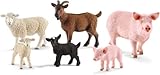
Schleich figures are solid, hand-painted and anatomically detailed, with starter sets pairing a few animals with a few accessories. They suit ages from roughly 3 to the early teens and survive years of rough play. The trade-off is cost per figure: they are usually priced above bulk tubes, and the figures are not to a single scale, so a lion and a giraffe look right together but a mouse and an elephant do not. Buy a themed set (farm, jungle, wildlife rescue) rather than single figures, since sets generally cost less per animal.
Best budget: Safari Ltd Toobs
A Toob packs a themed assortment (farm, ocean, dinosaurs, North American wildlife, insects) into a reusable tube, which also solves storage. The figures are small and less detailed than Schleich, but you get far more species for the money. This is the best choice for classrooms, party favours and children who like sorting and naming animals. The trade-off is size: at 1–3 inches, some pieces are small enough to be a hazard for under-3s, so check the age label.
Best for building: LEGO Creator 3-in-1 animal sets
These give three different animal builds from one box, which suits children who tire of a static toy. The trade-off is durability during rough play: built animals come apart, and they are less suited to farm-and-zoo storytelling than fixed figures. Piece counts range widely between sets, so match the count to the builder’s age; a set marked 7+ is a poor fit for a five-year-old, even a keen one.
Best for toddlers: LEGO DUPLO animals or wooden sets
Toddler sets should be large enough to fail the small-parts test (see the safety table below). DUPLO animal sets and solid wooden animal sets from brands like Melissa and Doug use big, rounded shapes. The trade-off is realism: proportions are simplified, so these are not good for children who want accurate species.
Best for collectors: Breyer horses
If the interest is horses, Breyer’s published scales make collecting predictable. Classics are 1:12 and Stablemates are 1:32, so you can plan a display. The trade-off is that the range is narrow (mostly horses and farm animals), and detailed models are fragile compared with play-grade figures.
Best for pretend-play houses: Calico Critters
Calico Critters suit children who want families, homes and stories rather than realistic wildlife. Figures are small and flocked (a soft fuzzy coating), so they are less wipe-clean than solid PVC. Accessories are tiny, which makes them better for ages 3+ with supervision and a dedicated play tray.
Best for gamers: Animal Crossing amiibo
Animal Crossing amiibo cards and figures use NFC, so a villager can be scanned in supported Animal Crossing games on Nintendo consoles. Nintendo lists which games and consoles support which amiibo, so check compatibility for your specific console and game before buying. The trade-off is that they are collectibles first and toys second: cards are fragile and small, and figures are less rugged than play-grade animals.
Worked example: why scale matters when mixing sets
Most animal figure lines are not to a consistent scale, but you can calculate whether sets will look right together. Divide the real animal’s size by the scale ratio.
- A horse about 15 hands tall (60 inches at the withers): at 1:12 it is 60 ÷ 12 = 5 inches; at 1:32 it is 60 ÷ 32 ≈ 1.9 inches.
- An African elephant with a shoulder height of about 10 feet (120 inches): at 1:32 it is 120 ÷ 32 = 3.75 inches; at 1:12 it is 120 ÷ 12 = 10 inches.
- A house cat about 10 inches at the shoulder: at 1:32 it is about 0.3 inches, which is why a true-to-scale mix of pets and wildlife is impractical.
The takeaway: a 1:12 horse beside a 1:32 elephant would make the horse nearly 1.3 times the elephant’s height (5 versus 3.75 inches in the first two bullets). If you want a consistent display, stay within one scale or one brand line.
Shelf planning follows the same logic. If your figures are about 3 inches wide and you leave half an inch between them, a 36-inch shelf holds 36 ÷ 3.5 ≈ 10 per row.
Safety limits that decide the age range
| Check | Number or standard | What it means |
|---|---|---|
| US small-parts cylinder | About 1.25 inches in diameter and 1 to 2.25 inches deep | If a toy or detached part fits inside, it is a choking hazard for children under 3 |
| Toy safety standard (US) | ASTM F963, referenced by CPSC rules | Look for a compliance statement on the box or product page |
| Toy safety standard (EU/UK) | EN 71 and the CE or UKCA mark | Required for toys sold in those markets |
| Age label | 3+ for most small figures, 18 months+ for large-brick sets | Treat as a safety limit, not a skill suggestion |
How to choose: decision matrix
| Your situation | Choose | Why |
|---|---|---|
| Child under 3 | DUPLO or large wooden animals | Pieces exceed the small-parts cylinder |
| Ages 3–6, rough play | Schleich themed sets | Solid, durable and easy to wipe clean |
| Classroom, party or lots of species | Safari Ltd Toobs | Most animals for the least spend |
| Ages 7+ who like building | LEGO Creator 3-in-1 | Three models per box, with rebuild value |
| Horse-focused collector | Breyer Classics or Stablemates | Published scales make displays consistent |
| Storytelling with houses and families | Calico Critters | Furniture, homes and character families |
| Plays Animal Crossing on Nintendo | amiibo cards or figures | Adds in-game functions via NFC |
Three checks before you buy
- Confirm the scale or size. Look for stated inches or a scale ratio, and avoid mixing lines if proportions matter.
- Count what you are actually getting. Divide the set’s price tier by the number of figures; a mid-range set of 3 animals can be worse value than a budget tube of 12 if you want variety.
- Check materials and care. Solid vinyl wipes clean, flocked figures do not, and wooden sets should not be soaked.
Frequently Asked Questions
What age are animal toy sets suitable for?
Large-brick and wooden sets are generally made for children from about 18 months, while small figure sets are typically labelled 3+ because of choking hazards. Always follow the age grade on the box. It reflects safety testing, not just difficulty.
Are Schleich figures worth the money?
For children who play with animals regularly, yes, because they are solid, detailed and long-lasting. They are not the cheapest per figure, so a bulk tube is better if you mainly want variety. Hand-me-down value is also high because the paint and plastic hold up well.
Do animal toy sets come in a consistent scale?
Generally not. Most lines scale each animal for play value, so a mouse is bigger than true scale next to a horse. Breyer is a notable exception, publishing scales such as 1:12 for Classics and 1:32 for Stablemates.
Do Animal Crossing amiibo work on every Nintendo console?
Support depends on the game and the console. Nintendo publishes compatibility information for amiibo, so check that list for your specific game before buying. Cards generally need an NFC reader, which varies between consoles and accessories.
How should I store and clean animal figures?
Solid PVC figures can usually be washed in lukewarm soapy water and air-dried. Flocked figures, wooden sets and electronics-linked collectibles should be wiped with a damp cloth only. A divided tray or the tube from a Toob prevents small pieces getting lost.
Related guides
More from Amazon
Programs that pair well with the guide above. Offers and eligibility are set by Amazon and may change.
A free business account with business pricing and bulk-buying tools for work, shop or home office.
Create a business accountFree shipping on eligible items, Prime Video and more. Eligible new members can start with a free trial.
Start a Prime free trialAudiobooks and podcasts to listen to on the go. Eligible new members can start with a free trial.
Try Audible freeAd-free music streaming. Eligible new subscribers can start with a free trial.
Try Music Unlimited freeAs an Amazon Associate we earn from qualifying purchases.