The best cube PC case for most builders is the Fractal Design Node 804 if you want drive space and a micro-ATX board in a compact box, and the Cooler Master Qube 500 Flatpack if you want to fit a full ATX board and a long GPU. Smaller mini-ITX builds are better served by the Thermaltake Core V1 or the Lian Li Q58. The right choice depends on three numbers: your motherboard size, your graphics card length, and your CPU cooler height.
As an Amazon Associate we earn from qualifying purchases at no extra cost to you.
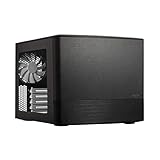
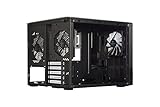
Quick comparison of the best cube PC cases
Dimensions and clearances below are approximate and based on manufacturer spec sheets. Revisions and regional variants differ, so confirm against the current spec page before buying.
| Pick | Best for | Board support | Approx. GPU clearance | Approx. CPU cooler limit | Price tier |
|---|---|---|---|---|---|
| Fractal Design Node 804 | Storage-heavy micro-ATX builds | Micro-ATX, mini-ITX | About 320 mm | About 160 mm | Mid-range |
| Cooler Master Qube 500 Flatpack | Full ATX in a cube, modders | ATX, micro-ATX, mini-ITX | About 400 mm | About 165 mm | Mid-range |
| Thermaltake Core V1 | Small, cheap mini-ITX builds | Mini-ITX | About 255 mm | About 140 mm | Budget |
| Lian Li Q58 | Compact mini-ITX with a long GPU | Mini-ITX | About 300 mm class | Low-profile to mid air coolers | Mid-range |
| Lian Li A3-mATX | Airflow-first micro-ATX | Micro-ATX, mini-ITX | About 415 mm | About 165 mm | Mid-range |
Best overall: Fractal Design Node 804
The Node 804 is a long-running micro-ATX cube with two chambers. The motherboard and GPU sit on one side and the PSU and drives on the other, which keeps cable clutter away from airflow. Per Fractal’s spec sheet it has room for a large stack of 3.5-inch and 2.5-inch drives, plus mesh panels and filtered intakes.
Who it suits: a gaming PC that also serves as a NAS or media-and-backup machine, or anyone who wants a quiet mid-power build with lots of storage.
Trade-off: it is not small. At roughly 40 litres it is bigger than many ITX towers, and the GPU limit means the very longest triple-fan cards will not fit with the front fans in place.
Best for a full ATX board: Cooler Master Qube 500 Flatpack
The Qube 500 is one of the few cubes that accepts a full ATX motherboard. The Flatpack version ships as a kit and can be assembled in different layouts. The open frame gives a lot of GPU and radiator room, and the spec sheet lists clearance for graphics cards around the 400 mm mark.
Who it suits: builders who want a standard ATX board and PSU, a flagship GPU, and the freedom to swap panels or add a radiator without buying a premium case.
Trade-off: the open side panels and cube footprint favour looks and thermals over dust control and noise. Fans run more audibly than in a closed-front case.
Best budget mini-ITX: Thermaltake Core V1
The Core V1 is a small cube that takes a mini-ITX board and a standard ATX-style PSU. Its panels are removable, and it can hold a radiator or a modest GPU, which makes it a common starting point for a first small build.
Who it suits: a mid-power gaming PC with a two-slot card under about 250 mm and a compact air cooler.
Trade-off: the clearances are tight, so cable management and cooler choice take planning, and high-TDP GPUs will run hot in it.
Best compact ITX cube: Lian Li Q58
The Q58 is a small, nearly cubic mini-ITX case built around a vertically mounted GPU with a PCIe riser. It supports SFX and SFX-L power supplies and a range of cooling layouts, so it suits a compact build with a strong GPU.
Who it suits: a desk-friendly build where footprint matters more than expandability.
Trade-off: SFX power supplies and ITX boards cost more than their full-size equivalents, and the riser needs a PCIe 4.0-capable cable for modern cards.
Best for airflow in a small footprint: Lian Li A3-mATX
The A3-mATX is a compact micro-ATX case with a mesh-heavy design and long-GPU support, usually listed at about 415 mm. It sits between a cube and a small tower in shape, so it appeals to buyers who want cube-like volume without the thermal compromises of tiny ITX cases.
Who it suits: high-wattage GPU builds in a small case.
Trade-off: storage options are limited compared with the Node 804, so plan for M.2 drives rather than a stack of hard disks.
How to choose: a worked fit calculation
Most cube case problems come from clearance maths, not from the case itself. Use this three-step check before buying.
Step 1: Work out usable GPU length
Take the case’s maximum GPU length and subtract anything in the way, such as front fans or a radiator. Example: a case rated for 320 mm with a 25 mm front fan installed in the GPU path. If the spec only lists clearance without fans, usable length is about 295 mm. A card listed at 304 mm will not fit with that fan, so you would remove it or pick a shorter card.
Step 2: Check cooler height against the side panel
Take the cooler height from the manufacturer’s spec and compare it with the case limit. A 158 mm tower cooler fits a 165 mm case with 7 mm to spare, but not a 140 mm case. Tall RAM and fan clips can add a few millimetres.
Step 3: Estimate a sensible power budget
Add the GPU’s rated board power, the CPU’s maximum turbo power, and about 75 W for the rest of the system. For example, a 250 W GPU plus a 125 W CPU plus 75 W is 450 W. Multiplying by 1.5 for transient headroom gives roughly 675 W, so a 750 W unit is a sensible choice. In SFX cases like the Q58, check that the 750 W class you want exists in SFX or SFX-L before choosing the case.
Volume is also a useful sanity check. A case of 344 × 307 × 389 mm works out to about 41 litres (34.4 × 30.7 × 38.9 cm ÷ 1,000), which gives far more thermal margin than a case near 20 litres. As a rule of thumb, higher-wattage parts need more litres or more mesh area.
Decision matrix: match your build to a case
| Your situation | Best choice | Why |
|---|---|---|
| Micro-ATX board, 4+ drives | Fractal Design Node 804 | Dedicated drive chamber |
| Full ATX board, long flagship GPU | Cooler Master Qube 500 Flatpack | ATX support, long clearance |
| Mini-ITX, mid-range GPU, tight budget | Thermaltake Core V1 | Lowest entry cost |
| Mini-ITX, wants the smallest footprint | Lian Li Q58 | Compact, vertical GPU layout |
| Micro-ATX, hot GPU, quiet fans | Lian Li A3-mATX | Mesh airflow, long GPU room |
What to look for in any cube case
- Airflow path: look for mesh or perforated intake panels on at least two faces. Solid glass fronts raise GPU temperatures noticeably in small volumes.
- PSU format: ATX, SFX and SFX-L are not interchangeable. Confirm the case’s supported formats and any PSU length limit.
- Radiator support: if you plan liquid cooling, check the supported radiator size and thickness, and how it affects GPU clearance.
- Dust filters: removable filters on every intake make long-term maintenance easier in compact builds.
- Cable room: in small cubes, a modular PSU with short custom or flat cables makes the build far easier.
Frequently Asked Questions
Are cube PC cases good for gaming?
Yes, as long as you pick one with enough airflow for your GPU. Cubes with mesh panels and decent volume handle mid-range and high-end GPUs well, while very small cubes limit you to lower-power cards or require careful fan tuning.
Are cube cases cooler or hotter than mid-towers?
Typically warmer, because a smaller internal volume holds less air and gives fans less room to work. Cubes with large mesh intakes, like the A3-mATX and Qube 500, close much of that gap. Expect small cases to run louder than mid-towers at the same temperatures.
Can a cube case fit a full-size graphics card?
Some can. The Qube 500 Flatpack and A3-mATX list GPU clearance around 400 mm or more, while the Core V1 is limited to about 255 mm. Always compare the card’s length, thickness and power connector position with the case’s spec sheet.
Do I need an SFX power supply for a cube case?
Not always. The Node 804, Qube 500 and Core V1 accept standard ATX power supplies, while the Q58 is designed for SFX or SFX-L. SFX units cost more per watt, so check what you need before committing to a case.
Is a micro-ATX or mini-ITX cube better?
Micro-ATX offers more expansion slots, more RAM slots and usually better pricing. Mini-ITX makes sense when footprint is the priority, though you accept fewer slots and higher motherboard and PSU cost. For most gaming builds with one GPU and one or two SSDs, either works.
How many litres should a cube case be for a high-end GPU?
There is no strict rule, but cases under roughly 20 litres need careful part choices and fan tuning for 250 W-plus GPUs. Cases around 30 to 40 litres, or smaller ones with mesh on several sides, offer more margin. Check published thermal reviews for the specific case and GPU combination.
Related guides
More from Amazon
Programs that pair well with the guide above. Offers and eligibility are set by Amazon and may change.
A free business account with business pricing and bulk-buying tools for work, shop or home office.
Create a business accountFree shipping on eligible items, Prime Video and more. Eligible new members can start with a free trial.
Start a Prime free trialAudiobooks and podcasts to listen to on the go. Eligible new members can start with a free trial.
Try Audible freeAd-free music streaming. Eligible new subscribers can start with a free trial.
Try Music Unlimited freeAs an Amazon Associate we earn from qualifying purchases.


