The best EATX PC case for most builders in 2026 is a full tower with a wide motherboard tray, such as the Corsair 7000D Airflow, the Fractal Design Meshify 2 XL, or the Phanteks Enthoo Pro 2 for true 12 x 13 inch boards. Check your motherboard’s exact width and depth against the case’s stated maximum before you buy, because “EATX” covers boards of several different sizes. Cooling, radiator clearance and PSU length decide the rest.
As an Amazon Associate we earn from qualifying purchases at no extra cost to you.
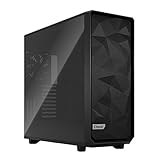


Our Top Picks
 CORSAIR 7000D Airflow Full-Tower ATX PC Case7000 Series21.65 x 9.76 x 23.62 inches41.23 poundsCheck on Amazon
Top 3 picks at a glance
Quick comparison of the best EATX cases
| Pick | Best for | Key specs (per manufacturer spec sheets; verify your revision) | Price range |
|---|---|---|---|
| Corsair 7000D Airflow | Best overall, high-airflow gaming/HEDT | Full tower, E-ATX support, large front and top radiator mounts, perforated front | Premium |
| Fractal Design Meshify 2 XL | Best for cooling and clean builds | Full tower, E-ATX support, mesh front, flexible drive layout, big GPU clearance | Upper mid-range to premium |
| Fractal Design Torrent | Best for high-TDP GPU airflow | E-ATX support, two large front fans and bottom intake fans, fan-forward design | Upper mid-range to premium |
| Phanteks Enthoo Pro 2 | Best for workstations and 12 x 13 in boards | Full tower, SSI-EEB/E-ATX class support, dual-PSU capable, many drive bays | Upper mid-range to premium |
| Lian Li O11 Dynamic EVO XL | Best for showcase and custom loops | Dual-chamber glass, E-ATX support, extensive radiator mounting | Premium |
| Lian Li Lancool 217 | Best value E-ATX airflow case | Mid-to-full tower, E-ATX support (about 280 mm width class), large front fans included | Mid-range |
| Cooler Master HAF 700 EVO | Best for extreme airflow and noisy-but-cool systems | Full tower, E-ATX support, large fans, front display on supported models | Premium |
First, which “EATX” is your board?
This is the check most spec sheets skip. The EATX standard is 12 x 13 inches (about 305 x 330 mm), but many consumer “E-ATX” boards are 12 x 10.4 to 12 x 11 inches (about 305 x 265-280 mm). A case that lists “E-ATX up to 280 mm” fits the second group, not the first. HEDT and workstation boards such as many TRX50 and WRX90 designs are often in the full 12 x 13 class.
| Your board | Typical size | Case requirement | Safe choices |
|---|---|---|---|
| Consumer “E-ATX” flagship (Intel Z-series or AMD X-series halo boards) | About 305 x 265-280 mm | E-ATX support with a width limit of at least 280 mm | Lancool 217, Meshify 2 XL, Torrent, 7000D Airflow |
| Workstation board, 12 x 13 in class | About 305 x 330 mm | Explicit SSI-EEB or 13 in depth support | Enthoo Pro 2, large Corsair or Lian Li full towers |
| Dual-socket server board | Varies (SSI-EEB, proprietary) | Server-class tray and bracket support | Enthoo Pro 2 Server Edition class, rackmount alternatives |
Measure your board from the manufacturer’s spec page, then subtract nothing. Cable routing cutouts and the PSU shroud edge can reduce usable space on a board that technically fits, so look for the stated maximum width rather than the case’s name.
Best overall: Corsair 7000D Airflow
The 7000D Airflow is the safest default if you want a full tower that takes E-ATX, large radiators and several fans. The perforated front and wide interior suit a high-TDP CPU paired with a flagship GPU. It suits builders who want room for a 360 mm or 420 mm radiator without fighting the layout.
Trade-off: it is large and heavy, and it needs substantial desk or floor space. Plan for roughly 25 kg once loaded.
Best for cooling and a clean look: Fractal Design Meshify 2 XL
The Meshify 2 XL combines a mesh front with a flexible interior. You can run the fans in the front, or fit radiators and fewer drive cages. It suits quiet-leaning performance builds where you want tidy cable routing and extra room for storage.
Trade-off: the mesh front passes more noise than a sealed panel, and the case is long. Check desk depth before ordering.
Best for high-power GPUs: Fractal Design Torrent
The Torrent uses large front fans and bottom intake fans to push air across the GPU. That helps when you run a hot, high-wattage card in an E-ATX system. It suits builders with 450 W-plus GPUs who prioritize GPU temperatures over looks.
Trade-off: radiator mounting is less flexible than in classic towers, and the open-front fan layout is not aimed at dust-free or silent operation.
Best for workstations: Phanteks Enthoo Pro 2
The Enthoo Pro 2 is the case to check first if your motherboard is the full 12 x 13 inch size. It is built for workstation and server-style boards, supports dual PSUs, and offers plenty of drive bays for storage-heavy builds. It suits Threadripper-class or multi-GPU rendering machines.
Trade-off: its look is conservative rather than flashy, and it is among the larger options, so plan for the footprint.
Best for showcase builds: Lian Li O11 Dynamic EVO XL
The dual-chamber glass design puts the motherboard and GPU on display while hiding cables and PSU behind the tray. It suits custom-loop builders who want many radiator positions. It is also the usual pick for showpiece E-ATX systems.
Trade-off: airflow depends on how you set up the fans, and the glass front/side design needs careful intake planning to keep a hot GPU in check.
Best value: Lian Li Lancool 217
The Lancool 217 gives E-ATX compatibility without full-tower pricing. Large front fans and a mesh-forward design make it a good airflow case. It suits consumer E-ATX flagship boards where the width limit is near 280 mm.
Trade-off: it is not for full 12 x 13 inch workstation boards, and drive capacity is limited compared with the bigger towers.
Best for raw airflow: Cooler Master HAF 700 EVO
The HAF 700 EVO is a high-airflow full tower with big fans and an E-ATX-ready interior. It suits builders who run a hot CPU and GPU together and care more about temperatures than noise.
Trade-off: it is very large and expensive for what it offers, and it is louder than the quiet-focused designs above.
Worked example: sizing the PSU and case for a workstation build
Take a Threadripper 7970X (350 W rated TDP per AMD’s spec sheet) plus an RTX 5090 (575 W total graphics power per NVIDIA’s spec). Add roughly 100 W for the board, memory, NVMe drives, fans and pump.
- Sustained load: 350 + 575 + 100 = about 1,025 W.
- Transient headroom: GPUs and CPUs spike above their rated numbers, so budget about 30-40% over sustained load: 1,025 x 1.35 = about 1,385 W.
- Result: a 1,500 W PSU is the realistic choice, with 1,600 W if you add a second GPU.
This matters for the case. High-wattage ATX 3.1 units are often 180-220 mm long, and thick 360 mm radiators in the front plus a long PSU can clash with the drive cage. Confirm PSU length limits and cable-routing space on the specific case. That is why the Enthoo Pro 2 and Meshify 2 XL are better than a compact E-ATX case for this build.
How to choose: decision criteria with numbers
- Board width: compare the board’s width to the case’s stated maximum. A 305 x 330 mm board needs explicit 13 in support, and “E-ATX up to 280 mm” will not do.
- GPU length and thickness: flagship cards range from about 300 mm to over 340 mm, and many take three or four slots. Check the case’s maximum GPU length with the front radiator installed, not just without it.
- Radiators: a 360 mm radiator needs front or top clearance for the radiator plus fans, usually 55-65 mm of total thickness. Check how this interacts with RAM and VRM heatsinks on wide boards.
- Cooler height: a tower air cooler is usually 150-165 mm tall. Confirm the case’s CPU cooler limit if you use air cooling.
- Weight and footprint: full towers can be 20-30 kg loaded. Check desk depth and whether you can lift the case.
- Noise: mesh and perforated fronts run cooler but louder. Solid-front cases with sound dampening run quieter but need more fan speed on hot components.
Frequently Asked Questions
Does an E-ATX case fit a standard ATX motherboard?
Yes. Almost every E-ATX case also supports ATX, micro-ATX and mini-ITX boards, because the standoff positions overlap. You get extra room, which can help with cable management and airflow.
Is E-ATX the same as SSI-EEB?
No. They are close in size but use different mounting hole layouts. A case that lists E-ATX does not always support SSI-EEB, so check for both if you use a workstation or server board.
Do I need an E-ATX case for a high-end gaming PC?
Usually not. A standard ATX board with a strong VRM handles gaming well. You need E-ATX only if your chosen board is that size, or if you want extra slots and memory channels for a workstation build.
Can E-ATX cases fit a 360 mm or 420 mm radiator?
Most full-tower E-ATX cases fit a 360 mm radiator at the top or front, and several support 420 mm. Check the spec sheet for the exact position and thickness limits, since the front fans, GPU and RAM can all restrict fit.
Are E-ATX cases harder to cool?
Not inherently. The larger interior gives air more space, but the case needs enough intake fans to move it. Mesh-front cases and those with bottom intake fans generally cool hot GPUs more effectively than glass-front cases.
Related guides
More from Amazon
Programs that pair well with the guide above. Offers and eligibility are set by Amazon and may change.
A free business account with business pricing and bulk-buying tools for work, shop or home office.
Create a business accountFree shipping on eligible items, Prime Video and more. Eligible new members can start with a free trial.
Start a Prime free trialAudiobooks and podcasts to listen to on the go. Eligible new members can start with a free trial.
Try Audible freeAd-free music streaming. Eligible new subscribers can start with a free trial.
Try Music Unlimited freeAs an Amazon Associate we earn from qualifying purchases.


