Our Top Picks

Top 3 picks at a glance

Table of Contents
- Quick Answer
- 1. WD Black SN8100 4TB
- 2. Samsung 9100 PRO 4TB with Heatsink
- 3. Kingston FURY Renegade G5 4TB
- 4. Crucial T710 4TB with Heatsink
- 5. Corsair MP700 PRO 4TB
- How to Choose
- Who Should Skip
- FAQ
- Conclusion
A 4TB Gen5 SSD is the capacity point where a gaming PC stops rationing space. Modern game installs routinely pass 100 GB, and a 4TB drive holds a large library alongside the operating system, launchers, capture folders and mods without constant uninstall decisions. The five drives below are all PCIe 5.0 x4 M.2 2280 models with TLC NAND and a DRAM cache, and each one is rated well beyond Gen4 speeds. They differ mainly in rated write speed, endurance and how cooling is handled, so the right pick depends on your motherboard and how hard you write to the drive. All figures come from published maker ratings rather than detailed research, and sustained speeds always depend on cooling and on the slot the drive sits in. DirectStorage titles and large open-world games also lean on fast random reads, which is why every drive here carries a DRAM cache and TLC NAND rather than the DRAM-less QLC designs common at lower prices.
As an Amazon Associate, we earn from qualifying purchases.
Quick Answer
For a 4TB Gen5 gaming drive, the WD Black SN8100 leads on rated read speed, the Kingston FURY Renegade G5 pairs the fastest rated writes with the highest endurance, and the Samsung 9100 PRO with Heatsink suits boards without an M.2 cover. The Crucial T710 and Corsair MP700 PRO round out the mid-range.
1. WD Black SN8100 4TB

The SN8100 is SanDisk’s flagship gaming drive and the fastest reader in this roundup, rated at up to 14,900 MB/s sequential read. Its rated write speed of 11,000 MB/s at this capacity is lower than the Kingston and Samsung drives below, which matters mainly for very large file copies rather than game loads. It uses an in-house SanDisk controller with 218-layer BiCS8 TLC NAND and a DDR4 DRAM cache, a combination aimed at consistent random performance in mixed gaming workloads.
This is the premium pick for a high-end board with a good M.2 heatsink, since the drive ships bare. Random read performance is rated up to 2,300K IOPS, and the 2,400 TBW endurance rating matches most of this class. A heatsink version of the SN8100 is sold under a separate listing, so builders whose boards lack an M.2 cover should compare that variant rather than assuming this bare drive includes cooling.
Specs
- Capacity: 4TB (model WDS400T1X0M)
- Interface: PCIe 5.0 x4, NVMe, M.2 2280
- Sequential read: up to 14,900 MB/s
- Sequential write: up to 11,000 MB/s
- Random read: up to 2,300K IOPS
- Controller: SanDisk in-house controller
- NAND: 218-layer BiCS8 TLC
- DRAM cache: Yes, DDR4
- Endurance: 2,400 TBW
- Heatsink: Not included
- Warranty: 5-year limited
2. Samsung 9100 PRO 4TB with Heatsink
Samsung’s 9100 PRO is the balanced flagship option, rated at up to 14,800 MB/s read and 13,400 MB/s write, and this version carries an integrated low-profile heatsink. That makes it the easiest fit for boards without an M.2 cover and for compact cases where a separate heatsink may not clear other components. It is built on Samsung V-NAND TLC with a DRAM cache and Samsung’s own controller, and it supports NVMe 2.0.
Endurance is rated at 2,400 TBW with a five-year limited warranty. Note that the bare version of this drive uses a different listing, so check the model code MZ-VAP4T0CW when ordering if you specifically want the heatsink model covered here. Samsung also publishes firmware and drive-health tools for its SSDs, which appeals to builders who like to monitor temperatures and endurance from the desktop.
Specs
- Capacity: 4TB (model MZ-VAP4T0CW)
- Interface: PCIe 5.0 x4, NVMe 2.0, M.2 2280
- Sequential read: up to 14,800 MB/s
- Sequential write: up to 13,400 MB/s
- Random performance: not stated
- Controller: Samsung in-house controller
- NAND: Samsung V-NAND TLC
- DRAM cache: Yes
- Endurance: 2,400 TBW
- Heatsink: Integrated low-profile heatsink
- Warranty: 5-year limited
3. Kingston FURY Renegade G5 4TB
The Renegade G5 is the endurance pick of this group. Kingston rates the 4TB model at up to 14,800 MB/s read and 14,000 MB/s write, the fastest rated write speed here, and backs it with a 4,000 TBW endurance rating that stands well above the 2,400 TBW class norm. For a drive that will also handle game capture, video projects or a frequently rewritten shader and mod library, that extra write headroom is the main reason to choose it.
It uses a Silicon Motion SM2508 controller with 218-layer BiCS8 TLC NAND and a DRAM cache, in a single-sided design that fits tight slots and slim systems. Kingston covers it with a limited five-year warranty.
Specs
- Capacity: 4TB (model SFYR2S/4T0)
- Interface: PCIe 5.0 x4, NVMe, M.2 2280
- Sequential read: up to 14,800 MB/s
- Sequential write: up to 14,000 MB/s
- Controller: Silicon Motion SM2508
- NAND: 218-layer BiCS8 3D TLC
- DRAM cache: Yes, DDR4
- Endurance: 4,000 TBW
- Design: Single-sided
- Heatsink: Not included
- Warranty: Limited 5-year
4. Crucial T710 4TB with Heatsink
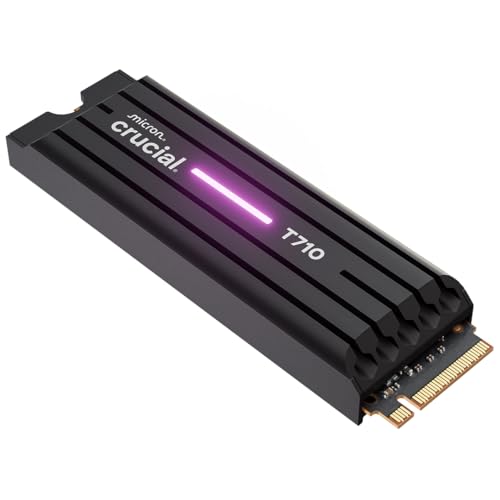
The T710 is Crucial’s efficiency-focused flagship. At this capacity Crucial rates it at up to 14,500 MB/s read and 13,800 MB/s write, with random performance up to 2,200K read IOPS and 2,300K write IOPS, and the maker positions the drive as drawing less power than the earlier T705 generation. That suits gaming PCs that run long sessions in warm rooms, where a cooler-running drive is less likely to throttle.
This version includes an integrated heatsink, and the drive itself is single-sided. It pairs a Silicon Motion SM2508 controller with Micron G9 TLC NAND and an LPDDR4 DRAM cache, and carries a 2,400 TBW rating with a five-year limited warranty. It sits in the mid-range of this roundup on rated reads while staying near the top on writes.
Specs
- Capacity: 4TB (model CT4000T710SSD5-01)
- Interface: PCIe 5.0 x4, NVMe 2.0, M.2 2280
- Sequential read: up to 14,500 MB/s
- Sequential write: up to 13,800 MB/s
- Random read: up to 2,200K IOPS
- Random write: up to 2,300K IOPS
- Controller: Silicon Motion SM2508
- NAND: Micron G9 TLC, 232-layer
- DRAM cache: Yes, LPDDR4
- Endurance: 2,400 TBW
- Heatsink: Integrated heatsink
- Warranty: 5-year limited
5. Corsair MP700 PRO 4TB

The MP700 PRO is the mid-range value route into 4TB Gen5 storage. Its rated speeds of 12,400 MB/s read and 11,800 MB/s write trail the flagships above, yet still sit far beyond any Gen4 drive, and its endurance rating of 3,000 TBW is second only to the Kingston in this roundup. For a games library that is mostly read rather than rewritten, that trade is sensible.
It uses a Phison E26 controller with high-density 3D TLC NAND and a DRAM cache. Corsair states that cooling is required, and this version ships without a heatsink, so plan on a motherboard M.2 cover or a third-party heatsink with real airflow over it.
Specs
- Capacity: 4TB (model CSSD-F4000GBMP700PNH)
- Interface: PCIe Gen5 x4, NVMe 2.0, M.2 2280
- Sequential read: up to 12,400 MB/s
- Sequential write: up to 11,800 MB/s
- Random read: up to 1,500K IOPS
- Random write: up to 1,600K IOPS
- Controller: Phison PS5026-E26
- NAND: High-density 3D TLC
- DRAM cache: Yes
- Endurance: 3,000 TBW
- Heatsink: Not included; cooling required
- Warranty: 5-year
How to Choose
Start with the slot. Full Gen5 speeds need a PCIe 5.0 x4 M.2 slot, which on many boards is the primary slot wired to the CPU; a Gen5 drive in a Gen4 slot runs at Gen4 speeds. Next, settle cooling before ordering. Gen5 drives throttle under sustained writes without a heatsink, so either pick a model with an integrated heatsink, like the Samsung or Crucial above, or confirm your motherboard includes a substantial M.2 cover.
Then weigh rated write speed and endurance against your habits. A library that is installed once and mostly read is served well by any drive here, while capture recording, content work and constant game updates reward the Kingston’s write rating and 4,000 TBW figure. Finally, confirm the basics: M.2 2280 fit, a DRAM cache for consistent mapping performance, TLC rather than QLC NAND, and a five-year warranty, which all five of these drives provide. Also check whether your board’s Gen5 slot shares bandwidth with the graphics card slot, since some layouts drop the GPU to eight lanes when the primary M.2 slot is populated; the motherboard manual settles that question before you buy.
Who Should Skip
Skip this entire category if your motherboard only offers Gen4 slots and you do not plan a platform upgrade soon, since a good Gen4 drive delivers the same real game-load experience in that slot for less. Skip 4TB if your library is small and a 2TB drive leaves comfortable headroom, and skip Gen5 altogether if your case has poor airflow and no M.2 heatsink option, because a throttling Gen5 drive can fall behind a cool-running Gen4 model under sustained writes. Console-focused buyers should also note these are PC drives; a separate roundup covers drives matched to console requirements.
FAQ
Is a 4TB Gen5 SSD worth it for a gaming PC?
It is worth it when your library is large enough that a 2TB drive forces regular uninstalls, or when you record capture footage to the same drive. The capacity removes storage management from the hobby, and the Gen5 interface keeps the drive relevant through future platform upgrades. It also leaves room for several very large titles to stay installed alongside a growing backlog of smaller games.
Does a Gen5 SSD need a heatsink?
In practice, yes for sustained work. Brief game loads rarely push a bare drive to throttling, but long installs, updates and file copies can. Use an integrated heatsink model or a motherboard M.2 cover, and make sure some case airflow reaches the slot.
Will a Gen5 SSD work in a Gen4 M.2 slot?
Yes. PCIe is backward compatible, so any of these drives works in a Gen4 slot and simply runs at Gen4 speeds, up to roughly 7,500 MB/s on reads. The drive is not wasted, since it can move to a Gen5 slot in a later build.
How much endurance does a gaming SSD need?
Gaming is a read-heavy workload, so even the 2,400 TBW ratings here represent many years of typical use. Endurance matters more when the same drive handles video capture, editing scratch space or constant large downloads, which is where the higher-rated Kingston and Corsair models earn their place.
Conclusion
For most gaming PCs, the WD Black SN8100 4TB is the headline pick on rated read speed, provided your board supplies the heatsink. The Samsung 9100 PRO with Heatsink is the simpler install, the Kingston FURY Renegade G5 is the choice for heavy writers, and the Crucial T710 and Corsair MP700 PRO cover efficiency and mid-range value. Match the drive to your slot, your cooling and your write habits, and any of the five will hold a large library at Gen5 speed.
Product and ASIN Reference
| Product | ASIN |
|---|---|
| WD Black SN8100 4TB NVMe SSD | B0F3B6MZM9 |
| Samsung 9100 PRO 4TB with Heatsink NVMe SSD | B0DX2FK3HX |
| Kingston FURY Renegade G5 4TB NVMe SSD | B0F43Z6NXL |
| Crucial T710 4TB with Heatsink NVMe SSD | B0F9XN5CB5 |
| Corsair MP700 PRO 4TB NVMe SSD | B0CWH9BX2P |
Related guides
More from Amazon
Programs that pair well with the guide above. Offers and eligibility are set by Amazon and may change.
A free business account with business pricing and bulk-buying tools for work, shop or home office.
Create a business accountFree shipping on eligible items, Prime Video and more. Eligible new members can start with a free trial.
Start a Prime free trialAudiobooks and podcasts to listen to on the go. Eligible new members can start with a free trial.
Try Audible freeAd-free music streaming. Eligible new subscribers can start with a free trial.
Try Music Unlimited freeAs an Amazon Associate we earn from qualifying purchases.