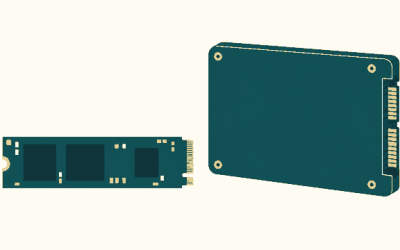
An Xbox Series X memory card — officially called the Storage Expansion Card — is the only external drive that can actually launch Series X|S-optimized games, because it’s the only storage option wired directly into the console’s PCIe 4.0 bus at the same 2.4GB/s the internal SSD delivers. Every USB drive, no matter how expensive, is physically capped at 5Gbps by the console’s ports, which is why your fast NVMe enclosure still can’t boot a Series X game. Here’s how the card actually works, and when a $60 hard drive is genuinely all you need.
As an Amazon Associate we earn from qualifying purchases at no extra cost to you.

Top 3 picks at a glance
Why only the proprietary card runs Series X|S games
Series X|S titles are built around Xbox Velocity Architecture, which assumes a guaranteed ~2.4GB/s of raw storage throughput (up to 4.8GB/s with hardware decompression). Games stream textures and world geometry directly off the SSD mid-frame using Sampler Feedback Streaming and DirectStorage-style APIs — the storage isn’t just loading levels, it’s functioning as a slow tier of memory.
The math explains the lockout. The internal SSD and the expansion card both run on PCIe Gen4 x2, delivering 2.4GB/s — about 19.2Gbps of bandwidth. The Xbox’s three USB-A ports are USB 3.2 Gen 1, capped at 5Gbps theoretical, which translates to roughly 400–450MB/s in the real world for a good SATA SSD and 100–140MB/s for a mechanical drive. That means even the best USB SSD delivers about one-sixth of the bandwidth optimized games are coded to expect. Microsoft solved this by allowing only licensed cards that replicate the internal drive’s performance exactly — so developers can code to one storage speed and never check which device the game sits on.
Quick Resume, load times, and in-game streaming behave identically whether a game sits on internal storage or the card. To the console, they’re one pool.
What each storage type can and can’t do
| Storage type | Real-world speed | Runs Series X|S optimized games | Runs Xbox One/360/OG games | Cold storage (park games) | Typical cost per TB |
|---|---|---|---|---|---|
| Internal SSD | ~2.4GB/s | Yes | Yes | Yes | — |
| Seagate / WD_BLACK expansion card | ~2.4GB/s | Yes | Yes | Yes | ~$130–180 |
| USB SSD (SATA or NVMe enclosure) | ~400–450MB/s | No | Yes | Yes | ~$55–80 |
| USB HDD | ~100–140MB/s | No | Yes | Yes | ~$20–30 |
Two rules govern everything: Optimized for Series X|S titles must live on internal storage or the card to launch. Backward-compatible games — anything from the Xbox One generation or earlier — run happily from USB because they were engineered for HDD-era I/O in the first place.
Which expansion cards exist in 2026
Only two licensed product lines plug into the dedicated Storage Expansion slot on the back of the console:
- Seagate Storage Expansion Card — the original option, sold in 512GB, 1TB, 2TB, and a 4TB model. Prices range from roughly $90 for 512GB up to $400–500 for 4TB.
- WD_BLACK C50 Expansion Card — the budget alternative, commonly in 512GB and 1TB capacities, usually $10–30 cheaper than the Seagate equivalent.
Performance is identical across all of them — that’s the point of the licensing program — so buy on capacity and price alone. One important detail if you’re shopping for an Xbox Series S memory card: it’s the exact same card and the exact same slot. There’s no Series S-specific version. And given the Series S ships with only ~364GB of usable space (versus ~802GB on the 1TB Series X), a card is arguably a better purchase there — two or three modern AAA installs can fill the internal drive on their own.
When a cheap USB drive is the smarter buy
The card is a luxury if your real problem is capacity, not convenience. A 4TB USB HDD at ~$90–110 holds a library of 30–50 parked games for less than a 512GB card. The trade-off is one transfer step: move a game back to internal storage before playing.
What that transfer actually costs you, moving a 120GB title:
- From USB HDD at ~110MB/s: 122,880MB ÷ 110 ≈ 1,120 seconds — about 19 minutes.
- From USB SSD at ~400MB/s: about 5 minutes.
- Card ↔ internal at multi-GB/s: typically 1–2 minutes.
Compare that to re-downloading 120GB: at 100Mbps that’s ~2.7 hours, and it burns a tenth of a 1.2TB monthly data cap. If your internet is slow or capped, USB cold storage isn’t a compromise — it’s the correct tool.
Match your situation to a setup
| Your situation | Best option | Why |
|---|---|---|
| Play mostly new AAA games, hate managing storage | 1TB–2TB expansion card | Zero friction; games are always playable where they sit |
| Series S owner, 364GB usable | 512GB or 1TB card | Cheapest way to double/triple playable capacity |
| Big library, but only 3–4 games in rotation | Cheap USB HDD for parking | ~$25/TB; a 20-minute transfer beats re-downloading |
| Heavy backward-compatible / older Game Pass player | USB SSD | Older titles run natively from USB; faster loads than HDD |
| Data-capped or slow internet | Largest USB HDD you can afford | Never re-download; archive everything |
| Mixed habits, moderate budget | 512GB card + 2TB HDD | Card for active games, HDD for the archive — often under $200 total |
Setting it up
- Expansion card: insert into the dedicated slot beside the HDMI port — it’s plug-and-play, no formatting. Then set it as default under Settings → System → Storage devices → Change installation locations.
- USB drive: needs USB 3.0 or newer and 128GB minimum. Plug in, and when prompted choose “Format for games & apps.”
- Moving games: My games & apps → select a title → Manage → Move or copy. Batch-select whole folders to queue a big migration overnight.
FAQ
Is the Xbox Series S memory card different from the Series X one?
No — identical slot, identical cards, identical 2.4GB/s performance. The Series S version of a game is smaller, but storage rules are exactly the same.
Can I use a regular NVMe SSD in an enclosure instead?
You can, but it connects over USB at ~400MB/s — so it can only store optimized games or play backward-compatible ones. There’s no way to make a USB device run Series X|S titles.
Does the card work on a friend’s console?
Yes. The card is hot-swappable and portable across any Series X or Series S — your installed games travel with it (saves live in cloud storage).
Do games moved to USB need re-downloading or updates?
No. Moving preserves the full install, including updates. Move it back and it launches immediately.