
Most people shopping for a portable SSD treat water resistance as a single checkbox: “waterproof, yes or no.” That’s a mistake that costs buyers real money. A drive labeled IP65 is not the same as one rated IP67 or IP68, and neither means the drive can survive a soak in a lake or a cycle through a washing machine. Water resistance ratings describe specific, controlled conditions — water pressure, duration, and exposure angle — and a rating that sounds impressive on a box may cover far less than you assume. The other common mistake is paying a premium for ruggedness you’ll never use. If your drive lives on a desk and travels in a padded laptop sleeve once a month, an IP68 rating is money spent for nothing. If you shoot video in the rain or toss your drive in a backpack with a water bottle, it’s the difference between a scary moment and a lost project.
This guide breaks down what water resistance ratings actually measure, how they interact with the rest of a drive’s design, and how to match the rating you need to the price you should pay. The examples used throughout — primarily the SanDisk Extreme and Extreme PRO lines — illustrate typical market pricing and specs, not an endorsement of one brand.
As an Amazon Associate we earn from qualifying purchases at no extra cost to you. Product prices and availability are accurate as of the date shown and are subject to change.

Top 3 picks at a glance
Decide These 3 Things First
1. Where does the drive actually live? Be honest. If it rides in a bag with water bottles, gets used outdoors, or travels through humid climates, you need at least IP55 and ideally IP65 or better. If it stays in a sleeve or on a desk, you can save money with a basic enclosure and spend the difference on capacity or speed.
2. How much capacity do you need now — and in 18 months? Water resistance scales with price. At current street prices, 1TB rugged drives cluster around $110–$240, 2TB models around $150–$290, and 4TB models from roughly $300 to over $700. Buying too small means paying that ruggedness premium twice.
3. What’s your real speed requirement? A 1050MB/s drive over USB 3.2 Gen 2 is plenty for document backups, photo libraries, and most 4K footage. If you offload high-bitrate video or work directly off the drive, 2000MB/s-class models justify their premium — but water resistance and speed are independent features, and paying for one shouldn’t mean settling for less of the other.
Understand the IP Rating Before You Pay for It
The IP (Ingress Protection) code has two digits. The first covers solids: IP5X means dust-protected (limited ingress, no harm), IP6X means dust-tight. The second covers water:
- IPX4: Splashing water from any direction. Think rain on a hike, not a drop in a sink.
- IPX5: Low-pressure jets from any direction — a hose spray, sustained rain.
- IPX7: Immersion up to 1 meter for 30 minutes.
- IPX8: Immersion beyond 1 meter, with depth and duration set by the manufacturer (read the fine print).
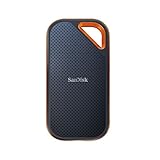
A drive rated IP65 — dust-tight and protected against jets — like the SanDisk Extreme Portable SSD across its 1TB, 2TB, and 4TB variants, handles rain and splashes confidently but is not rated for submersion. That’s a critical distinction. Many buyers see “water resistant” and assume a dropped-in-a-puddle scenario is covered. It isn’t, unless the rating’s second digit is 7 or 8. Also note that IP ratings apply only when ports are sealed or capped exactly as the manufacturer specifies; a USB-C port with a cable plugged in is an open hole.
Size and Weight: Ruggedness Adds Bulk
Water and dust sealing require gaskets, over-molding, and sealed enclosures, which add mass. Typical IP65-rated portable SSDs in the 1TB–4TB range weigh roughly 40–60 grams and measure around 100 x 50 x 9–11 mm — noticeably thicker than sealed-free consumer drives, which can dip under 30 grams and 8 mm thick. If you pocket the drive daily, that difference matters. If it lives in a bag, it won’t. Look for a weight under 60 grams if portability is a priority; rugged drives exceeding 80 grams usually signal additional drop protection (rubberized bumpers) rather than better sealing.
Materials and Build: What the Rating Depends On
The IP rating is only as good as the enclosure. Look for:
- Over-molded construction: A silicone or TPU coating bonded to a solid inner shell. Coatings that are glued or snapped on separate at the seams over time, quietly voiding the rating.
- Sealed or covered ports: USB-C ports are the vulnerable point. Some designs seal the port itself; others rely on the plug’s connection being the only exposure. Understand which you’re buying.
- No moving parts — verify it’s actually an SSD: Portable SSDs have no spinning platters, which makes them inherently more drop-tolerant than spinning drives, but cheap listings sometimes still sell mechanical externals mislabeled as SSDs.
- Thermal design: Sealed enclosures trap heat. A drive sustaining 1050MB/s reads will thermally throttle if the shell can’t dissipate heat; well-designed rugged drives use aluminum cores under the coating. Check whether the manufacturer publishes sustained (not just peak) transfer figures.
Performance: Speed Doesn’t Excuse a Slow Real World
USB 3.2 Gen 2 (10Gbps) is the current sweet spot, delivering roughly 1000–1050MB/s peak reads — matching drives like the SanDisk Extreme line. USB 3.2 Gen 2×2 (20Gbps) pushes to 2000MB/s, as in the Extreme PRO class, but requires a compatible port on your computer; on an older laptop you’ll pay the premium and see Gen 2 speeds at best. Water resistance has no inherent speed cost, but sealed thermal design does — a poorly cooled IP-rated drive may drop to 400–600MB/s during long transfers. If your workflow involves copying 100GB+ at a stretch, prioritize published sustained-write specs or heat-sink designs over headline numbers.
Price Tiers: What Your Money Buys
- Budget ($70–$150, up to 1TB): Often IP54 at best or unrated. Fine for desk-to-desk use. Read speeds typically 400–800MB/s on older USB 3.2 Gen 1 interfaces.
- Mid-range ($150–$300, 1TB–2TB): This is where most buyers should land. IP55–IP65 ratings, USB 3.2 Gen 2 at ~1050MB/s, 2–3 meter drop ratings. The SanDisk Extreme 2TB at $289.99 and 1TB models around $219.99 sit at the top of this band; comparable competitors frequently undercut them by 20–30%.
- Premium ($300–$750+, 2TB–4TB): You’re mostly paying for capacity here, plus IP65 sealing and either Gen 2×2 speed or 4TB density. The 4TB Extreme’s $725 asking price illustrates the capacity premium — 4TB rugged SSDs historically cost 2–3x per gigabyte versus 2TB. Watch for sales; this tier’s prices swing $100+ during major retail events.
Warranty and Support: The Underrated Factor
Water resistance ratings are engineering claims, not guarantees — a drive rated IP65 that leaks isn’t automatically covered. Look for a manufacturer warranty of at least 3 years (5 on professional lines) and check whether the warranty covers data recovery or only the hardware (almost always the latter). Reputable brands offer 3–5 year limited warranties on these products; no-name drives often carry 12 months or nothing. Also confirm the stated rating comes with conditions — some manufacturers specify exposure only with the port cover closed or exclude saltwater.
Spec Checklist
| Spec | Budget | Mid | Premium |
|---|---|---|---|
| IP rating | IP54 or unrated | IP55–IP65 | IP65–IP68 |
| Interface | USB 3.2 Gen 1 | USB 3.2 Gen 2 | USB 3.2 Gen 2×2 |
| Peak read speed | 400–800MB/s | ~1050MB/s | ~2000MB/s |
| Capacity range | 480GB–1TB | 1TB–2TB | 2TB–4TB |
| Weight | Under 35g | 40–60g | 50–80g |
| Drop rating | Often none stated | 1–2 meters | 2–3 meters |
| Price (typical) | $70–$150 | $150–$300 | $300–$750+ |
| Warranty | 1–2 years | 3 years | 3–5 years |
Red Flags
- “Waterproof” with no IP code. Marketing language without a rating means nothing testable. Demand the two-digit number.
- IP68 with no stated depth or duration. IPX8 is manufacturer-defined; if they don’t publish it, they may not have tested it rigorously.
- Sealed pricing on unsealed specs. A drive priced like an IP65 model but rated IP54 (or unrated) is selling you the aesthetic of ruggedness.
- Old-model listings at new-model prices. Note that some older-generation drives — like certain 1TB and Extreme PRO listings — carry prior-version hardware and speeds at nearly current prices. Verify you’re buying the updated firmware/hardware revision before paying a premium.
- No published sustained speeds or thermal behavior. Vague “up to” numbers hide throttling.
- Warranty under 3 years on a drive marketed as rugged — the build claims and the support should match.
FAQ
Can an IP65-rated portable SSD survive being dropped in water?
No. IP65 protects against dust and low-pressure water jets — rain, splashes, spray. Submersion requires a second digit of 7 (1 meter for 30 minutes) or 8 (manufacturer-specified depth and time). If a drop in water is a realistic scenario for you, buy IP67 or IP68 or keep the drive in a waterproof pouch.
Does water resistance affect SSD speed or lifespan?
Indirectly, yes. Sealed enclosures trap heat, and sustained transfers can push a poorly designed rugged drive into thermal throttling, cutting speeds from ~1050MB/s to 500–600MB/s. Lifespan isn’t meaningfully affected by sealing itself — NAND endurance is the limiting factor — but heat is a contributor to long-term wear, so good thermal design matters.
Is it worth paying extra for IP68 over IP65?
Only if submersion is a plausible risk: kayaking, boating, fieldwork in storms, or travel where the drive might fall into water. For everyday carry, commuting, and desk use, IP65 covers rain, spills, and splashes at a lower price. Most buyers who don’t work near water never need the higher rating.
Does the water resistance rating still apply years later?
Gaskets and over-molded seams degrade with flexing, temperature swings, and UV exposure. A drive that tested to IP65 when new may seal less well after years of pocket wear, and the rating applies only with ports closed as designed. Treat the rating as strongest when the drive is newest, and consider a protective case for high-risk use as the drive ages — especially relevant if you’re buying in 2026 and expecting five-plus years of field use.


