
Top 3 picks at a glance
The Short Answer
For 500GB of game saves, you need a 500GB portable SSD. That size gives you about 465GB of usable formatted space, which is enough for the saves themselves plus room for system overhead and future growth. Game save files are small — most console and PC saves are 5MB to 300MB each — so 500GB can technically hold tens of thousands of saves. In practice, most gamers buying a 500GB drive are also storing full game installs, captures, or backups alongside saves, and a 500GB model is the most cost-effective fit for that use.
If you only need to back up raw save files and nothing else, even a 250GB drive would cover 500GB worth of saves with room to spare, since you will never have 500GB of pure save data. But if your goal is to back up or move 500GB of total gaming data including installs, get at least a 500GB SSD and consider a 1TB if your library is growing. As of 2026, 500GB portable SSDs remain the sweet spot for price and portability, typically ranging from $59 to $160 depending on speed and durability.
As an Amazon Associate we earn from qualifying purchases at no extra cost to you. Product prices and availability are accurate as of the date shown and are subject to change.

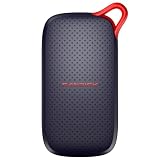


Physically, all 500GB portable SSDs are pocket-sized. Expect a drive about the size of a credit card or smaller, weighing 1 to 2 ounces, and drawing under 5 watts from a USB port.
Standard Sizes
Portable SSDs do not vary much in capacity options, but their physical footprint does differ by brand and performance tier. The term “size” means two things: storage capacity and physical dimensions. For 500GB game saves, you care about both — enough capacity to hold the data, and a form factor that fits your console, desk, or media console.
| Model Example | Capacity | Dimensions (inches) | Dimensions (cm) | Weight | Typical Price Range |
|---|---|---|---|---|---|
| SSK Portable SSD (1050MB/s) | 250GB | 2.76 x 1.46 x 0.47 | 7.0 x 3.7 x 1.2 | 1.06 oz / 30g | $55 – $65 |
| SSK Portable SSD (1050MB/s) | 500GB | 2.76 x 1.46 x 0.47 | 7.0 x 3.7 x 1.2 | 1.06 oz / 30g | $85 – $95 |
| SanDisk Portable SSD (1000MB/s) | 500GB | 3.81 x 1.98 x 0.38 | 9.67 x 5.03 x 0.96 | 1.41 oz / 40g | $100 – $115 |
| SanDisk Extreme Portable SSD (2000MB/s) | 500GB | 4.02 x 2.09 x 0.38 | 10.21 x 5.31 x 0.96 | 1.83 oz / 52g | $150 – $165 |
Key takeaways from the table: A 250GB and 500GB drive from the same line are physically identical — you are paying for denser storage, not a larger case. Standard read speeds for budget to mid-range 500GB models fall between 1000MB/s and 1050MB/s over USB 3.2 Gen 2, while premium rugged models reach up to 2000MB/s. All four examples are bus-powered, requiring 2.5 to 4.5 watts, so no external power adapter is needed. For console use, any drive under 4.5 inches long will sit discreetly next to or behind the console without blocking vents.
In terms of usable capacity, expect these formatted numbers: a 250GB drive formats to about 232GB, and a 500GB drive formats to about 465GB. File system overhead and manufacturer decimal vs. binary measurement account for the difference. If you have exactly 500GB of data to move, you will need a 1TB drive, which formats to about 931GB, to fit it all at once.
How to Measure Your Space
Before choosing a portable SSD, check the physical space where it will live and the cable clearance you need. Game consoles and compact desks can be tight on room, and a bulky drive or stiff cable can strain a USB port.
- Measure your console or PC clearance. Use a tape measure to check the flat surface on top of, beside, or behind your console or PC tower. Most portable SSDs need a footprint of at least 4 x 2 inches. Leave an extra 1 inch on the cable side for bend radius.
- Check USB port location and ventilation. On PlayStation 5, Xbox Series X, and similar consoles, USB-A ports are on the front and rear. Measure the distance from the port to any wall or cabinet back. The drive should sit 2 to 3 inches away from exhaust vents where temperatures can reach 95 to 110 degrees Fahrenheit during long sessions.
- Measure cable length needs. Most 500GB portable SSDs include a 6 to 12 inch USB-C to USB-C cable and a USB-C to USB-A adapter. If your drive will sit inside a media cabinet drawer, measure from the console port to the resting spot and add 2 inches of slack. For runs over 18 inches, plan on a longer certified USB 3.2 cable.
- Weigh portability needs. If you carry saves between locations, check pocket or bag space. At 0.38 to 0.47 inches thick, these drives fit in any controller case or small tech pouch. Weight under 2 ounces means they add no noticeable bulk.
- Account for enclosure and protection. If you use a silicone sleeve or hard case for travel, add 0.2 to 0.3 inches to each dimension and 0.5 to 1.0 ounce to weight. Rugged models like the Extreme series already include rubber bumpers, so no extra case is needed for shelf use.
By Room or Use Case
Living Room Console Setup
In a living room with a PS5 or Xbox Series X inside an entertainment center, physical size matters more than raw speed. Consoles use portable SSDs for cold storage and save backups, not for playing current-generation titles directly from the drive. A compact 500GB drive measuring under 3.0 x 1.5 inches, such as the SSK 500GB at 2.76 x 1.46 inches, tucks behind the console or mounts with a small adhesive Velcro strip inside the cabinet. Keep the drive on a flat surface with at least 1 inch of airflow around it and avoid stacking it on top of the console where heat concentrates. A drive rated up to 1000MB/s is more than fast enough for save transfers, which typically move at 300MB/s to 800MB/s in real-world console USB conditions.
Home Office and PC Gaming Desk
For a PC gaming desk, you can prioritize speed and cable management. A 500GB portable SSD at 1000MB/s to 2000MB/s will handle rapid backup of save folders located in Documents, AppData, or Steam userdata directories. Plan for a drive about 3.8 to 4.0 inches long sitting next to your monitor base or under the desk in a cable tray. The weight of 1.4 to 1.8 ounces means it will not slide off a desk from cable tension if you use a 12-inch cable. If your PC has USB-C 3.2 Gen 2×2, a 2000MB/s model will cut a full 100GB game backup from about 100 seconds to roughly 50 seconds compared to a 1000MB/s model. For save files alone, the difference is negligible — a 10GB save collection transfers in under 15 seconds on either.
Small Apartment or Dorm Room
In tight spaces where the console doubles as a media player, choose the smallest footprint possible. A stick-style SSD under 3 inches long can hang directly from the USB port without occupying shelf space, provided you support the cable so it does not put stress on the port. Use a short 6-inch cable to reduce clutter and secure the drive with a clip to prevent it from falling behind furniture. Storage-wise, 500GB is ideal when you cannot keep a larger desktop external drive. It holds 8 to 12 full PS4 or Xbox One game installs at 30GB to 60GB each, or 4 to 7 current-generation titles at 60GB to 120GB each, plus all associated saves.
Travel, Dorm Hopping, and Handheld Gaming
If you carry saves between houses, to a friend’s setup, or for handheld PCs like the ROG Ally or Steam Deck, durability and weight are the drivers. Look for a 500GB model with IP65 water and dust resistance and drop protection up to 6.5 feet. Physical dimensions of roughly 4.02 x 2.09 x 0.38 inches still fit in a jacket pocket or a small carrying case measuring 5 x 3 inches. Power draw remains under 5 watts, so the drive will run directly from a handheld’s USB-C port or a laptop without a hub. For frequent travel, a hard-shell case adding 0.7 ounces is worth it to protect the connector.
Common Sizing Mistakes
1. Buying exactly 500GB for 500GB of data. As noted, formatted capacity is about 7 percent less than advertised. A 500GB drive will not hold 500GB of data in one transfer. Add a 10 to 15 percent buffer. If your library shows 490GB used, step up to 1TB.
2. Confusing save files with game installs. Many gamers overestimate save size and underestimate install size. A single save for a title like Elden Ring or Baldur’s Gate 3 is often 10MB to 50MB. The install is 50GB to 100GB. If you plan to back up games plus saves, size for installs first.
3. Ignoring physical clearance and cable strain. A drive that is only 0.38 inches thick can still block a second USB port if it sits flush against the console. Measure port spacing — most consoles have ports 0.75 to 1.0 inches apart. Use a right-angle adapter if clearance is tight, and never let the drive dangle from the port.
4. Choosing speed over fit. Paying $150 to $165 for a 2000MB/s Extreme model is unnecessary if your console caps external transfers at 800MB/s to 1000MB/s. Save money with a 1000MB/s to 1050MB/s drive in the $85 to $115 range unless you also edit video or transfer large files on a PC with a 20Gbps port.
5. Forgetting about future saves and updates. Game patches and new saves accumulate quickly. A 500GB drive that is 90 percent full will slow down and leaves no room for a second backup version. Try to keep at least 15 to 20 percent free — about 70GB to 90GB on a 500GB drive — for longevity and faster writes.
FAQ
How many game saves can a 500GB portable SSD hold?
Tens of thousands. Most individual save files are tiny. For example, 465GB of usable space divided by an average 50MB save equals more than 9,000 saves, and many saves are only 5MB to 20MB. Even large, save-heavy RPG collections rarely exceed 5GB total for saves alone. The rest of the 500GB is best used for full game backups, screenshots, and video clips, which are much larger.
Is a 250GB portable SSD enough for 500GB of game saves?
For pure save files, yes — 250GB formats to about 232GB, which is far more than any real-world collection of save files alone. But if you mean 500GB of total gaming data including installed games, no. You would need at least a 500GB drive for about 465GB usable, and ideally a 1TB drive to move 500GB at once without splitting the transfer.
What physical size should I look for on a TV stand?
Look for a drive no larger than 4.0 x 2.5 x 0.5 inches and under 2 ounces. That size sits flat next to any console without blocking vents and fits inside most media console drawers or cable channels. Models under 3 inches long are best if your stand depth is less than 14 inches or if ports are on the front and you want the drive hidden behind the console with a 6-inch cable.
Do I need 1050MB/s, 1000MB/s, or 2000MB/s for game saves?
For saves only, any of them is fast enough and you will not notice a difference. Save backups are limited by console USB overhead and small file handling, not peak sequential speed. The 1000MB/s to 1050MB/s drives priced $85 to $115 are the best value for console save duty. Choose 2000MB/s, typically $150 to $165 for 500GB, only if you also do large PC file transfers, 4K video editing, or want the added rugged protection that often comes with the faster models.
