
A shark x pc case search usually starts with a simple frustration: you have the components you want but the enclosure either looks cheap, traps heat, or refuses to cooperate with your GPU length. The cases in this roundup span budget open-frame builds to premium dual-chamber showpieces, so the question is not which one is objectively the best but which one matches your specific constraints—radiator size, motherboard form factor, aesthetic preference, and wallet tolerance.
What separates a worthwhile case from a mediocre one comes down to three things: how intelligently the airflow path is designed, whether the internal clearance actually fits modern hardware without forcing awkward compromises, and whether build quality justifies the price gap between options that are otherwise spec-similar. Owner feedback across forums and review sites consistently penalizes cases with sharp interior edges, flimsy drive trays, and fan mounts that require full disassembly to access. This guide flags those patterns without pretending to have opened a single chassis.
As an Amazon Associate we earn from qualifying purchases at no extra cost to you.


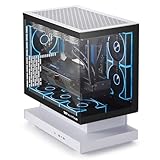
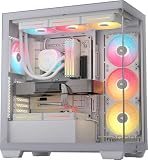

Top 3 picks at a glance
Quick Picks
| Product | Best for | Price |
|---|---|---|
| Cooler Master Sneaker-X Bundle | Turnkey mini-ITX gaming | $528.20 |
| MegaPC Open-Frame Mid-Tower | Open-air enthusiasts on a budget | $165.99 |
| ASUS ROG Cronox ARGB | Large GPUs with screen flair | $559.99 |
| ASUS ROG Hyperion GR701 White | EATX enthusiasts who want airflow | $519.99 |
| HYTE Y70 Touch Infinite | LCD-integrated dual-chamber builds | $389.99 |
| darkFlash FLOATRON F1 | Panoramic views on a micro-ATX budget | $154.99 |
| CORSAIR 3500X LX RGB | White-themed mid-tower value | $129.99 |
| Lian Li V100 | Lowest-cost ATX mid-tower with brand trust | $74.99 |
How We Picked
We filtered these candidates by published compatibility specs (GPU clearance, radiator support, motherboard size), owner-reported build quality, and value relative to feature density. A case that supports only 240mm radiators while charging a premium gets penalized against one offering 360mm at half the price. Aesthetics matter but we weighted them below structural utility—a panoramic glass panel that causes GPU hot spots is a net negative regardless of how photogenic it is in a listing image.
The 8 Best Shark X Pc Case in 2026
Cooler Master Sneaker-X Bundle
This limited edition bundle removes the guesswork from a 360mm-AIO mini-ITX build by pairing the case with a matched liquid cooler and 850W SFX PSU in one package. Owners praise the snug internal layout and the satisfaction of not hunting compatible components separately. The 300mm GPU clearance and 3-slot support handle most current graphics cards, though enthusiasts eyeing flagship cards at 400mm-plus will need to look elsewhere.
- Pro: Bundle eliminates compatibility headaches and often underprices buying parts individually.
- Pro: Mini-ITX footprint keeps desk real estate minimal without sacrificing AIO cooling headroom.
- Con: Limited edition availability means pricing fluctuates and future replacement parts may be scarce.
Skip it if you need EATX support, plan to upgrade to an oversized GPU, or already own a cooler and PSU you want to reuse.
MegaPC Open-Frame Mid-Tower
An open-frame design appeals to builders who want maximum airflow and easy component access without wrestling a traditional chassis. The tempered glass side panel and pre-installed ARGB PWM fan add a visual polish usually absent from budget open-frame alternatives. USB Type-C and 240mm radiator support round out a package that punches above its price.
- Pro: Open-frame layout simplifies cable management and GPU swaps dramatically.
- Pro: ARGB fan and Type-C front I/O at $165.99 undercut most enclosed competitors.
- Con: Open-frame construction offers zero dust protection; expect more frequent cleaning cycles.
Skip it if you live in a dusty environment, want a fully enclosed aesthetic, or need radiator support beyond 240mm.
ASUS ROG Cronox ARGB
The Cronox targets builders who want a large GPU mounted alongside an integrated display for system monitoring or custom visuals. Curved tempered glass on the front panel gives a distinctive silhouette, and BTF compatibility means cleaner rear-connect builds with supported motherboards. Four ARGB fans come pre-installed, and the 9.2-inch screen is a genuine differentiator in this price tier.
- Pro: GPU clearance up to 400mm removes one of the most common fitment frustrations.
- Pro: Integrated 9.2-inch screen adds functional display real estate without aftermarket mounts.
- Con: At $559.99, the premium is steep compared to cases offering similar airflow without a screen.
Skip it if you find the screen gimmicky, prefer a traditional enclosed panel design, or need the lowest possible price for a high-clearance case.
ASUS ROG Hyperion GR701 White EATX
High-airflow design, 420mm radiator support, and tool-free side panels make the Hyperion a strong pick for EATX and full ATX builders who prioritize thermal headroom. Pre-installed four 140mm fans and a built-in GPU holder address two common pain points—initial fan cost and card sag—out of the box. The white colorway and front USB-C round out a modern feature set backed by a two-year warranty.
- Pro: 420mm radiator support handles even the hottest CPU configurations with ease.
- Pro: Tool-free panels and included GPU holder reduce assembly friction noticeably.
- Con: Large physical footprint demands desk or floor space that smaller cases do not.
Skip it if you are space-constrained, only need micro-ATX, or want to keep total system cost under $500.
HYTE Y70 Touch Infinite
The Y70 Touch Infinite combines a dual-chamber layout with an integrated 2.5K LCD touchscreen, appealing to builders who want real-time monitoring or dynamic wallpapers without a separate display. Ten fan mounts provide serious airflow flexibility, and the included PCIe 4.0 riser cable enables a vertical GPU orientation without buying a riser separately. Black and white color options are both available at the same price.
- Pro: Built-in 2.5K LCD and riser cable add hundreds of dollars of value versus buying separately.
- Pro: Ten fan capacity supports extreme air-cooling or large water-cooling loops.
- Con: Dual-chamber designs are wider than single-chamber mid-towers, so desk clearance matters.
Skip it if you find the LCD unnecessary, are space-limited on your desk, or would rather spend the difference on a better GPU.
darkFlash FLOATRON F1
A 270-degree panoramic glass panel delivers a showcase effect at a micro-ATX price point that few competitors match. Three ARGB PWM fans, back-connect motherboard support, and 360mm AIO compatibility make it a versatile choice for builders who want clean cable routing and strong visuals. At $154.99 it sits well below enclosed panoramic alternatives from major brands.
- Pro: 270-degree panoramic view with back-connect support is rare at any price, let alone sub-$160.
- Pro: Three included ARGB fans provide immediate lighting and airflow without extra purchases.
- Con: Panoramic glass can trap warm air around the GPU if exhaust placement is not carefully managed.
Skip it if you need full ATX or EATX, are concerned about sustained GPU thermals under panoramic glass, or prefer enclosed panels for dust control.
CORSAIR 3500X LX RGB Link
For builders assembling a white-themed system on a tight budget, the 3500X LX RGB Link delivers high airflow, three pre-installed fans, and reverse-connection motherboard compatibility at $129.99. The spacious interior eases installation, and the integrated GPU anti-sag mechanism protects heavy cards without aftermarket brackets. RGB Link compatibility means the lighting syncs with CORSAIR peripherals out of the box.
- Pro: GPU anti-sag and spacious interior solve two installation complaints common to budget cases.
- Pro: RGB Link ecosystem integration eliminates separate lighting controller purchases.
- Con: Mid-tower dimensions limit radiator options to 240mm or 280mm, falling short of 360mm.
Skip it if you run a high-TDP CPU requiring a 360mm AIO, want panoramic glass, or are not invested in the CORSAIR ecosystem.
Lian Li V100
At $74.99 the V100 is the cheapest name-brand ATX mid-tower on this list, and Lian Li’s reputation for fit and finish at low prices is well-established. It strips away RGB and panoramic glass in favor of straightforward ventilation and reliable construction. For budget builders who want a no-nonsense enclosure, it remains a safe default.
- Pro: Lowest entry price with a brand known for durable steel and sensible internal layouts.
- Pro: Clean design fits anywhere without clashing lighting or excessive glass.
- Con: No pre-installed fans or USB Type-C, meaning initial costs creep higher as you add essentials.
Skip it if you want included fans, modern front I/O, or any visual flair beyond basic ventilation grilles.
Buying Guide
Thermal headroom and radiator compatibility
Your CPU and GPU TDPs dictate how much cooling the case must accommodate. If you run a 125W+ processor, a 360mm AIO mount is almost mandatory for comfortable noise levels. Cases that cap radiator support at 240mm force either louder fan curves or a hot component. Check both front and top mount options—some cases list 360mm support only on the front, which can conflict with long GPUs.
GPU clearance and mounting constraints
Modern graphics cards exceed 320mm in length, and vertical-mount enthusiasts need adequate clearance plus a riser cable. A published 300mm GPU limit rules out most current-flagship options. Beyond length, check whether the case supports the card’s thickness—three-slot is the current practical minimum—and whether an included anti-sag bracket is present or must be added separately.
Form factor and real-world interior space
Mini-ITX cases demand SFX or SFX-L power supplies and often limit cooler height. ATX and EATX cases offer more internal room but consume significantly more desk or floor space. Dual-chamber designs like the HYTE Y70 separate the PSU behind the motherboard tray, which improves aesthetics but widens the overall footprint. Match the form factor to your existing or planned components rather than choosing the most compact option that technically fits.
Our Verdict
The HYTE Y70 Touch Infinite is the top overall pick for 2026—it bundles a 2.5K LCD, a PCIe 4.0 riser, and ten fan mounts into a single chassis at $389.99, delivering feature density no other case on this list matches at that price. For budget-conscious builders, the CORSAIR 3500X LX RGB at $129.99 offers the best combination of included fans, anti-sag protection, and ecosystem lighting without forcing compromises on build quality. However, if your priority is maximum GPU clearance for a flagship card and you value a rear-connect build, the ASUS ROG Cronox with its 400mm support and BTF compatibility wins despite its premium cost.
FAQ
What does “shark x pc case” actually refer to?
It is a search phrase people use when looking for a case that fits an unusual form factor, has a distinctive design, or belongs to a specific brand line they half-remember. The cases in this roundup do not carry that exact product name, but they address the same underlying buyer intent—finding a compelling enclosure that solves a specific compatibility or aesthetic problem.
Can I use a 360mm AIO in a micro-ATX case?
Some can, but it depends on whether the manufacturer allocates a front or top 360mm mount specifically in a micro-ATX layout. The darkFlash FLOATRON F1 explicitly lists 360mm AIO support in a micro-ATX chassis, while most other micro-ATX cases cap at 240mm or 280mm. Always verify the exact mount location before purchasing.
Is back-connect motherboard support worth seeking out?
It significantly improves visual cleanliness by routing all power and data connections behind the motherboard tray, eliminating visible cable clutter. If you plan to show off internal components through glass panels, back-connect compatibility removes the need for a separate cable-management project. Both the darkFlash FLOATRON F1 and ASUS ROG Cronox support it with compatible motherboards.
Do I need a PCIe riser cable for vertical GPU mounting?
Yes—vertical mounting rotates the GPU so its PCIe connector faces upward rather than aligning with the motherboard slot. Without a riser cable, the card physically cannot be mounted vertically. The HYTE Y70 Touch Infinite includes a PCIe 4.0 riser in the box, which is one reason its value proposition stands out compared to buying the accessory separately at $40 to $80.


