
The RTX 4060 is the better gaming card overall, running roughly 15-30 percent faster than the RX 5700 at 1080p while using about 65 W less power and adding ray tracing and DLSS frame generation; the RX 5700 only wins on price, so it makes sense as a used bargain for 1080p raster gaming on a tight budget.
The RX 5700 is a 2019 RDNA 1 card that launched at $349; the RTX 4060 is a 2023 Ada Lovelace card that launched at $299. Both carry 8 GB of VRAM, but they sit in very different places today. The RTX 4060 is previous-generation now that the RTX 5060 and RTX 5050 are on shelves, yet it remains widely sold new, while the RX 5700 exists almost entirely on the used market. That makes this a classic “cheap old card vs newer efficient card” decision.
As an Amazon Associate we earn from qualifying purchases at no extra cost to you.
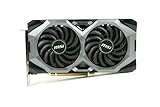

Spec Comparison
| Specification | Radeon RX 5700 | GeForce RTX 4060 |
|---|---|---|
| Architecture | RDNA 1.0 | Ada Lovelace |
| Release date | 7 July 2019 | 18 May 2023 |
| Launch price (MSRP) | $349 | $299 |
| Shader units | 2,304 stream processors | 3,072 CUDA cores |
| Boost clock | 1,725 MHz | 2,460 MHz |
| Process | 7 nm | 5 nm |
| Board power (TDP) | 180 W | 115 W |
| Memory | 8 GB GDDR6 | 8 GB GDDR6 |
| Memory bus / bandwidth | 256-bit / 448.0 GB/s | 128-bit / 272.0 GB/s |
| L2 cache | 4 MB | 24 MB |
| Interface | PCIe 4.0 x16 | PCIe 4.0 x8 |
| Power connectors | 1x 6-pin + 1x 8-pin | Usually 1x 8-pin on retail cards |
| Length (reference) | 268 mm | 240 mm (varies by model) |
| Width | 2-slot | 2-slot |
| Outputs | 1x HDMI 2.0b, 3x DP 1.4a | 1x HDMI 2.1, 3x DP 1.4a |
Some spec databases list a 12-pin connector for the RTX 4060, but NVIDIA never sold a Founders Edition of this card, and nearly all retail partner models use a single standard 8-pin plug; a few compact models are even more modest. The RX 5700 needs a 6-pin and an 8-pin.
The RX 5700’s wider bus and higher raw bandwidth look impressive, but the RTX 4060’s 24 MB L2 cache cuts trips to memory, which keeps it competitive at 1080p. The narrow bus does hurt the 4060 more at higher resolutions.
Raster Performance at 1080p and 1440p
TechPowerUp’s RTX 4060 review measured the 4060 about 20 percent faster than the RX 5700 XT across its game suite, roughly level with an RTX 2080. Other direct comparisons put the gap over the 5700 XT smaller, around 8-16 percent. The plain RX 5700 sits about 10 percent below the 5700 XT, so combining these figures puts the RTX 4060 roughly 15-30 percent ahead of the RX 5700 on average at 1080p.
The gap narrows at 1440p, where the RX 5700’s 256-bit bus helps and the RTX 4060’s 128-bit bus starts to limit it; some games even favor the AMD card there. Typical expectations, which vary with settings, CPU and game patch:
- 1080p high, modern AAA: RTX 4060 around 70-110 fps; RX 5700 around 55-90 fps.
- 1440p medium-high: both often land in the 45-75 fps range, with a smaller gap.
- Esports titles: both deliver very high frame rates; the CPU is usually the limit.
Ray Tracing, DLSS and Frame Generation
This is where the generations separate. The RX 5700 has no hardware ray tracing, and it also lacks some DirectX 12 Ultimate features such as mesh shaders, which a small but growing number of games require. The RTX 4060 has third-generation RT cores and handles light to moderate ray tracing at 1080p, especially with upscaling.
The RTX 4060 also supports DLSS Super Resolution with the DLSS 4 transformer model and DLSS Frame Generation, which RTX 40 cards support (Multi Frame Generation is limited to RTX 50). In supported games, frame generation can substantially raise displayed frame rates, though it works best from a base around 50-60 fps and adds some latency. The RX 5700 can use FSR 2 upscaling and FSR 3 frame generation in games that implement them, but not FSR 4, which targets RX 9000 cards.
Driver longevity also tilts toward NVIDIA here. AMD put RX 5000 and RX 6000 cards on a maintenance-mode driver branch in late 2025; it later clarified that new-game support and fixes continue, but new features go to RX 7000 and RX 9000 first.
8 GB on Both Cards
Neither card has a VRAM advantage, and 8 GB is the main limit on both. A practical guide:
- 1080p high: 8 GB is fine in most games.
- 1080p ultra in demanding new releases: 8 GB can run short; dropping textures one notch fixes it.
- 1440p high textures: 8 GB is tight; the RTX 4060’s x8 PCIe link means it is also hurt more on PCIe 3.0 boards when VRAM overflows.
Power Draw, PSU Sizing and Fit
The RTX 4060’s 115 W rating is about 36 percent lower than the RX 5700’s 180 W. Over a year of heavy gaming that difference is modest in electricity cost but significant for heat and noise in small cases.
PSU worked example (GPU + CPU + about 150 W headroom) with a 65 W CPU:
- RX 5700: 180 + 65 + 150 = 395 W, so a quality 450-550 W unit with both 6-pin and 8-pin leads.
- RTX 4060: 115 + 65 + 150 = 330 W, so a quality 400-450 W unit is plenty.
Many RTX 4060 models are compact dual-fan or even single-fan cards, while the reference RX 5700 is 268 mm long. For small-form-factor builds, the RTX 4060 is far easier to fit and cool.
Cost per Frame
At launch, the RTX 4060 offered both more performance and a lower price: $299 versus $349. Taking the 4060 as roughly 20 percent faster, its launch cost per unit of RX 5700 performance was about $299 / 1.2 ≈ $249, against $349 for the RX 5700, around 30 percent better value.
Today the situation reverses. A used RX 5700 usually sells for around $100-$150, while the RTX 4060 is commonly around $250-$300 new or roughly $200-$240 used. At those prices, the RX 5700 delivers about 75-85 percent of the 4060’s 1080p raster performance for roughly half the money. Check used RX 5700 cards for fan wear, thermal paste condition, and whether they spent time in a mining rig; RDNA 1 cards also had driver stability complaints early in their life that were largely resolved later.
Which Card for Which Buyer
| Situation | Pick |
|---|---|
| Lowest cost 1080p raster gaming | RX 5700 (used) |
| Wants ray tracing, DLSS and frame generation | RTX 4060 |
| Small case, quiet build or 450 W PSU | RTX 4060 |
| Games that require DX12 Ultimate features | RTX 4060 |
| 1440p raster on a strict budget | RX 5700 is closer than expected; either works with medium settings |
| Buying new with a warranty | RTX 4060, or step up to an RTX 5060 or RX 9060 XT |
Frequently Asked Questions
How much faster is the RTX 4060 than the RX 5700?
Combining published review data, the RTX 4060 is roughly 15-30 percent faster at 1080p. TechPowerUp measured it about 20 percent ahead of the RX 5700 XT, which itself is around 10 percent faster than the RX 5700. The gap shrinks at 1440p.
Does the RTX 4060 need a 12-pin connector?
No, most retail RTX 4060 cards use a single standard 8-pin PCIe connector. Some spec databases list a 12-pin plug, but that does not reflect typical partner cards. Check the specific model’s spec sheet before buying.
Can the RX 5700 do ray tracing?
No, the RX 5700 has no hardware ray tracing units. RT options in games are either unavailable or impractically slow. It also lacks some DirectX 12 Ultimate features newer games may require.
Is the RX 5700 still worth buying used in 2026?
It can be, if the price is low enough and you mainly play rasterized games at 1080p. It offers solid frame rates for the money but no ray tracing, no FSR 4 and higher power draw. If the price gap to an RTX 4060 is small, the newer card is the safer pick.
Which card is better for streaming and recording?
The RTX 4060 is the better choice because its NVENC encoder supports AV1 as well as H.264 and HEVC. The RX 5700’s encoder handles H.264 and HEVC but not AV1, and its H.264 quality at low bitrates has generally been considered weaker. Streamers on platforms that accept AV1 gain the most from the 4060.
What PSU do I need for the RTX 4060?
The RTX 4060 is rated at 115 W. With a 65 W CPU and 150 W headroom, the total is around 330 W. A quality 400-450 W unit is enough for most builds.

