
Setting up a central data hub in a modern home is no longer just a project for IT professionals. Between family photos, 4K home theater streaming, remote work backups, and automated smart home logs, personal storage fills up fast. Integrating a Network Attached Storage (NAS) array or direct-attached storage unit into a living space requires balancing data security, physical space, noise output, and overall budget. As home storage demands expand in 2026, the central dilemma for most homeowners comes down to a fundamental array selection: nas hard drive redundancy raid 1 vs raid 5.
Selecting between these two Redundant Array of Independent Disks (RAID) configurations changes not only how your system handles a sudden drive crash, but also how many physical drive bays you need on your desk, how warm your media cabinet gets, and how much cash you spend up front. While both modes protect your photos and documents from hardware failure, they accomplish this through entirely different technical mechanics that impact daily life in a residential setting.
As an Amazon Associate we earn from qualifying purchases at no extra cost to you.


Top 3 picks at a glance
Quick Verdict
For small spaces, simple media libraries, and entry-level home offices, RAID 1 (Mirroring) is the most practical choice. It requires only two drive bays, operates quietly, consumes minimal electricity (around 10W to 15W idle), and delivers simple plug-and-play peace of mind. Every byte of data on Drive A is duplicated on Drive B. The drawback is space efficiency: you lose 50% of your total drive capacity to redundancy.
For growing households, extensive 4K media collectors, and large file archives, RAID 5 (Striping with Parity) is the superior long-term strategy. Requiring a minimum of three drives, RAID 5 calculates single-parity data across all disks. This yields significantly better storage efficiency—utilizing roughly 66% to 80% or more of total disk volume. While the hardware footprint is larger and rebuild times during a failure are more intensive, RAID 5 maximizes storage value per dollar as drive counts scale.
Side by Side
| Feature | RAID 1 (Mirroring) | RAID 5 (Striping with Parity) |
|---|---|---|
| Acoustic Comfort | Quiet; only 2 drives seeking simultaneously (approx. 20–26 dBA). | Moderate to high; 3 to 5+ drives read/write together (approx. 28–36 dBA). |
| Durability & Fault Tolerance | 1-drive failure protection. Simple, low-stress rebuild. | 1-drive failure protection. High-stress, processor-intensive rebuild. |
| Price Range (Entry) | $350 – $600 (Enclosure + 2 Drives) | $600 – $1,200+ (Enclosure + 3–5 Drives) |
| Maintenance & Swap | Extremely easy; pull dead drive and drop in duplicate. | Moderate; requires array parity recalculation during rebuild. |
| Space Needed | Compact; 2-bay enclosure (~6″ x 4″ x 8″ footprint). | Larger; 4-bay to 5-bay chassis (~8″ x 7″ x 9″ footprint). |
| Look & Form Factor | Minimalist tower; easy to tuck behind books or monitors. | Substantial mini-tower; needs open cabinet or dedicated desk space. |
| Scalability | Limited; capped at 2 drives unless array is replaced. | High; add drives to existing array in multi-bay enclosures. |
| Best For | Apartments, home offices, budget-conscious setups. | Family media servers, creative professionals, large data footprints. |
Where Nas Hard Drive Redundancy Raid 1 Wins
RAID 1 remains the benchmark for minimalist, high-reliability home storage. By writing identical data to two mirrored drives simultaneously, it guarantees that if one disk suffers a mechanical failure, your files remain completely intact and accessible on the second disk.
The primary advantage of RAID 1 in a residential setting is physical and acoustic unobtrusiveness. A two-bay NAS chassis takes up about as much desk space as a thick hardcover book. Because only two drives spin, heat generation is low, allowing small 80mm or 90mm fans to quietly pull air through the casing without sounding like a laptop cooling pad on full blast. For a quiet home office desk or a bedroom shelf, this low noise profile is invaluable.
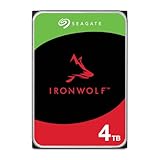
System simplicity is another significant benefit. If your primary NAS unit suffers a power supply failure or mother-board breakdown, RAID 1 drives can often be extracted and read individually on a standard computer with the correct file system reader. Rebuilding a degraded RAID 1 array after replacing a bad disk involves a straightforward block-for-block clone. This places minimal computational stress on the drives. Pairing two moderate-capacity drives—such as a pair of Western Digital 1TB WD Red Plus NAS Internal Hard Drives or Seagate IronWolf 4TB NAS Internal Hard Drives—gives you an immediate, low-stress safeguard for tax records, project files, and personal photo libraries.
Where Raid 5 Wins
While RAID 1 is simple, its 50% storage overhead becomes expensive when managing tens of terabytes. This is where RAID 5 excels. Instead of duplicating entire disks, RAID 5 stripes data across three or more drives while distributing “parity” information (the mathematical calculation used to reconstruct lost data) across all member disks.
The main strength of RAID 5 is usable capacity per dollar spent. In a 3-drive array, you lose only 33% of raw capacity to redundancy. In a 4-drive array, that loss drops to 25%, and in a 5-drive array, it drops to 20%. Consider a multi-bay chassis, such as an ORICO 5 Bay RAID External Hard Drive Enclosure or a flexible unit like the UGREEN 5-Bay USB-C DAS Enclosure. If you populate four 4TB drives in RAID 5, you achieve 12TB of usable storage out of 16TB total raw space. In RAID 1 (or RAID 10), that same raw 16TB would yield only 8TB of usable storage.
Read performance also scales significantly in RAID 5. Because the system can read data blocks simultaneously from multiple drives in the array, throughput speeds rise. This makes RAID 5 ideal for handling multiple incoming connections at home—such as streaming a 4K movie in the living room while automated system backups run on two separate laptops in adjacent rooms.
Cost Over 5 Years
Calculating the true cost of home data redundancy requires looking beyond the initial purchase price to consider drive longevity, energy consumption, and expansion paths over a half-decade lifespan.
An entry-level 2-bay RAID 1 setup running two enterprise-grade NAS drives (like 4TB CMR drives priced around $180–$190 each) alongside an entry-level dual-bay enclosure will run roughly $450 to $550 initially. Over five years, a two-drive system idling at roughly 12 Watts continuously consumes about 105 kWh annually. At an average U.S. electricity rate of $0.16 per kWh, powering a RAID 1 array costs about $17 per year, or roughly $85 over five years.
Conversely, a 4-bay or 5-bay RAID 5 system requires a larger initial outlay. Buying a multi-bay enclosure ($190–$220) plus four 4TB NAS drives (~$720–$760) puts the upfront investment near $950 to $1,000. Operating four drives along with a larger system fan draws around 30 Watts on average. That equals roughly 262 kWh annually, or $42 per year in electricity—totalling roughly $210 over five years.
However, cost-per-usable-terabyte flips the advantage back to RAID 5 over time:
- RAID 1 (2 x 4TB Drives): ~4TB usable space. Total 5-year cost (Hardware + Power): ~$585 = ~$146 per usable TB.
- RAID 5 (4 x 4TB Drives): ~12TB usable space. Total 5-year cost (Hardware + Power): ~$1,190 = ~$99 per usable TB.
If your household storage footprint remains below 4TB to 6TB, RAID 1 is more economical up front. If your data footprint exceeds 8TB, RAID 5 delivers lower long-term cost per gigabyte.
Which One for Your Home
Small Apartment
Space and acoustics dominate small-apartment considerations. A compact 2-bay RAID 1 setup tucked onto a bookshelf or inside an open entertainment console keeps acoustic noise beneath ambient living room levels. The low power draw keeps surrounding furniture cool, eliminating the need for aggressive active cabinet ventilation.
Family with Kids/Pets
A multi-person household generates vast amounts of data—phone video backups, shared family media collections, and homework files. Here, RAID 5 in a sturdy 4-bay or 5-bay enclosure offers the necessary capacity headroom. Modern multi-bay enclosures feature sturdy drive-locking mechanisms that protect spinning disks from accidental knocks by pets or children.
Rental
Renters often lack dedicated media closets or hardwired Ethernet jack routing throughout the home. A quiet 2-bay RAID 1 array connected directly to a Wi-Fi router on a sideboard requires no wall drilling or specialized mounting. It moves easily during leases with minimal risk of mechanical disruption during transit.
Long-Term Home
Homeowners building an integrated tech ecosystem (AV racks, smart security cameras recording 24/7, multi-room audio servers) should invest in RAID 5. A higher bay capacity chassis housed in a utility closet or dedicated home office desk setup provides structured, scalable storage that absorbs high-volume family media for years without requiring total system swaps.
FAQ
What happens if a hard drive fails in RAID 1 vs RAID 5?
In RAID 1, the system continues running normally off the remaining healthy drive. You simply pull the failed drive, insert a replacement of equal or larger capacity, and the system mirrors the data over. In RAID 5, the array enters a “degraded” mode, using parity data across the remaining drives to calculate missing files on the fly. Rebuilding RAID 5 requires reading every remaining sector across all good drives to reconstruct data onto the new disk, placing higher stress on the surviving drives during the rebuild process.
Can I start with RAID 1 and migrate to RAID 5 later?
Most modern NAS operating systems support online RAID level migration. You can start with two drives in RAID 1 and, when you add a third drive of equal size, convert the array into RAID 5 without formatting your existing data. However, direct-attached hardware enclosures (DAS) without software management usually require wiping the drives to reconfigure dip switches or hardware RAID modes, requiring a separate temporary backup before changing modes.
Is RAID 1 or RAID 5 a substitute for an offsite backup?
No. A common phrase in system administration is “RAID is redundancy, not backup.” RAID protects your system from hardware mechanical failure. It does not protect against accidental deletion, file corruption, ransomware, power surges, or home disasters like fire or water damage. Always maintain a secondary backup offsite or in cloud storage following the 3-2-1 backup rule (3 copies of data, 2 different media types, 1 offsite location).
How much drive space do I actually lose to parity and redundancy?
In RAID 1, you always reserve exactly 50% of your overall capacity for mirroring, regardless of drive size. In RAID 5, you lose the usable capacity equivalent of exactly one drive in the array. For example, a 3-drive array loses 1/3 (33%) of total raw space, a 4-drive array loses 1/4 (25%), and an 8-drive array loses 1/8 (12.5%), making RAID 5 increasingly space-efficient as you add drive bays.


