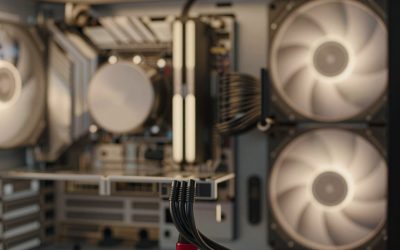
Your PC contains two very different types of memory that sound almost the same on a spec sheet: DDR5 in your motherboard slots and GDDR6 on your graphics card. They are both “double data rate” memory, yet they are engineered for opposite priorities. Knowing how they differ explains why you cannot swap one for the other and why each is tuned the way it is.
As an Amazon Associate we earn from qualifying purchases at no extra cost to you.


Our Top Picks
 CORSAIR Vengeance RGB DDR5 RAM 32GB32GB (2 x 16GB)5.43 x 0.27 x 1.77 inches0.11 PoundsCheck on Amazon


Top 3 picks at a glance
Two jobs, two designs
System memory (DDR5) feeds the CPU, which juggles many small, unpredictable tasks and needs low latency to respond quickly. Graphics memory (GDDR6) feeds the GPU, which crunches massive parallel workloads and needs enormous bandwidth to keep thousands of cores fed. That single difference, latency versus bandwidth, drives almost every design choice that follows.
The key contrasts
| Attribute | DDR5 (system RAM) | GDDR6 (graphics) |
|---|---|---|
| Optimized for | Low latency | High bandwidth |
| Per-pin speed | ~4,800-8,000 MT/s | ~14,000-20,000 MT/s |
| Bus width | 64-bit per channel | Very wide (256-384 bit+) |
| Placement | Removable DIMMs | Soldered near GPU |
| Upgradeable | Yes | No |
| Latency | Lower | Higher |
Why bandwidth versus latency matters
GDDR6 achieves staggering total bandwidth by running at very high per-pin speeds across an extremely wide bus, moving hundreds of gigabytes per second to satisfy a GPU rendering millions of pixels. To hit those speeds it accepts higher latency, which is fine because graphics work is predictable and streamed in bulk. DDR5 does the reverse: modest bandwidth per channel but lower latency, so the CPU is not left waiting on the scattered, branchy accesses that general computing produces.
Why they are soldered or socketed the way they are
GDDR6 must sit physically close to the GPU with short, carefully tuned traces to reach its speeds, so it is soldered right next to the graphics chip and cannot be upgraded. DDR5 is designed to work in removable DIMM slots, trading some signal integrity for the flexibility to add or replace memory, which is why you can upgrade system RAM but never graphics memory.
What this means for buyers
You choose DDR5 capacity and speed when building or upgrading a PC, but GDDR6 comes fixed with whatever graphics card you buy. That is why “how much VRAM” is a card-selection decision, while “how much RAM” is a separate one. Both matter for gaming: too little system RAM causes stutter and swapping, while too little VRAM forces texture downgrades and pop-in.
How the two work together in a game
It helps to picture the division of labor during a single frame. Your CPU, fed by DDR5, handles game logic, physics, AI, and preparing draw instructions, all of which involve unpredictable, scattered memory accesses where low latency keeps the processor responsive. Those instructions and the associated textures then flow to the GPU, which leans on its GDDR6 to stream the vast amounts of texture and geometry data needed to render the scene at high bandwidth. Both must be adequate: if system RAM is too small, the game stutters as it swaps data to disk, and if VRAM is too small, the GPU drops textures or hitches loading them. The two memory types never substitute for each other; they are teammates with distinct, complementary roles.
FAQ
Can I add GDDR6 memory to my graphics card?
No. GDDR6 is soldered directly onto the graphics card next to the GPU and cannot be added or upgraded. The only way to get more VRAM is to buy a card that comes with a larger amount.
Is GDDR6 faster than DDR5?
In total bandwidth, yes, dramatically, which is why GPUs use it. But DDR5 has lower latency, which suits the CPU’s workload better. They are optimized for different things, so “faster” depends on whether you mean bandwidth or responsiveness.
Bottom line
DDR5 and GDDR6 are both double-data-rate memory, but DDR5 is built for the CPU’s need for low latency in removable, upgradeable DIMMs, while GDDR6 is built for the GPU’s need for massive bandwidth in soldered, non-upgradeable chips. You pick your system RAM, but graphics memory comes fixed with your card. Both matter for smooth gaming, and neither can do the other’s job.