Our Short List of 3

- Best for: Receiver owners with a couch near the rear wall who want diffuse, room-filling rear ambience.
- Configuration: 2-way, 4-driver bipolar surround speakers (pair)
- Tweeters: dual 1-inch neodymium balanced dome
- Woofers: dual 4-inch polymer-treated
- Power handling: 20–100 watts

- Best for: Small rooms and gaming setups that need pinpoint rear effects from a compact, wall-mountable cabinet.
- Tweeter: 1-inch Terylene dome, Hi-Res Audio certified
- Woofer: 4-inch mica-fortified polypropylene
- Design: Power Port bass-enhancing cabinet, wall-mountable
- Compatibility: Dolby Atmos and DTS:X systems (per listing title)

- Best for: Dedicated theater rooms with a receiver, especially systems already running Klipsch Reference Premiere fronts.
- Tweeters: dual 1-inch LTS titanium diaphragm with 90° x 90° Tractrix horns
- Woofers: dual 5.25-inch Cerametallic
- Technology: Wide Dispersion Surround Technology (WDST)
- Impedance: 8 ohms
All 5 Picks at a Glance
| Product | Specs | Action |
|---|---|---|
| Fluance SXBP2 |
| Check price on Amazon |
| Polk Signature Elite ES10 |
| Check price on Amazon |
| Klipsch RP-502S II |
| Check price on Amazon |
 Samsung SWA-9200S |
| Check price on Amazon |
 Sony SA-RS3S |
| Check price on Amazon |
The rear channels are where a surround system either becomes a room or stays a wide stereo image with occasional noises behind you. The real decision is not driver size. It is what the speakers have to connect to: passive pairs need a receiver with spare surround channels, while soundbar owners can only add the wireless rear kit built for their exact bar. Dispersion matters next, because a bipolar cabinet spreads effects across the back wall, while a small direct-firing box pins them to one spot.
This guide is for three kinds of buyers: receiver owners finishing a 5.1 or 7.1 layout, gamers who want effects placed behind the seat rather than simulated, and soundbar owners whose bar supports an add-on rear kit. Every pick below is a genuine rear-channel product — a surround pair or a rear kit — taken from its Amazon listing, with the connection type, driver layout, and compatibility limits stated up front.
Our Top Picks
Top 3 picks at a glance
Quick Picks
As an Amazon Associate we earn from qualifying purchases.
| Product | Best for | Key spec from title |
|---|---|---|
| Fluance SXBP2 | Receiver owners who want diffuse rear ambience | 2-way bipolar pair, dual 4-inch woofers |
| Polk Signature Elite ES10 | Small rooms needing pinpoint rear effects | 1-inch tweeter, 4-inch woofer, Power Port |
| Klipsch RP-502S II | Dedicated theaters with full-size front speakers | WDST, dual 5.25-inch Cerametallic woofers |
| Samsung SWA-9200S | Samsung soundbar owners adding true rears | 2.0-channel wireless rear speaker kit |
| Sony SA-RS3S | Sony soundbar owners adding true rears | Wireless rear pair, 100W total output |
How to Choose
Match the connection to the system you already own
Rear speakers split into two camps that never mix. Passive pairs such as the Fluance, Polk, and Klipsch picks wire into an AV receiver’s surround terminals, so they only work if a receiver with free channels is already in the rack. Wireless rear kits carry their own amplification and radio link, but each one speaks to a single brand family: the Samsung kit ignores Sony bars, and the Sony pair ignores Samsung bars. Check the exact soundbar model list on the listing before ordering, because a one-letter difference in model names can mean a different kit.
Choose a radiation pattern: diffuse or pinpoint
Bipolar and wide-dispersion cabinets fire drivers in two directions, smearing rear effects across the back of the room so a helicopter sounds like it fills the space instead of coming from one box. That suits movie-first rooms and couches pushed against the rear wall. Direct-firing surrounds such as the Polk ES10 aim everything at the listener, which keeps game audio and multi-channel music precise: a footstep behind your character lands in one clear spot. Neither is better in the abstract. Pick diffuse for atmosphere, direct for accuracy, and match the choice to how close the seat sits to the speakers.
Plan placement before you buy
In a 5.1 layout the surrounds belong just behind the listening position and slightly above ear level, angled toward the seat; in 7.1 they split into side and rear pairs. That geometry decides the hardware. Wall-hugging rooms need cabinets with keyhole slots or mountable backs and shallow depth, while open rooms can use stands. Passive pairs also need a cable path from the receiver, which can mean running wire under rugs or along baseboards. Wireless kits remove the long run but still need a power outlet near each rear position, so count your rear-wall outlets before assuming wireless means cable-free.
Keep power and bass expectations realistic
Rear channels carry effects, ambience, and the occasional musical swell, not the full weight of a soundtrack, so modest power handling is normal and a large front-stage amplifier channel is wasted here. What matters is an 8-ohm load that any receiver can drive and a sensitivity figure that lets the pair keep up with your fronts at the same volume setting. Small rear cabinets also roll off well above deep bass, so set the receiver’s crossover around the listing’s low-frequency limit and let the subwoofer take over below it. Skipping that step leaves effects thin and strains the little woofers.
The 5 Best Options
Fluance SXBP2
- Best for: Receiver owners with a couch near the rear wall who want diffuse, room-filling rear ambience.
- Configuration: 2-way, 4-driver bipolar surround speakers (pair)
- Tweeters: dual 1-inch neodymium balanced dome
- Woofers: dual 4-inch polymer-treated
- Power handling: 20–100 watts
Receiver owners with a couch near the rear wall who want diffuse, room-filling rear ambience.
The response stops at 130 Hz, so set the receiver crossover at or above that point and let the subwoofer cover the rest.
The SXBP2 is the straightforward way to finish a receiver-based 5.1 or 7.1 system when the couch sits close to the back wall. Each cabinet fires from two faces, with a 1-inch tweeter and 4-inch woofer per side, so rear effects wash across the room instead of beaming from a single point behind your head. That makes it forgiving of awkward seating and off-center couches. It is a passive design, so your receiver supplies the power, and the trapezoidal cabinet is shaped to sit on a stand or hang on the rear wall.
Polk Signature Elite ES10
- Best for: Small rooms and gaming setups that need pinpoint rear effects from a compact, wall-mountable cabinet.
- Tweeter: 1-inch Terylene dome, Hi-Res Audio certified
- Woofer: 4-inch mica-fortified polypropylene
- Design: Power Port bass-enhancing cabinet, wall-mountable
- Compatibility: Dolby Atmos and DTS:X systems (per listing title)
Small rooms and gaming setups that need pinpoint rear effects from a compact, wall-mountable cabinet.
It is a direct-firing design, so placement matters more — aim both cabinets at the listening position rather than flat along the wall.
Where the Fluance spreads sound out, the ES10 aims it. This compact direct-firing pair suits small rooms, deskside theater setups, and gamers who want rear effects placed precisely rather than diffused — a door closing behind your character should come from one spot. The 4-inch woofer uses Polk’s Power Port design to keep its modest cabinet from sounding thin, and the cabinet is wall-mountable for rooms where stands will not fit. As a passive pair it needs a receiver, and it voices cleanly alongside Polk Signature Elite fronts if you are building within one family.
Klipsch RP-502S II
- Best for: Dedicated theater rooms with a receiver, especially systems already running Klipsch Reference Premiere fronts.
- Tweeters: dual 1-inch LTS titanium diaphragm with 90° x 90° Tractrix horns
- Woofers: dual 5.25-inch Cerametallic
- Technology: Wide Dispersion Surround Technology (WDST)
- Impedance: 8 ohms
Dedicated theater rooms with a receiver, especially systems already running Klipsch Reference Premiere fronts.
At 17 pounds per cabinet these need studs or proper anchors for wall mounting, and Amazon US stock has historically come through third-party sellers, so confirm the seller and condition at checkout.
The RP-502S II is the step-up pick for a dedicated theater room, built around Klipsch’s Wide Dispersion Surround Technology: two driver sets angled away from each other so effects wrap around the seating instead of firing from one face. Dual 5.25-inch Cerametallic woofers give it more output headroom than the smaller pairs here, which suits bigger rooms and receivers that get pushed hard during action scenes. It is also the natural rear partner for Reference Premiere front speakers. The cabinets are large and heavy for surrounds, so plan the wall mounting or stands before they arrive.
Samsung SWA-9200S
- Best for: Owners of a listed Samsung soundbar who want real rear channels without running speaker wire across the room.
- Kit type: 2.0-channel wireless rear speaker kit
- Speakers: two front-firing rear speakers
- Connection: wireless link to soundbar; no separate receiver module
- Compatibility (per listing): 2023 bars B550, B650, C450, Q600C, S50B, S60B, S61B, B63C; 2024 bars B550D, B750D, S60D, S61D, S700D
Owners of a listed Samsung soundbar who want real rear channels without running speaker wire across the room.
Check your bar’s exact model number against the listing list before ordering — near-identical model names use different kits.
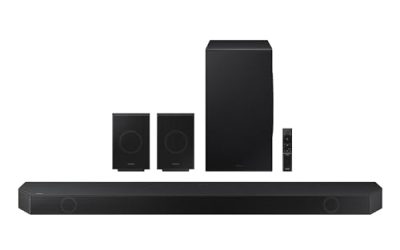
If your front stage is a Samsung soundbar, this is the rear upgrade built for it. The kit adds two front-firing rear speakers that link to the bar wirelessly, turning a bar-and-subwoofer setup into genuine surround with effects physically behind you. There is no separate receiver module to hide, which keeps the install short. The catch is the compatibility list: the kit only pairs with the Samsung soundbar models named on the listing, including several Q-series, S-series, and B-series bars, and it will not talk to any other brand’s bar or to a receiver.
Sony SA-RS3S
- Best for: Owners of a listed Sony soundbar or the STR-AN1000 receiver who want powered rears with no speaker wire to run.
- Type: wireless rear speakers, pair
- Output: 100 watts total (50 watts per speaker)
- Design: two-way speaker system
- Compatibility (per listing): BRAVIA Theatre BAR 8 and BAR 9, HT-A7000, HT-A5000, HT-A3000, HT-S2000, STR-AN1000
Owners of a listed Sony soundbar or the STR-AN1000 receiver who want powered rears with no speaker wire to run.
Each speaker needs its own power outlet at the rear of the room, and the pair only works with the Sony models on the listing.
Sony soundbar owners get their own dedicated path in the SA-RS3S, a wireless rear pair that connects directly to compatible BRAVIA Theatre bars, HT-A series soundbars, and the STR-AN1000 receiver named on the listing. Each speaker carries its own amplification, rated at 100 watts total across the pair, and the two-way design gives rear effects more body than the tiny satellites bundled with cheaper kits. Because each speaker plugs into its own power outlet, placement is flexible anywhere along the rear wall. Like the Samsung kit, the guest list is strict and brand-locked.
Which One Fits Your Situation
You have a receiver and a couch against the wall
Choose the Fluance SXBP2. Bipolar cabinets were made for exactly this geometry: with no space behind the seat, their two firing faces spread rear effects along the wall instead of blasting the nearest listener. Set the receiver crossover at 130 Hz or above, hang them just above ear height, and the rear soundstage stays even from every seat on the couch.
You game in a small room and want effects placed precisely
Choose the Polk ES10. Direct-firing cabinets keep positional cues sharp, which matters more in games than in films: footsteps, reloads, and callouts behind your character stay in one readable spot. Wall-mount the pair at ear height behind the chair, angle them inward, and their compact size leaves room for a desk, monitor arms, and everything else a small gaming room has to hold.
You are building a dedicated theater around a receiver
Choose the Klipsch RP-502S II. A bigger room and a receiver that gets driven hard need surrounds with real headroom, and the dual 5.25-inch woofers and horn tweeters here keep up with full-size front speakers during loud scenes. The wide-dispersion layout also forgives rows of seating, since no single seat sits in a narrow sweet spot. Budget for solid mounts or stands — these are not light cabinets.
You own a soundbar and cannot run speaker wire
Choose your brand’s kit: the Samsung SWA-9200S for a listed Samsung bar, or the Sony SA-RS3S for a listed Sony bar or the STR-AN1000 receiver. Both replace the long wire run with a wireless link and built-in amplification, so the only cables left are short power cords at the rear wall. Verify the exact bar model on the listing first — these kits are deliberately locked to their own model lists.
Common Mistakes
- Buying a wireless rear kit for the wrong brand or an unlisted soundbar model; the kits are locked to specific model lists and will not pair outside them.
- Ordering passive surrounds when there is no receiver to power them — they carry no amplification of their own.
- Placing both rear speakers together in the center behind the couch instead of separated to the left and right.
- Setting the receiver crossover too low for small rear cabinets, which leaves effects thin and strains the woofers.
- Assuming wireless means no cables at all; every kit here still needs power at the rear wall.
Frequently Asked Questions
Can I use ordinary bookshelf speakers as rear surrounds?
Yes, if they are passive and your receiver has spare surround channels. Dedicated surrounds earn their place through shape and radiation pattern: bipolar and wide-dispersion models spread effects for movie rooms, while compact direct-firing models like the ES10 are easier to mount and aim. Check the impedance and power handling on the listing against your receiver’s ratings before mixing brands.
Do wireless rear speaker kits work with any soundbar?
No. Each kit is built for one brand’s model list: the Samsung SWA-9200S pairs only with the Samsung bars named on its listing, and the Sony SA-RS3S only with the listed Sony bars and receiver. A kit from the wrong brand will not connect at all, so match the full model number, including suffix letters, before ordering.
Where do rear speakers go in a 5.1 setup?
Just behind the listening position, separated to the left and right, and raised slightly above ear level so effects pass over the seat rather than firing into the back of it. Bipolar models tolerate being mounted flat on the rear wall; direct-firing models should angle toward the listener. Keep both speakers at matching heights and distances so the rear image stays balanced.
Do rear speakers need to match my front speakers?
Matching the same brand family helps voices and effects keep one tonal character as they move around the room, which is why the Klipsch and Polk picks pair naturally with their own front lines. It is not a hard requirement, though: rear channels mostly carry effects and ambience, and a receiver’s room calibration can level-match a mixed set. Prioritize the right connection type and radiation pattern first.
Related guides
More from Amazon
Programs that pair well with the guide above. Offers and eligibility are set by Amazon and may change.
A free business account with business pricing and bulk-buying tools for work, shop or home office.
Create a business accountFree shipping on eligible items, Prime Video and more. Eligible new members can start with a free trial.
Start a Prime free trialAudiobooks and podcasts to listen to on the go. Eligible new members can start with a free trial.
Try Audible freeAd-free music streaming. Eligible new subscribers can start with a free trial.
Try Music Unlimited freeAs an Amazon Associate we earn from qualifying purchases.