The Samsung T7 Portable SSD 1TB is the best all-round portable SSD for gaming in this group: its USB 3.2 Gen 2 interface works with nearly every modern PC, laptop, handheld and console, and its listed 1,050 MB/s read speed is about the ceiling of a 10Gbps port. If your computer has a rare 20Gbps USB port, the Samsung T9 pushes the ceiling to 2,000 MB/s. A “portable SSD for gaming” is an external solid-state drive fast enough to load games from, not just back them up. The picks below are compared by interface, listed speed, capacity and ruggedness.
Our Top Picks
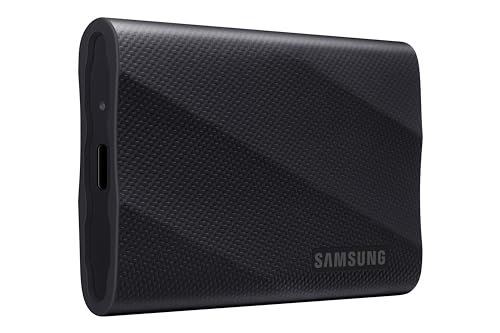


Top 3 picks at a glance
Quick List
- Samsung T7 1TB – best for most players who want a proven 10Gbps drive
- Samsung T9 1TB – best for PCs with a 20Gbps USB port and sustained large transfers
- SanDisk Extreme 1TB (new model) – best for a rugged, water- and dust-resistant drive with encryption
- SSK Portable SSD 500GB – best for a smaller library or a secondary drive that ships with USB-C and USB-A cables
- Samsung T7 2TB – best for a big Steam, Epic or Game Pass library on one drive
- Lexar ES3 1TB – best for a very light, pocketable drive that also targets consoles and phones
Which One Is Right for You?
| If you… | Choose |
|---|---|
| have a 20Gbps (USB 3.2 Gen 2×2) port and want the fastest transfers | Samsung T9 1TB |
| want a safe default for a laptop, handheld or console | Samsung T7 1TB |
| keep a large library and hate shuffling games between drives | Samsung T7 2TB |
| carry the drive in a bag or pocket and worry about spills and drops | SanDisk Extreme 1TB |
| only need a few games and want the smallest capacity | SSK 500GB |
| want something thin and light that also works with consoles | Lexar ES3 1TB |
Most of these drives share the same 10Gbps ceiling, so the real decision is capacity, durability and port compatibility. Only the T9 and the new SanDisk model advertise 2,000 MB/s, and both need the host port to keep up. Check what your USB ports actually support before you pay for a faster drive.
All 6 Picks in Detail
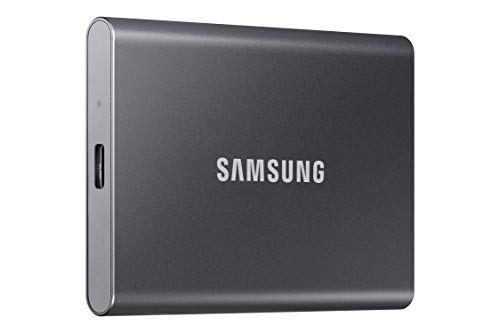
1. Samsung T7 1TB – Best for most players
As an Amazon Associate we earn from qualifying purchases at no extra cost to you.

The T7 is the straightforward choice. The listing describes PCIe NVMe technology behind a USB 3.2 Gen 2 interface with read and write speeds up to 1,050 and 1,000 MB/s. That is essentially the maximum a 10Gbps port can deliver, so a faster drive would gain nothing on most laptops. It is small, supports a wide range of capacities up to 4TB, and works with phones as well as PCs.
- 1TB capacity, Titan Gray finish
- USB 3.2 Gen 2 (10Gbps) interface
- Up to 1,050 MB/s read and 1,000 MB/s write
- PCIe NVMe inside
- About 3.3 x 2.2 x 0.3 inches and 0.13 pounds per the listing
- Records 4K 60fps video directly on supported cameras and phones, per the listing
Pros
- Fast enough to load games quickly on any 10Gbps port
- Very small and light
Cons
- Not the fastest here; the T9 doubles the listed top speed on a 20Gbps port
- No ingress-protection rating is stated in the listing
Compared with the 2TB version, it is the leaner choice if your library is under about 800GB of usable space. For a lot of players this is the sweet spot between capacity and portability, and its long presence in the market means plenty of independent write-ups exist if you want a second opinion.
2. Samsung T9 1TB – Best for 20Gbps ports and sustained transfers

The T9 uses USB 3.2 Gen 2×2, a 20Gbps interface, with listed sustained read and write speeds up to 2,000 MB/s. The listing also highlights Dynamic Thermal Guard, a thermal solution that keeps the drive cool during longer transfers, and Magician software for firmware updates, encryption and health monitoring. The catch is the port: if your computer only has 10Gbps ports, the T9 falls back to roughly the same speed as a T7.
- 1TB capacity, black
- USB 3.2 Gen 2×2 (20Gbps)
- Up to 2,000 MB/s sustained read and write
- Dynamic Thermal Guard for heat control
- Samsung Magician software with firmware updates and encryption
- About 3.5 x 2.4 x 0.55 inches and 0.27 pounds per the listing
Pros
- Highest listed speed in the group
- Thermal design suits long copies
Cons
- Needs a 20Gbps port to reach 2,000 MB/s
- Thicker and heavier than the T7
If your system has no 20Gbps port, the T7 gives you a similar day-to-day experience in a smaller body.
3. SanDisk Extreme 1TB (new model) – Best for ruggedness and encryption

This SanDisk drive is the toughest one on the list. The listing claims an IP65 rating against water and dust, protection from drops of up to 3 meters, and 256-bit AES encryption with password protection. It lists speeds up to 2,000 MB/s, which the listing calls nearly twice as fast as the previous generation. There is a discrepancy worth knowing about: the title states a USB-C 3.2 Gen 2 interface, which is a 10Gbps standard, while 2,000 MB/s normally needs a 20Gbps connection. Confirm the interface and real-world speeds on the product page before buying.
- 1TB capacity, black
- Up to 2,000 MB/s listed transfer speed
- IP65 water and dust resistance
- Up to 3m drop protection
- 256-bit AES encryption
- About 3.35 x 2 x 0.39 inches and 0.1 pounds per the listing
Pros
- The only drive here with a stated IP rating and drop rating
- Encryption included
Cons
- Interface wording and the 2,000 MB/s claim need to be checked together
- Console support is not stated in the listing
Choose it over the T9 if durability matters more than the interface clarity; choose the T9 if you want a clearly documented 20Gbps drive.
4. SSK Portable SSD 500GB – Best for a small library or backup drive

The SSK is the budget-minded choice by capacity, not by claims: it lists read speeds up to 1,050 MB/s and writes up to 1,000 MB/s over USB 3.2 Gen 2, with both USB-C and USB-A cables in the box. The listing explains that 25 percent of available capacity acts as an SLC cache, so sustained writes beyond that cache will slow down. It also notes that 500GB shows as roughly 465GB in Windows because of binary calculation, which is normal and not a defect.
- 500GB capacity, grey
- USB 3.2 Gen 2 (10Gbps)
- Up to 1,050 MB/s read and 1,000 MB/s write
- USB-C and USB-A cables included
- S.M.A.R.T. diagnostics and TRIM
- LED activity indicator; about 2.7 x 1.5 x 0.5 inches
Pros
- Cables for both port types
- Compact enough to ignore in a bag
Cons
- Smaller capacity fits only a handful of large games
- Write speed drops once the cache fills
Next to the Lexar ES3, it offers half the capacity but ships with a USB-A cable too.
5. Samsung T7 2TB – Best for a big game library
This is the same T7 platform at 2TB. It has the same USB 3.2 Gen 2 interface, the same listed speeds of up to 1,050 MB/s, and the same body. The reason to buy it is room: modern AAA games often exceed 100GB each, so 2TB holds a meaningfully larger rotation without deleting and reinstalling. It is a good fit for a single gaming laptop or handheld that has little internal storage.
- 2TB capacity, Titan Gray
- USB 3.2 Gen 2 (10Gbps)
- Up to 1,050 MB/s listed speed
- PCIe NVMe inside
- About 3.3 x 2.2 x 0.3 inches per the listing
- Works with PC and mobile devices
Pros
- Large capacity in a very small drive
- Same dependable interface as the 1TB model
Cons
- More capacity than casual players need
- Speed is capped by the 10Gbps interface
Pick it over the T7 1TB only if you actually fill the smaller drive, since both perform alike. It also suits a handheld PC owner who wants the entire library available on the road without juggling installs.
6. Lexar ES3 1TB – Best for a thin, pocketable drive

The ES3 is built around portability. The listing gives its weight as 42 grams and its thickness as 10.5mm, supports USB 3.2 Gen 2 with up to 1,050 MB/s read and 1,000 MB/s write, and names compatibility with Android phones, laptops, cameras, Xbox Series X|S, PS4, PS5 and iPhone 17 series models. It includes Lexar DataShield 256-bit AES encryption software. The listing notes that MagSafe is not available in this version.
- 1TB capacity, silver
- USB 3.2 Gen 2 (10Gbps)
- Up to 1,050 MB/s read and 1,000 MB/s write
- 256-bit AES encryption software
- 42g and 10.5mm thick per the listing
- Type-C cable included
Pros
- Very light and thin
- Console and phone compatibility is stated
Cons
- No magnetic mounting in this version
- No water or drop rating is stated
Compared with the T7 1TB, it is lighter and states console support, though the Samsung has a longer track record.
Specs Compared
| Drive | Capacity | Interface | Listed read / write | Durability and security | Console / platform notes |
|---|---|---|---|---|---|
| Samsung T7 1TB | 1TB | USB 3.2 Gen 2 (10Gbps) | Up to 1,050 / 1,000 MB/s | Confirm on listing | PC and mobile |
| Samsung T9 1TB | 1TB | USB 3.2 Gen 2×2 (20Gbps) | Up to 2,000 MB/s sustained | Thermal Guard; Magician encryption | Desktop, camera, game console |
| SanDisk Extreme 1TB | 1TB | Listing states USB-C 3.2 Gen 2; confirm | Up to 2,000 MB/s | IP65, 3m drop, 256-bit AES | Confirm on listing |
| SSK 500GB | 500GB | USB 3.2 Gen 2 (10Gbps) | Up to 1,050 / 1,000 MB/s | S.M.A.R.T., TRIM | USB-C and USB-A cables |
| Samsung T7 2TB | 2TB | USB 3.2 Gen 2 (10Gbps) | Up to 1,050 MB/s | Confirm on listing | PC and mobile |
| Lexar ES3 1TB | 1TB | USB 3.2 Gen 2 (10Gbps) | Up to 1,050 / 1,000 MB/s | 256-bit AES software | Xbox Series X|S, PS4, PS5, Android, iPhone 17 series |
How We Chose These
We compiled this list from current catalog listings and published USB explainers rather than from our own testing. For each drive we read the listing title, feature bullets and specification fields, then compared interface generation, listed read and write speeds, capacity, physical size and any stated durability or encryption. We kept to portable NVMe-style drives that advertise at least 1,000 MB/s, and where a listing was ambiguous, as with the SanDisk interface wording, we flagged it instead of guessing. We also checked how consoles treat external USB storage so the advice on game support is accurate. Speeds quoted are manufacturers’ maximums, not measured results.
What to Look For
Interface: 10Gbps versus 20Gbps
USB naming is confusing. USB 3.2 Gen 1 is 5Gbps, USB 3.2 Gen 2 is 10Gbps and USB 3.2 Gen 2×2 is 20Gbps. A 10Gbps drive reaches roughly 900 to 1,050 MB/s in practice, which is where the T7, SSK and Lexar sit. A 20Gbps drive can reach 1,700 to 1,900 MB/s sustained, but only when both the drive and the port support 20Gbps, and few consumer PCs have such a port. If your port is 10Gbps, a Gen 2×2 drive simply runs at Gen 2 speeds, so you would not benefit from the extra cost.
What speed matters for gaming
Load times depend on more than raw throughput. Once the drive can deliver about 1,000 MB/s, games spend most of their loading time on decompression and CPU work, so doubling throughput brings smaller gains than the numbers suggest. Where speed does matter is copying: installing or moving a 100GB game takes about 100 seconds at 1,000 MB/s in ideal conditions and about 50 seconds at 2,000 MB/s. Sustained speed also depends on caching; the SSK listing describes a cache using 25 percent of free capacity, and once it fills, writes slow down.
Console and handheld compatibility
External drives work differently on consoles. On PlayStation 5, you can store PS5 games on a USB drive but must copy them to the internal SSD to play them; PS4 games can be played from the external drive. On Xbox Series X|S, external USB 3.0 or later drives can run Xbox One, Xbox 360 and original Xbox titles, while Series X|S optimized games must be moved back to the internal drive or the proprietary expansion card to play. So a portable SSD is a storage and backup aid for current-generation console games and a direct play drive for older titles. PC handhelds can generally run games directly from an external drive, with slightly longer loads than internal storage.
Capacity planning
A drive advertised as 1TB formats to roughly 930GB of usable space in Windows, and 500GB shows as around 465GB. Large games range from 50GB to well over 150GB, so a 1TB drive holds roughly six to ten big titles and a 2TB drive about double. Leave 10 to 15 percent free to keep write speeds healthy. As a rule of thumb, buy the capacity that fits your current library plus the next year of installs.
Durability, heat and cables
An IP65 rating means dust-tight and protected against water jets, which suits a bag or a desk with drinks nearby. The listed 3m drop rating is a manufacturer claim, not a guarantee. Heat can throttle speeds during long copies, which is why Samsung highlights thermal control on the T9. Always use the supplied cable; a cheap or damaged cable can limit speed to 5Gbps or cause disconnects.
Setting up the drive for games
On Windows, a new portable SSD usually arrives formatted as exFAT, which works on both Windows and macOS and is accepted by consoles, though each console may reformat the drive for its own use. For a drive that will only ever serve a Windows gaming PC, NTFS is a fine choice and handles very large game files and permissions cleanly. When you point a launcher such as Steam at the drive, create a dedicated library folder on it rather than installing into the root, so the launcher can find the games again if the drive letter changes. Always use the safe-removal option before unplugging, because a game that is still writing a save or shader cache can corrupt data if the cable is pulled. Finally, remember that an external drive is not a backup of itself: keep important saves and personal files in a second location.
A short worked example helps with sizing. Imagine your library holds four 120GB games, two 60GB games and a 40GB indie collection. That is 480 plus 120 plus 40, or 640GB. With a 15 percent free-space buffer you need roughly 750GB of usable space, which points to a 1TB drive, and the 2TB model only makes sense if you expect the library to grow past about 1.5TB of games.
Questions
Can I play games directly from a portable SSD?
On a PC or handheld, yes. Games run from an external SSD with somewhat longer loads than from an internal NVMe drive. On consoles, only older-generation titles run directly from external storage.
Is the Samsung T9 worth it over the T7?
Only if your computer has a 20Gbps USB port and you move very large files often. On a standard 10Gbps port, the T9 runs at roughly the same speed as a T7.
Will a portable SSD work on PS5?
Yes, for storing PS5 games and for playing PS4 games. PS5 games must be copied to the console’s internal storage to be played. The Lexar ES3 listing names PS5 compatibility explicitly; for other drives, confirm on the product page.
Why does 1TB show as less than 1TB?
Manufacturers count a terabyte as one trillion bytes, while Windows reports space in binary units, so 1TB appears as about 930GB. Some space is also used by formatting. This is normal.
Do I need an encrypted drive?
Not for a game library, but encryption is helpful if you also carry personal files. The SanDisk, Lexar and Samsung T9 listings each mention encryption or encryption software.
How do I keep the drive fast over time?
Keep 10 to 15 percent of the drive free, avoid unplugging during writes, and use the supplied cable. Updating firmware through the maker’s utility is also recommended where offered.
Update History
- October 14, 2026 – Initial publication; product set drawn from current catalog listings.
- Check the product page for current specifications and availability before buying.
Sources
- Retailer listing titles, feature bullets and specification fields for all six drives
- Published explainers on USB 3.2 Gen 1, Gen 2 and Gen 2×2 naming and real-world speeds
- Console maker guidance, as summarized by independent publications, on external storage for PlayStation 5 and Xbox Series X|S