
Setting up a modern home entertainment hub is one of the most rewarding home improvement projects you can undertake. However, nothing ruins a carefully curated living room aesthetic or a cozy movie night faster than the constant, disruptive clicking of traditional mechanical hard drives spinning inside your media cabinet. Even worse is the dreaded buffering screen that appears when your system struggles to convert a high-definition 4K video file on the fly. If you want a silent, seamless, and clutter-free entertainment setup, standard storage solutions simply will not cut it.
To eliminate these frustrations, discerning homeowners are upgrading their entertainment centers with dedicated, whisper-quiet network-attached storage (NAS) enclosures and hardware transcoders. By pairing these sleek hubs with the best internal ssd for plex media server stream transcoding, you can ensure that your media library loads instantly, streams without stuttering, and operates in absolute silence. Populating your media server with high-speed solid-state drives transforms your closet or living room console into a silent powerhouse capable of delivering cinema-grade playback to every screen in your house simultaneously.
As an Amazon Associate we earn from qualifying purchases at no extra cost to you.


Top 3 picks at a glance
Quick Picks
| Product | Best for | Price |
|---|---|---|
| Synology DS225+ Private Cloud Media Server | Best Compact 2-Bay Server | $364.99 |
| Synology DS425+ Private Cloud Media Server | Best High-Capacity 4-Bay Server | $589.44 |
| ORIVISION H.265/264 4K HDMI VGA Decoder | Best Hardware IP Transcoder | $246.00 |
How We Picked
When selecting the ideal hardware to host your home media library, we evaluated units based on physical footprint, thermal efficiency, noise output, and ease of storage integration. Because these devices often sit in communal living areas, home offices, or media closets, we prioritized compact designs that blend naturally with high-end furniture and home decor. We also paid close attention to how these systems manage heat and power consumption, focusing on models that draw minimal wattage (ranging from 15 watts to 40 watts) to keep utility bills low and eliminate loud fan noise.
Furthermore, we analyzed how easily these platforms interface with solid-state storage. To get the absolute most out of the best internal ssd for plex media server stream transcoding, your host hardware must feature high-speed internal interfaces, robust memory configurations, and capable processors. We selected systems that allow users to easily install SATA or NVMe SSDs to act as primary storage volumes or high-speed cache pools. This ensures that temporary transcode files are written and read instantly, preventing bottlenecks when multiple family members stream different movies at the same time.
The 3 Best Picks
Synology DS225+ Private Cloud Media Server
The Synology DS225+ is the ideal entry point for homeowners who want a sleek, space-saving media hub that sits discreetly on a bookshelf or inside an AV cabinet. Measuring just 6.5 by 4.2 by 8.7 inches and weighing a mere 2.8 pounds, this 2-bay diskless unit fits easily into tight spaces without cluttering your room. Powered by an efficient Intel CPU, it features dedicated hardware transcoding engines that effortlessly convert video formats on the fly. To unlock its true potential, populating this server with the best internal ssd for plex media server stream transcoding ensures that your Plex poster art, metadata, and temporary video buffers load instantaneously without the sluggish seek times or mechanical noise of traditional hard drives.
- Pros: Highly power-efficient Intel CPU handles hardware-accelerated transcoding smoothly; incredibly compact footprint fits into any living room decor.
- Cons: Limited to two drive bays, which restricts maximum long-term storage expansion.
When to skip: Skip this model if you have a massive, multi-terabyte library of uncompressed Blu-ray rips that requires more than two physical drive bays to store and protect your data.
Synology DS425+ Private Cloud Media Server
For dedicated home theater enthusiasts who require extensive storage capacity along with top-tier performance, the Synology DS425+ is a premier 4-bay solution. This diskless chassis allows you to build a robust, fault-tolerant storage array while maintaining a quiet, elegant profile in your home office or media closet. By dedicating one or more of its four bays to the best internal ssd for plex media server stream transcoding, you can create a hybrid storage system where cold media files rest on high-capacity drives while the active Plex database and transcode cache run on lightning-fast solid-state storage. Its advanced cooling system runs quietly, drawing roughly 28 watts of power during active use.
- Pros: Four drive bays provide excellent flexibility for RAID data protection and SSD caching; robust build quality with quiet, efficient cooling fans.
- Cons: Higher initial price point of $589.44 before purchasing any internal drives.
When to skip: Skip this model if you only stream to one or two screens in a small apartment and do not need complex data backup or expansive multi-drive storage pools.
ORIVISION H.265/264 4K HDMI VGA Decoder
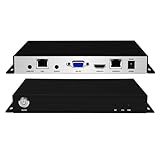
The ORIVISION H.265/264 4K Decoder is a specialized, professional-grade hardware transcoder designed for advanced smart home networks and multi-screen AV setups. Housed in a durable, fanless metal chassis that measures approximately 5.4 by 4.1 by 1.1 inches, this compact device can be tucked invisibly behind a wall-mounted television or flat inside a structured media panel. While it does not host storage internally, it excels at decoding and translating IP video streams across various network protocols like RTMP, RTSP, and SRT. When integrated into a wider home network where a central server utilizes the best internal ssd for plex media server stream transcoding, this decoder ensures high-bitrate video feeds are distributed across your home without lag.
- Pros: Fanless, completely silent design is perfect for quiet bedrooms and home theaters; supports a massive array of streaming protocols for versatile AV routing.
- Cons: Lacks internal drive bays, requiring a separate network storage device to hold your media library.
When to skip: Skip this unit if you want an all-in-one, plug-and-play storage and streaming server rather than a dedicated network video decoder and distribution tool.
Buying Guide
Choosing the Right Host Hardware for SSD Caching
When building a premium home media network, understanding how your server interacts with solid-state drives is crucial. While traditional mechanical hard drives offer cheap, high-capacity storage for bulk movie files, they are terrible at handling the constant, random read/write cycles required by Plex metadata and temporary transcode directories. To resolve this, look for NAS enclosures that support hybrid storage configurations. Installing the best internal ssd for plex media server stream transcoding to act as your system’s primary volume or as a dedicated cache pool allows the server to instantly read and write temporary video chunks, preventing playback pauses and reducing drive wear.
Noise, Power, and Ventilation in Home Environments
Unlike commercial server rooms, home media hardware must coexist with your daily life. A system that sounds like a jet engine or heats up your living room cabinet like a space heater will quickly become a nuisance. Look for media servers that operate within a quiet range of 18 to 25 decibels and feature adjustable fan profiles. Power consumption is another key factor; a server running 24/7 should ideally draw between 15 and 35 watts under normal load. Utilizing solid-state drives instead of spinning disks not only drops your noise floor to zero decibels for those drives but also lowers power draw and heat generation, prolonging the lifespan of your electronic components.
Understanding Transcoding Protocols and Formats
Transcoding is the process of converting a video file on the fly so it can play back smoothly on a device that doesn’t natively support the original format—such as streaming a 4K HEVC file to an older tablet or a remote smart TV over a cellular connection. This process is incredibly CPU-intensive. Hardware-accelerated transcoding utilizes the dedicated graphics processing of your server’s CPU to handle this workload efficiently. Having a fast internal SSD ensures that the directory where these temporary video files are written never bottleneck your processor, allowing you to scrub forward and backward through a movie with instantaneous response times.
Our Verdict
As we design smart homes for 2026, creating a clean, silent, and highly responsive media center is easier than ever. For the vast majority of homeowners, the Synology DS225+ Private Cloud Media Server paired with a high-performance internal solid-state drive represents the sweet spot of value, size, and power. Priced at $364.99, its compact 2-bay design fits seamlessly into any home decor, while its Intel CPU handles hardware transcoding beautifully without generating excessive heat or noise.
If you have a massive media collection and want the peace of mind that comes with multi-drive data protection, the Synology DS425+ is an outstanding upgrade that offers plenty of room to scale. For advanced smart home integrators who need to route live video feeds across multiple displays using professional IP protocols, the fanless ORIVISION 4K Decoder is a powerful, silent tool that completes a high-end, multi-room AV distribution network.
FAQ
Why do I need an internal SSD for Plex transcoding?
When Plex transcodes a video, it continuously writes temporary video chunks to a temporary directory before sending them to your playback device. Traditional hard drives struggle with these rapid, simultaneous read and write actions, leading to buffering. Using a solid-state drive for this directory ensures these files are written instantly, resulting in smooth, lag-free playback.
Can I use an external SSD instead of an internal one?
While external USB SSDs can work, they are often bottlenecked by USB interface speeds, external cable connections, and power delivery limits. An internal SATA or NVMe SSD connects directly to your server’s motherboard, providing superior reliability, faster data transfer speeds, and a cleaner aesthetic free of messy external cables.
How much power do these media servers consume annually?
Most modern compact media servers are highly energy-efficient. A 2-bay or 4-bay NAS typically draws between 15W and 30W of power during active streaming. Running 24/7, this translates to roughly 130 to 260 kilowatt-hours per year, which generally costs between $20 and $40 annually depending on local utility rates.
What is the ideal storage capacity for a Plex transcode cache?
You do not need a massive drive solely for transcoding and metadata. An internal solid-state drive with a capacity of 250GB to 500GB is more than enough to store extensive Plex metadata libraries, movie posters, and several simultaneous temporary transcode streams without running out of space.


