- Top Pick: Samsung 9100 PRO with Heatsink
- Runner-up: WD Black SN8100 with Heatsink
- Also consider: Crucial T705 with Heatsink
The best Gen5 SSDs with heatsinks pair PCIe 5.0 speeds with cooling that is already fitted at the factory, so the drive can hold its rated throughput during long game installs and big file transfers. The Samsung 9100 PRO with Heatsink leads this group for most gaming PCs, with the WD Black SN8100 close behind. Below are five factory-cooled Gen5 drives worth shortlisting, plus the checks that matter before buying.
Gen5 controllers run hotter than Gen4 parts, and most motherboard M.2 covers are thin. A drive that ships with its own heatsink removes the guesswork: the thermal solution is designed for that controller, the height is published, and there is no separate cooler to buy or fit.
As an Amazon Associate, we earn from qualifying purchases.
Top 3 picks at a glance
Quick Answer
For most gaming PCs, the Samsung 9100 PRO with Heatsink is the easiest pick thanks to its low-profile cooler and top-tier speeds. The WD Black SN8100 adds RGB lighting and strong efficiency, the Crucial T705 and T700 cover faster and mid-range tiers, and the Corsair MP700 PRO SE Hydro X suits custom liquid-cooled builds.
Table of Contents
- Quick Answer
- Samsung 9100 PRO with Heatsink
- WD Black SN8100 with Heatsink
- Crucial T705 with Heatsink
- Crucial T700 with Heatsink
- Corsair MP700 PRO SE Hydro X Series
- How to Choose
- Who Should Skip
- FAQ
- Final Verdict
- Product and ASIN Reference
Samsung 9100 PRO with Heatsink

Samsung’s flagship Gen5 drive is the simplest recommendation here because its heatsink is genuinely low profile. At up to 8.88 mm tall on the 1TB to 4TB models, it is PCI-SIG D8 compliant and fits tight slots, laptops with room to spare, and the PlayStation 5 expansion bay. The 2TB version is rated at up to 14,700 MB/s sequential reads and 13,400 MB/s writes, with random performance up to 1,850K read and 2,600K write IOPS.
The 9100 PRO uses Samsung’s own 5 nm controller and V-NAND TLC flash, and Samsung rates the 2TB model for 1,200 TBW of endurance. For a gaming library drive that also handles capture recording or mod installs, this is the premium-tier default: fast, slim, and backed by Samsung Magician software support.
Specs:
- Capacity: 2TB (also sold in 1TB, 4TB and 8TB)
- Interface: PCIe 5.0 x4, NVMe 2.0
- Form factor: M.2 2280
- Sequential read/write: up to 14,700 / 13,400 MB/s
- Random read/write: up to 1,850K / 2,600K IOPS
- Endurance: 1,200 TBW
- Cooling: integrated low-profile heatsink, 8.88 mm max height
- Warranty: 5-year limited
WD Black SN8100 with Heatsink
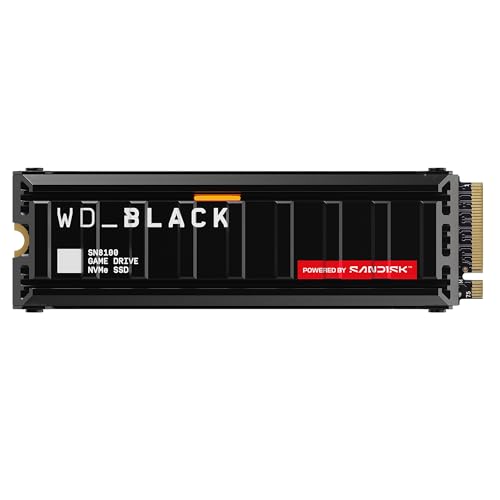
The SN8100 is WD Black’s Gen5 flagship, and its heatsink version is built for gaming desktops first. The anodized aluminum cooler is low profile, fully passive, and adds customizable RGB lighting, which is rare on storage. SanDisk rates the drive at sequential reads up to 14,900 MB/s, with writes up to 11,000 MB/s on the 1TB model and up to 14,000 MB/s on the 2TB and 4TB models.
Inside is TLC 3D CBA NAND and a low-power design with average operating power of 7 W or under, which helps in compact cases. The 1TB version carries a 600 TBW endurance rating and the same 5-year limited warranty as the rest of the line. Pick this one if the drive will be visible through a case window and you want the lighting to match the build.
Specs:
- Capacity: 1TB (also sold in 2TB, 4TB and 8TB)
- Interface: PCIe 5.0 x4, NVMe
- Form factor: M.2 2280
- Sequential read/write: up to 14,900 / 11,000 MB/s
- NAND: TLC 3D CBA
- Endurance: 600 TBW
- Cooling: anodized aluminum heatsink with customizable RGB, passive
- Warranty: 5-year limited
Crucial T705 with Heatsink

The T705 is Crucial’s fastest Gen5 drive, rated at up to 14,500 MB/s reads and 12,700 MB/s writes on the 2TB model, with random performance up to 1,550K read and 1,800K write IOPS. It pairs a Phison E26 controller with Micron 232-layer TLC NAND and a DRAM cache, and the heatsink version wraps it in an aluminum and copper cooler designed to dissipate heat without fans or liquid cooling.
Crucial is clear that the heatsink model needs adequate system airflow to hold peak speeds, so it suits a well-ventilated gaming tower better than a sealed small-form-factor case. Endurance is rated at 1,200 TBW for the 2TB drive. This is the premium-tier pick for buyers who want near-flagship speed and a chunky passive cooler from the same box.
Specs:
- Capacity: 2TB (also sold in 1TB and 4TB)
- Interface: PCIe 5.0 x4, NVMe 2.0
- Form factor: M.2 2280
- Sequential read/write: up to 14,500 / 12,700 MB/s
- Random read/write: up to 1,550K / 1,800K IOPS
- Controller: Phison PS5026-E26
- Endurance: 1,200 TBW
- Cooling: aluminum and copper heatsink, passive
- Warranty: 5-year limited
Crucial T700 with Heatsink

The T700 is the earlier E26 generation, and it now sits in the mid-range tier of Gen5 while still doubling Gen4 speeds. The 2TB heatsink model is rated at up to 12,400 MB/s reads and 11,800 MB/s writes, with random performance up to 1,500K IOPS. Its aluminum heatsink is pre-installed, and Crucial publishes an incompatible-motherboard list worth checking because the cooler is tall for an M.2 drive.
Under the heatsink it uses the same recipe as its successor: Phison E26 controller, Micron 232-layer TLC NAND and a DRAM cache, with endurance rated at 1,200 TBW on the 2TB model. For a gaming PC that will mostly load games rather than move huge files all day, the T700 delivers Gen5 throughput without paying for the newest flagship silicon.
Specs:
- Capacity: 2TB (also sold in 1TB and 4TB)
- Interface: PCIe 5.0 x4, NVMe 2.0
- Form factor: M.2 2280
- Sequential read/write: up to 12,400 / 11,800 MB/s
- Random read: up to 1,500K IOPS
- Controller: Phison PS5026-E26
- Endurance: 1,200 TBW
- Cooling: aluminum heatsink, passive
- Warranty: 5-year limited
Corsair MP700 PRO SE Hydro X Series

Corsair’s Hydro X variant takes a different route: instead of fins, the MP700 PRO SE ships with a pre-installed water block that plumbs straight into a custom liquid-cooling loop using standard quarter-inch fittings. The 4TB model is rated at up to 14,000 MB/s sequential reads and 12,000 MB/s writes, driven by a Phison E26 controller and high-density 3D TLC NAND.
This is an enthusiast-tier part for a narrow audience. If your gaming PC already runs a custom loop, routing the SSD through it removes the drive’s heat from the case air entirely and avoids fan noise. If you do not have a loop, Corsair sells the same drive family with an active air cooler instead, and the standard motherboard heatsink route is simpler for everyone else.
Specs:
- Capacity: 4TB (also sold in 2TB)
- Interface: PCIe 5.0 x4, NVMe 2.0
- Form factor: M.2 2280
- Sequential read/write: up to 14,000 / 12,000 MB/s
- Controller: Phison PS5026-E26
- NAND: high-density 3D TLC
- Cooling: pre-installed Hydro X water block for custom loops
- Warranty: 5-year limited
How to Choose
Start with the slot. A Gen5 drive needs a PCIe 5.0 x4 M.2 slot to reach its rated speeds; in a Gen4 slot it still works, but it runs at Gen4 throughput. Check your motherboard manual for which slots are Gen5, since on some boards the top slot shares bandwidth with the graphics card.
Next, measure the space. Heatsink heights vary a lot across these five drives, from the Samsung’s sub-9 mm profile to tall finned coolers that can clash with a GPU backplate or a motherboard’s own M.2 cover. If your board already has a good M.2 heatsink, the factory-cooled versions still work, but you generally use one cooler or the other, not both stacked.
Then match capacity and endurance to the job. A 1TB drive fills quickly with modern game installs, so 2TB is the practical sweet spot for a primary gaming drive, while 4TB suits large libraries and capture work. TBW ratings matter most for drives that record or rewrite constantly; for a mostly read-only game library, any drive here has endurance to spare.
Finally, decide how much speed you can actually use. All five drives load games quickly, and the gap between 12,400 MB/s and 14,900 MB/s shows up mainly in sustained transfers, installs and DirectStorage titles rather than everyday loading screens.
Who Should Skip
Skip Gen5 entirely if your motherboard has no PCIe 5.0 M.2 slot and you are not planning a platform upgrade; a good Gen4 drive costs less and loads games nearly as fast in practice. Skip the tall heatsink models if your build is a compact ITX case or the drive sits under a thick GPU, and choose the low-profile Samsung instead. Skip the Hydro X model unless you already own, or are definitely building, a custom liquid-cooling loop. And if your PC is mainly for esports titles and older games, the storage is rarely the bottleneck, so the money is better spent on the graphics card or monitor.
FAQ
Do Gen5 SSDs really need a heatsink for gaming?
For short bursts, many Gen5 drives cope with a motherboard heatsink alone, but sustained writes during large installs can push a bare drive into thermal throttling. A factory heatsink is the safe option because it is sized for the controller and keeps rated speeds stable without extra parts.
Will a heatsink Gen5 SSD fit in a PlayStation 5?
Only the low-profile models. Sony’s expansion bay has strict height limits, and the Samsung 9100 PRO with Heatsink is published as PS5 compatible. Tall finned coolers like the Crucial heatsinks and the Corsair water block are designed for desktop PCs and will not fit the console.
Can I remove the factory heatsink and use my motherboard heatsink instead?
On some models the heatsink is removable, but doing so can affect warranty coverage depending on the brand, and the drive still needs some form of cooling to hold Gen5 speeds. It is usually better to buy the bare version of a drive when you plan to use the motherboard’s cooler.
Is a Gen5 SSD noticeably faster than Gen4 for game load times?
In most current games the difference is small, because loading is often limited by the CPU and game engine rather than raw storage bandwidth. Gen5 pulls ahead in very large file transfers, fast installs, and DirectStorage games built to stream assets directly from the SSD.
Final Verdict
For a straightforward Gen5 gaming upgrade, the Samsung 9100 PRO with Heatsink is the pick: flagship speeds, the slimmest cooler here, and the flexibility to fit desktops or a PS5. The WD Black SN8100 is the better choice when RGB and power efficiency matter, the Crucial T705 and T700 split the premium and mid-range tiers with strong passive coolers, and the Corsair MP700 PRO SE Hydro X is the specialist option for custom-loop builds. Any of the five will hold Gen5 speeds far better than a bare drive left to fend for itself.
Related guides
More from Amazon
Programs that pair well with the guide above. Offers and eligibility are set by Amazon and may change.
A free business account with business pricing and bulk-buying tools for work, shop or home office.
Create a business accountFree shipping on eligible items, Prime Video and more. Eligible new members can start with a free trial.
Start a Prime free trialAudiobooks and podcasts to listen to on the go. Eligible new members can start with a free trial.
Try Audible freeAd-free music streaming. Eligible new subscribers can start with a free trial.
Try Music Unlimited freeAs an Amazon Associate we earn from qualifying purchases.


