
The best fermentation kits for easy homemade ferments are Masontops Pickle Pipe for low-cost sauerkraut and pickles, Kraut Source for a more complete jar-lid system, and Fermentools for a flexible kit with glass weights and an adjustable airlock.
All three approaches use the same basic method: vegetables sit below a salt brine while an airlock lets fermentation gases escape without allowing much oxygen back in. The important differences are jar compatibility, how securely the vegetables stay submerged, how much cleaning each part requires, and whether you need a system that can handle kimchi as well as small batches of sauerkraut.
As an Amazon Associate we earn from qualifying purchases at no extra cost to you.


Our Top Picks


Top 3 picks at a glance
Best fermentation kits compared
| Kit or system | Typical jar size | Airlock design | Weights | Best for | Typical market range |
|---|---|---|---|---|---|
| Masontops Pickle Pipe kit | Regular-mouth Mason jars, commonly 1 quart | Silicone one-way valve built into the lid | Usually purchased separately, such as Pickle Pebbles | Simple sauerkraut, pickles, and inexpensive starter batches | Usually $15–$35, depending on included accessories |
| Kraut Source lid system | Wide-mouth Mason jars, commonly 1 quart | Water-sealed moat with a floating lid | Glass fermentation weights are commonly included | Repeatable vegetable ferments with minimal oxygen exposure | Usually $35–$55 |
| Fermentools jar kit | Wide-mouth Mason jars, commonly 1 quart | Replaceable grommet and airlock assembly | Glass weights are commonly included | Sauerkraut, pickles, kimchi, and users who want replaceable parts | Usually $30–$60 |
| Ball fermentation accessory set | Ball wide-mouth Mason jars, generally 1 quart | Model-dependent lid or venting insert | Some sets include a spring or weight; verify the package | Beginners already using Ball jars | Usually $15–$35 |
| Small fermentation crock | Often 1–5 liters | Water-sealed ceramic rim | Ceramic weights | Large sauerkraut batches and frequent fermenters | Usually $50–$150 |
1. Masontops Pickle Pipe: the easiest low-cost entry
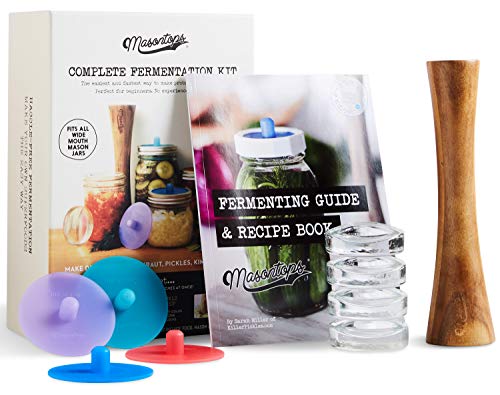
The Masontops Pickle Pipe is a silicone fermentation lid with a built-in one-way valve. It fits compatible regular-mouth Mason jars and is especially convenient when you already own jars but do not want a separate bubbling airlock mounted on top.
Its strength is simplicity. There is no water reservoir to refill, and the flexible silicone valve has fewer external parts than a traditional bubbler. That makes it a good choice for a first quart of sauerkraut or a jar of cucumber pickles. The limitation is that the lid itself normally does not provide the weight needed to keep shredded cabbage or sliced vegetables below the brine. Add glass fermentation weights, such as Masontops Pickle Pebbles, before buying if the kit does not include them.
Best use case
- Choose it for one- or two-quart batches and the lowest accessory cost.
- Use it for sauerkraut when you can pack the cabbage firmly below its liquid.
- Use a separate weight for pickles and kimchi, which have more floating pieces and air pockets.
2. Kraut Source: the most controlled jar-lid design
Kraut Source uses a water-sealed lid system designed for wide-mouth Mason jars. Its moat-and-floating-lid arrangement creates a physical barrier around the jar opening, while fermentation gases push through the water seal. The system commonly includes glass weights, which removes one of the most important omissions in cheaper starter kits.
This design is particularly useful for sauerkraut because shredded cabbage can rise as carbon dioxide forms. The glass weight gives the vegetables a broad, stable surface, while the water seal reduces the chance that oxygen reaches the brine. The trade-off is cleaning: the moat must be rinsed and dried, and standing water should not be left unattended between batches.
Kraut Source is a strong option if you want a repeatable routine rather than the smallest possible kit. It is less convenient for very chunky kimchi than a wide-mouth lid with a central airlock, because large pieces can be awkward to arrange beneath the floating lid.
3. Fermentools: the most flexible all-rounder
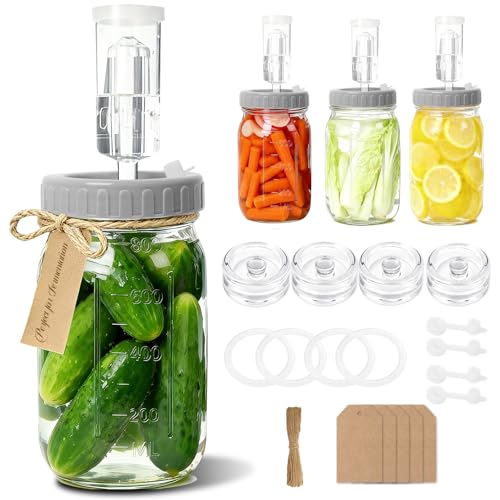
Fermentools jar kits typically combine a wide-mouth lid, a grommet-mounted airlock, and glass fermentation weights. The replaceable grommet and airlock arrangement is familiar to brewers and gives gases a dedicated exit path without requiring a water-filled moat.
The glass weights are valuable for kimchi and pickles because they are heavy enough to hold irregular vegetables under the liquid. A wide-mouth jar also makes packing and removal easier than a narrow-mouth container. Fermentools is a particularly sensible choice when you expect to make several different ferments and want individual components that can be replaced rather than discarding an entire lid.
Inspect the airlock after each batch. The small channels can retain brine or chili paste, and a clogged airlock defeats its purpose. For kimchi, place the jar in a tray because active bubbling can push liquid through the airlock.
How to choose by recipe
| Your situation | Best fit | Why |
|---|---|---|
| First batch of sauerkraut, lowest cost | Masontops Pickle Pipe plus a glass weight | Simple one-way venting and inexpensive replacement parts |
| Frequent sauerkraut maker | Kraut Source | Broad weight and water-sealed lid help control floating cabbage |
| Kimchi with garlic, ginger, and irregular pieces | Fermentools or another wide-mouth airlock kit with glass weights | Easy packing, strong submersion, and a removable airlock |
| Crunchy cucumber pickles | Fermentools or Kraut Source | Weights keep cucumbers and herbs below the brine |
| Several liters at once | Water-sealed ceramic crock | More capacity and less surface area relative to the batch |
| Limited storage or occasional use | Silicone-valve lid | Flat, compact, and faster to put away than a crock |
Jar size, weights, and temperature control
A 1-quart jar holds about 900 milliliters of practical working volume once vegetables, brine, headspace, and a weight are accounted for. Do not fill it to the rim. Leave roughly 3–5 centimeters of headspace so gas and liquid have somewhere to move.
For salt-brined vegetables, weigh the vegetables and liquid together, then use a salt concentration appropriate to the recipe. A useful example is a 2% brine: for 1,000 grams of water and vegetables, use 20 grams of non-iodized salt. If the recipe specifies salt based only on water, follow that recipe rather than mixing calculation methods.
Temperature matters more than a fancy lid. Most vegetable ferments work well around 18–22°C. At 24–26°C, fermentation usually accelerates and flavors can become sour faster; at 15–17°C, the process slows considerably. A temperature-controlled fermentation chamber is unnecessary for most kitchens, but a stick-on thermometer or digital probe is useful. Keep jars away from direct sunlight, ovens, and radiators.
Cleaning and maintenance: the overlooked buying factor
- Silicone valve lids: rinse the valve from both sides and check that it opens freely. Wash with warm soapy water and allow it to dry completely.
- Water-sealed lids: clean the moat, floating lid, and any channel where brine can collect. Replace the moat water if it becomes cloudy or evaporates.
- Grommet airlocks: remove the airlock from the grommet when possible. Wash the narrow tube and inspect the seal for cracks.
- Glass weights: wash promptly, especially after kimchi. Chili paste dries in grooves and around rims if left overnight.
- Ceramic crocks: clean the rim and weights thoroughly, then dry before storage to discourage odors and mold.
A dishwasher may be suitable for some glass and silicone components, but follow the maker’s material guidance. Do not use a chipped glass weight or a cracked jar: pressure is normally low, but damaged glass is still a safety risk.
Practical setup for a first batch
- Wash the jar, lid, weight, and utensils. Rinse away soap residue.
- Prepare the vegetables and salt according to the recipe. For sauerkraut, massage cabbage until it releases enough liquid to cover the packed vegetables.
- Pack firmly in layers, pressing out large air pockets. Leave 3–5 centimeters of headspace.
- Place the fermentation weight on top and confirm that the brine rises above the vegetables.
- Install the airlock or venting lid without overtightening. Put the jar on a tray.
- Store it at about 18–22°C and check daily for brine coverage, leaks, and pressure.
- Taste with a clean utensil after several days. Refrigerate when the flavor reaches the desired acidity.
If vegetables remain above the brine, first press them down with a clean weight. If the jar is too full, remove some contents rather than tightening the lid further. If no bubbling appears, check temperature, salt measurement, and whether the lid’s valve or airlock is blocked; visible bubbles are helpful but not required for fermentation. Discard a batch with fuzzy mold, rotten odors, or unusual colors rather than scraping the surface and continuing.
Frequently asked questions
Do I need to buy a separate fermentation weight?
It depends on the kit. The Masontops Pickle Pipe normally does not provide the weight needed to keep vegetables below the brine, so a separate glass weight is recommended. Kraut Source and Fermentools commonly include glass weights. Weights are especially useful for shredded cabbage, cucumbers, and kimchi because they help hold vegetables under the liquid.
Can I use regular Mason jars with these fermentation systems?
Yes, but jar compatibility varies by system. The Masontops Pickle Pipe fits compatible regular-mouth Mason jars, while Kraut Source and Fermentools are designed for wide-mouth Mason jars. Check the jar opening before buying, particularly if you already own jars. Wide-mouth jars also make packing and removing vegetables easier.
How full should I pack a fermentation jar?
Leave roughly 3–5 centimeters of headspace rather than filling the jar to the rim. This gives fermentation gases and liquid room to move. Pack vegetables firmly in layers and press out large air pockets, then place the weight on top. Confirm that the brine rises above the vegetables before installing the lid or airlock.
What should I do if brine or kimchi liquid leaks out?
Put the jar on a tray and check it daily for brine coverage, leaks, and pressure. Active bubbling can push liquid through the airlock, particularly with kimchi, so a tray helps contain spills. Do not overtighten the airlock or venting lid. Also inspect the airlock after each batch because brine or chili paste can clog its small channels.
Can I make a large batch in a one-quart jar?
A one-quart jar is best suited to a small batch, with about 900 milliliters of practical working volume once vegetables, brine, headspace, and a weight are included. For several liters at once, a water-sealed ceramic crock is more appropriate. A crock provides greater capacity and less surface area relative to the batch.
Final recommendation
For the lowest-cost introduction to homemade ferments, choose a Masontops Pickle Pipe and budget for separate glass weights. For the easiest sauerkraut workflow with a purpose-built water seal, choose Kraut Source. For one kit that covers sauerkraut, pickles, and kimchi with replaceable airlock parts, Fermentools is the strongest all-round choice. Move to a ceramic crock only when your batch size and fermentation frequency justify its extra cost, weight, and cleaning space.


