
Setting up a streamlined home office workspace or compact workstation requires balancing component costs without sacrificing everyday system responsiveness. When building or upgrading a dedicated desktop, choosing your boot drive dictates how quickly your operating system loads, how fast productivity software opens, and how smoothly large files transfer across your local network. Selecting a DRAMless drive leverages Host Memory Buffer (HMB) technology, keeping physical power consumption and heat output low inside tight computer enclosures while saving you money on hardware.
If you are configuring a custom home desk setup or modern office PC, finding the best dramless 1tb nvme ssd for budget boot drive duties ensures high storage density without paying extra for dedicated DRAM cache that general multitasking rarely requires. In this guide, we evaluate eight leading M.2 2280 options across performance and price tiers to help you pick the right match for your workstation in 2026.
As an Amazon Associate we earn from qualifying purchases at no extra cost to you.



Top 3 picks at a glance
Quick Picks
| Product | Best for | Price |
|---|---|---|
| Kingston NV3 1TB M.2 2280 NVMe SSD | Best Overall PCIe 4.0 Value | $161.00 |
| Silicon Power 1TB NVMe M.2 PCIe Gen3x4 SSD | Best Ultra-Budget PCIe 3.0 | $161.97 |
| Sandisk Optimus 5100 1TB NVMe SSD | Best Mainstream Workstation | $184.99 |
| SIX NVME M.2 SSD PCIe 4.0 1TB with Heatsink | Best with Built-in Cooling | $169.99 |
| Crucial P310 1TB SSD | Best Compact Versatility | $174.64 |
| WD_Black SN7100 1TB NVMe SSD | Best High-Speed Performance | $191.00 |
| Sandisk 1TB Optimus GX 7100 NVMe SSD | Best High-Throughput Workstation | $213.99 |
| fanxiang S501Q SSD 1TB PCIe 3.0×4 | Best Lowest-Cost Entry | $149.99 |
How We Picked
We evaluated each SSD based on physical form factor compatibility, power drawer metrics, peak sequential bandwidth, and price-to-performance value for everyday home desktop builds. All models feature the standard M.2 2280 footprint (22mm wide by 80mm long) to ensure fitment across standard motherboards and compact PC enclosures. We prioritized drives operating on standard 3.3V power rails with typical active power consumption under 6.5 watts to maintain low thermal output near desktop hardware. Finally, we compared PCIe 3.0 (up to 3200 MB/s) and PCIe 4.0 (up to 7350 MB/s) interfaces to ensure strong boot speeds across different motherboard generations.
The 8 Best Picks
Kingston NV3 1TB M.2 2280 NVMe SSD
The Kingston NV3 (SNV3S/1000G) is ideal for budget-conscious builders needing reliable PCIe 4.0 Gen 4×4 speeds for a primary operating system drive. It features sequential read speeds up to 6000 MB/s while adhering to the standard 22mm x 80mm M.2 footprint. Operating on standard 3.3V power rails, it consumes roughly 3.5W to 4.5W during active file operations, keeping thermals low inside modern desktop chassis without requiring heavy passive heatsinks.
- Fast sequential read speeds up to 6000 MB/s accelerate system boot times.
- Low operational wattage near 4.5W keeps thermal management effortless.
- Write speeds decrease during prolonged multi-gigabyte file transfers.
Skip this pick if you regularly render massive 4K video projects that demand continuous, heavy write caching.
Silicon Power 1TB NVMe M.2 PCIe Gen3x4 SSD (SP001TBP34A60M28)
Designed for home office workers upgrading legacy PC builds, the Silicon Power A60 utilizes a reliable PCIe Gen3x4 interface across standard M.2 2280 dimensions. Operating at standard 3.3V power requirements with modest wattage demands around 3.5W, it produces minimal operational heat inside small-form-factor home workstations. It delivers dependable boot drive speeds without requiring a full system motherboard upgrade.
- Runs cool with a low 3.5W active power draw for small cases.
- Broad compatibility across older Gen3 desktop and laptop motherboards.
- Sequential bandwidth is restricted by PCIe Gen3 limits.
Skip this pick if your motherboard supports PCIe 4.0 and you want maximum file transfer throughput.
Sandisk Optimus 5100 1TB NVMe SSD
The Sandisk Optimus 5100 targets home workspace builders looking for consistent daily multi-tasking performance in a clean M.2 2280 format. Operating on PCIe 4.0 architecture, this drive draws between 4.0W and 5.0W during typical system indexing and app launches. Its efficient DRAMless architecture leverages Host Memory Buffer technology to maintain swift OS boot times and application loading across long work sessions.
- Stable PCIe 4.0 speeds keep system operations fluid and responsive.
- Moderate power consumption preserves cool case temperatures.
- Higher price than baseline entry-level Gen4 competitors.
Skip this pick if you are adhering to a strict sub-$160 budget for primary storage.
SIX NVME M.2 SSD PCIe 4.0 1TB with Heatsink
Engineered for high-throughput desktop setups and gaming builds, this SIX NVME drive delivers read speeds up to 7350 MB/s over PCIe gen 4×4 protocols. It features an integrated metal heatsink over its M.2 2280 layout, managing active power draws between 5.0W and 6.5W. The extra thermal dissipation keeps speeds stable during sustained OS tasks, home gaming, or console expansion.
- High read speeds up to 7350 MB/s speed up system startup.
- Pre-installed heatsink maintains stability during intensive workloads.
- Height profile with heatsink might block tight laptop drive bays.
Skip this pick if you are installing storage into an ultra-thin laptop with tight clearance.
Crucial P310 1TB SSD (CT1000P310SSD801)
The Crucial P310 delivers flexible performance for desktop PCs, laptops, and handheld consoles, pushing sequential speeds up to 7,100 MB/s on PCIe Gen4. Its standard M.2 2280 form factor features a single-sided layout with active power draw between 4.2W and 5.5W. It includes Acronis Data Recovery Software to simplify migrating your existing boot partition from an older drive.
- High read performance up to 7,100 MB/s cuts application load times.
- Bundled Acronis cloning software simplifies operating system upgrades.
- Price per gigabyte sits higher than basic entry drives.
Skip this pick if you do not need bundled cloning software and prefer the lowest initial cost.
WD_Black SN7100 1TB NVMe SSD (WDS100T4X0E)
Built with Next Gen TLC 3D NAND, the WD_Black SN7100 delivers read speeds up to 7,250 MB/s and write speeds up to 6,900 MB/s over Gen4 PCIe. Adhering to standard 22mm x 80mm dimensions, this DRAMless drive utilizes optimized HMB protocols to draw roughly 5.0W under load, making it a powerful boot drive for high-end home office builds and creative workstations.
- Impressive 7,250 MB/s read and 6,900 MB/s write capabilities.
- Next Gen TLC 3D NAND offers durable long-term drive write health.
- Commands a premium price point compared to standard DRAMless options.
Skip this pick if your daily tasks are limited to simple web browsing and document handling.
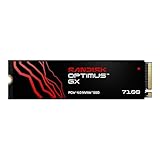
Sandisk 1TB Optimus GX 7100 NVMe SSD (SDSP71100TAN)
The Sandisk Optimus GX 7100 delivers top-tier PCIe Gen 4 bandwidth with sequential reads reaching up to 7250 MB/s. Configured in the common M.2 2280 form factor, it draws around 4.8W to 6.2W during active operations. Its robust controller management makes it suitable for demanding desktop workstation environments that process large datasets or high-resolution media archives.
- Strong 7250 MB/s read speed ensures rapid operating system boot-ups.
- Consistent continuous file management for demanding office software.
- The highest price point among our tested DRAMless selections.
Skip this pick if you want the most cost-effective cost-per-gigabyte drive for a secondary machine.
fanxiang S501Q SSD 1TB PCIe 3.0×4 NVMe SSD
For budget-focused builds, the fanxiang S501Q provides an accessible entry point using a PCIe 3.0×4 interface paired with an SLC Cache and 3D NAND. Reaching speeds up to 3200 MB/s in a standard M.2 2280 single-sided stick, it operates on 3.3V power with a modest 3.2W draw. Its low power footprint ensures cool, quiet running in compact desktop cases.
- Lowest price point in our review lineup for budget builds.
- Low typical wattage of 3.2W minimizes heat inside compact cases.
- Speeds are capped at 3200 MB/s due to PCIe 3.0 specs.
Skip this pick if your modern PC motherboard supports full PCIe 4.0 transfer rates.
Buying Guide
Understanding HMB and DRAMless Efficiency
Traditional solid-state drives include an onboard DRAM chip to hold the drive’s file mapping table. DRAMless drives cut costs and board complexity by using Host Memory Buffer (HMB) technology. HMB allows the SSD controller to borrow a tiny portion of your main system RAM (typically 16MB to 64MB) across the PCIe bus. This keeps drive weight under 8 grams, lowers active power consumption to between 3.2W and 6.5W, and keeps system boot speeds extremely responsive.
PCIe Gen3 vs. PCIe Gen4 Bandwidth Differences
PCIe 3.0 drives top out around 3200 MB/s to 3500 MB/s, while PCIe 4.0 drives can reach 6000 MB/s to 7350 MB/s. For everyday operating system boot times and launching productivity software, the real-world difference is measured in fractions of a second. However, if your home setup involves moving heavy files across local storage arrays, a Gen4 drive provides noticeable throughput advantages over older Gen3 hardware.
Form Factor Dimensions and Thermal Management
All drives reviewed here use the standard M.2 2280 physical specification, measuring exactly 22mm wide and 80mm long. They fit directly into desktop motherboards and laptop drive slots. Drives operating at peak Gen4 speeds draw up to 6.5 watts under continuous heavy writes, generating heat. Installing drives under motherboard heatspreaders or selecting models with built-in heatsinks prevents thermal throttling in tight computer enclosures.
Our Verdict
For the overall best combination of speed and cost on modern systems, the Kingston NV3 1TB at $161 provides exceptional PCIe 4.0 value with 6000 MB/s throughput. If you demand top-tier transfer speeds for heavier workloads, the WD_Black SN7100 1TB ($191) and the SIX NVME 1TB ($169.99 with integrated heatsink) offer performance above 7200 MB/s. For strict budget upgrades or older systems, the fanxiang S501Q ($149.99) and Silicon Power A60 ($161.97) deliver cool, energy-efficient OS boot drives at the lowest price points.
FAQ
Is a DRAMless NVMe SSD good for a boot drive?
Yes. Modern DRAMless SSDs use Host Memory Buffer (HMB) technology to access a small fraction of system memory for mapping. This provides rapid operating system boot times and quick application loading without the cost or thermal output of dedicated onboard DRAM chips.
How much power does an M.2 NVMe SSD consume?
Budget DRAMless M.2 NVMe SSDs typically operate on a standard 3.3V rail. Active power consumption ranges from roughly 3.2 watts on PCIe 3.0 models up to 6.5 watts on high-speed PCIe 4.0 drives, dropping to milliwatts during system idle states.
What does standard M.2 2280 mean for installation?
M.2 2280 designates the physical dimensions of the drive stick: 22 millimeters wide by 80 millimeters long. This is the universal mounting standard for modern desktop motherboards, laptop expansion slots, and handheld gaming consoles.
Do I need a heatsink for a budget DRAMless SSD?
For standard daily productivity and operating system tasks, most DRAMless drives run cool enough without a separate heatsink. However, if your drive reaches speeds above 7000 MB/s or sits in a compact chassis with limited airflow, using a simple heatsink prevents thermal speed throttling.


