
The best DJ turntables for vinyl scratch and mix DJs are the Technics SL-1200MK7 / SL-1210MK7 for the most stable mixing and reliable tracking, the Reloop RP-7000 MK2 and RP-8000 MK2 for the highest adjustable torque and battle-ready features for scratching, and the Pioneer PLX-1000 for maximum raw torque on a budget, with the Pioneer PLX-CRSS12 as the hybrid option if you want DVS control without a needle for scratching.
As an Amazon Associate we earn from qualifying purchases at no extra cost to you.

Our Top Picks
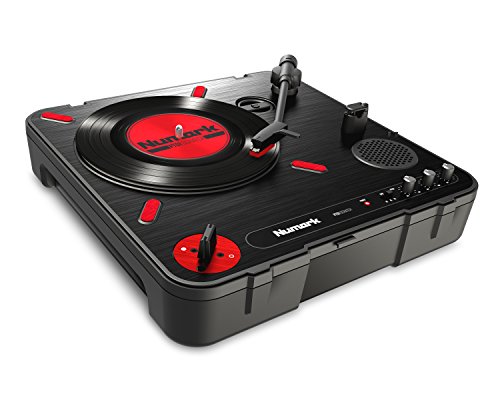 NUMARK PT01 Scratch Portable Turntable with Scratch Switch11.8 x 11.8 x 4 inches4.4 PoundsCheck on Amazon

How to Choose: Scratch vs. Mix Priorities
Scratch DJs and mix DJs stress different parts of a turntable. Choosing wrong means fighting the hardware instead of playing it.
- For scratching: Prioritize starting torque, brake speed, motor recovery time, and a battle layout. You need the platter to return to 33 1/3 RPM instantly after you push, pull, and release the record. High torque and short start-up time matter more than ultra-low wow and flutter.
- For mixing: Prioritize motor stability (wow and flutter, quartz lock), pitch resolution and range, and tonearm tracking. You need two records to hold pitch for minutes without drift so beats stay locked.
- For both: Look for a heavy, damped chassis, an S-shaped or straight tonearm with proper bearings, and wide cartridge compatibility. Durability of the pitch fader and RCA/ground connections is critical for gigging.
Head-to-Head Comparison: The 5 Best DJ Turntables for 2026
These are the core models you will find in clubs, battle setups, and serious home studios. All are direct-drive, quartz-controlled, and use a standard SME headshell mount except where noted.
| Model | Starting Torque | Start-Up Time (0 to 33 RPM) | Wow & Flutter | Pitch Range | Tonearm | Best For |
|---|---|---|---|---|---|---|
| Technics SL-1200MK7 / SL-1210MK7 | 0.18 N·m (1.8 kgf·cm) | 0.7 sec | 0.025% WRMS | ±8% / ±16% | Universal S-shape, gimbal suspension | Long mixes, club standard, accuracy |
| Pioneer PLX-1000 | 0.45 N·m (4.5 kgf·cm) | 0.3 sec | 0.1% WRMS | ±8% / ±16% / ±50% | S-shape, rubber-damped | High torque for scratch on a budget |
| Reloop RP-7000 MK2 | 0.28 N·m (2.8 kgf·cm) adjustable | 0.6 sec (at max torque) | 0.05% WRMS | ±8% / ±16% / ±50% | S-shape, vertical height adjustable | Scratch, heavy scratch customization |
| Reloop RP-8000 MK2 | 0.28 N·m (2.8 kgf·cm) adjustable | 0.6 sec | 0.05% WRMS | ±8% / ±16% / ±50% | S-shape + MIDI / Serato controls | Scratch + DVS/hybrid controller workflow |
| Pioneer PLX-CRSS12 | 0.32 N·m (3.2 kgf·cm) + Magvel clamp torque control | 0.4 sec (analog) / instant (DVS mode) | 0.015% WRMS (digital correction) | ±8% / ±16% / ±50% (analog) / ±66% (DVS) | Toneless mag-lev system + digital tonearm | Tonearm-free scratching, DVS turntablism |
1. Technics SL-1200MK7 / SL-1210MK7 – The Mix Standard
The reference for a reason. The coreless direct-drive motor eliminates cogging, which is the micro-judder you feel on cheaper motors. That gives it the lowest measured wow and flutter in this group and near-perfect quartz-locked speed. The pitch fader has 0.1% clickless resolution around 0% and reverse function, but no ultra-pitch.
Tracking is where the Technics wins. The gimbal-suspended S-arm with precise bearings holds 2-3.5g tracking force without skipping during back-cueing, and the die-cast aluminum platter with heavy rubber mat resists feedback. Torque is lower than Pioneer or Reloop, so it feels slightly slower to recover if you do heavy hamster scratches and stall the platter. For house, techno, disco and open-format mixing where a 6-minute blend cannot drift, it is the safest pick. Usually $800–$1100 per deck.
2. Pioneer PLX-1000 – Maximum Torque Value
Built on the classic Super OEM platform, the PLX-1000 trades some speed accuracy for brute force. At 4.5 kgf·cm it is the strongest motor here, which scratch DJs feel immediately – you can do chirps and crabs without the platter bogging down. Start/stop is 0.3 seconds. The trade-off is higher wow and flutter (0.1%) and more noticeable pitch fader wobble than the Technics.
The chassis is extremely heavy and well-damped, and the S-arm is excellent for most scratch cartridges like the Ortofon VNL or Shure M44-7 style. It has the standard battle layout with pitch on top and power/reverse switch placement that works for left-handed scratch setups. Usually $700–$850.
3. Reloop RP-7000 MK2 and RP-8000 MK2 – The Turntablist’s Toolkit
Both share the same motor and build but serve different workflows. The RP-7000 MK2 is the pure vinyl deck. The RP-8000 MK2 adds 8 velocity-sensitive RGB pads, Serato integration, and MIDI control for cue points, loops and samples directly from the deck.
Key advantage is adjustability: torque is switchable (1.6 to 2.8 kgf·cm), brake speed is adjustable via a knob under the platter, and pitch range goes to ±50% for extreme pitch play. That lets a scratch DJ set a fast brake for transform scratches or a slow brake for mix-style stops. The tonearm height, counterweight and anti-skate are more adjustable than on the Technics, which helps when using high-tracking-force scratch cartridges at 3-4g. Build is solid but lighter than the PLX-1000, so add a heavy mat if you battle. Usually $550–$750 for the RP-7000 MK2 and $700–$900 for the RP-8000 MK2.
4. Pioneer PLX-CRSS12 – Hybrid Needle-Free Scratching
This is not a traditional turntable. In Analog mode it works like a normal deck with a Magvel clamp holding the record. In Digital mode it removes the tonearm entirely – the record position is read by a contactless sensor and sent as DVS control to Serato or rekordbox. That means no needle skipping, no record wear, and adjustable digital torque that feels heavier than vinyl.
For pure vinyl mixing it is overkill and you lose the analog feel. For competitive scratching, portablism, and DVS users who are tired of replacing styli, it solves the biggest pain point. You still need DVS software and control vinyl. Usually $1100–$1400.
Decision Matrix: Which Turntable Matches Your Setup
| Your Situation | Recommended Choice | Why |
|---|---|---|
| You play long blend mixes (house/techno/drum & bass) in clubs | Technics SL-1200MK7 | Best speed stability, lowest wow/flutter, industry-standard layout |
| You scratch daily, want strongest pull-back recovery | Pioneer PLX-1000 or Reloop at Max Torque | 4.5 and 2.8 kgf·cm recover faster after hand drag |
| You use Serato/rekordbox DVS and want pads on the deck | Reloop RP-8000 MK2 or PLX-CRSS12 | Built-in MIDI/control without reaching for a separate controller |
| You battle and need no-skip performance | PLX-CRSS12 in Digital Mode | No tonearm means no skipping regardless of technique |
| You need one deck for both mixing and scratching | Reloop RP-7000 MK2 | Adjustable torque/brake + ultra-pitch covers both styles |
Spec Deep Dive: What the Numbers Mean in Practice
Torque and Motor Stability – Worked Calculation
Torque alone does not tell you how fast the platter recovers. Recovery time depends on torque, platter inertia, and drag from your hand.
A 33 1/3 RPM platter spins at 3.49 radians per second. A typical DJ platter + slipmat + 180g record has a moment of inertia (I) of about 0.018 to 0.022 kg·m².
Angular acceleration = Torque / I. Time to reach speed = Target speed / Acceleration.
Example at max rating:
- Pioneer PLX-1000: 0.45 N·m / 0.020 kg·m² = 22.5 rad/s². Time = 3.49 / 22.5 = 0.155 seconds in ideal conditions. Pioneer rates it at 0.3 seconds because the motor limits current and must overcome static friction.
- Technics SL-1200MK7: 0.18 N·m / 0.020 = 9.0 rad/s². Time = 3.49 / 9.0 = 0.387 seconds. Rated at 0.7 seconds.
The gap doubles when you add hand drag. If your hand adds 0.1 N·m of friction while scratching, usable torque drops to 0.35 N·m for the Pioneer and 0.08 N·m for the Technics. That is why high-torque decks feel more “locked” during crabs and flares – they retain enough net torque to keep accelerating back to speed even while you are touching the vinyl.
For mixing, the opposite matters: low wow and flutter. A 0.025% rating (Technics) means speed drifts only 0.008 RPM at 33.3 RPM. At 0.1% (PLX-1000), drift is 0.033 RPM – small, but enough to require pitch nudging on a 4-minute blend.
Tonearm Tracking and Cartridge Compatibility
All S-arm models here accept standard SME headshells, so you can mount any moving-magnet DJ cartridge. This is critical because scratching and mixing want different styli.
- Scratch: Use a spherical/conical stylus with high tracking force (3.0–4.0g), high output (6–9 mV) and a reinforced cantilever. Examples: Ortofon VNL, Ortofon Concorde MkII Scratch, Audio-Technica AT-XP5. These hold the groove when you back-cue aggressively. Anti-skate set to 0–1, tonearm height so the arm is parallel to the record at your chosen tracking force.
- Mix: Use an elliptical stylus with moderate force (2.0–3.0g) for better high-frequency detail and lower record wear. Examples: Ortofon Concorde MkII Mix, Audio-Technica AT-VM95E. Set anti-skate to match tracking force.
The PLX-CRSS12 bypasses this entirely in Digital mode – cartridge choice is irrelevant because there is no stylus. In Analog mode it uses the same headshell standard.
Avoid straight underhung tonearms unless you only scratch DVS; they reduce skating error for scratching but increase inner-groove distortion for mixing.
Battle Layout and Durability
Battle layout means pitch fader on top, start/stop button on the side, and reversed RCA/ground placement so the deck can be placed with the tonearm at the back. All models except the stock Technics allow this by rotating the deck 90 degrees, but the Reloop and Pioneer place the pitch fader and power controls higher on the plinth to avoid hand collisions during scratching.
For durability, check three failure points: pitch fader (should be replaceable without soldering, all five are), RCA cables (detachable on Reloop and Pioneer, hardwired on Technics), and platter coating (powder-coated platters on Reloop/Pioneer chip less than painted Technics when needles drop).
Concrete Settings for Scratch vs. Mix
Scratch Setup (Reloop RP-7000 MK2 / PLX-1000 example)
- Torque switch: High (2.8 or 4.5 kgf·cm). Brake: Fast (1-2 o’clock).
- Slipmat: Thin, waxy butter rug or Dr. Suzuki Mix Edition. Heavy felt increases drag and slows recovery.
- Cartridge: Spherical, 3.5g tracking force, anti-skate 0. Tonearm height 0-1mm above parallel to increase stability on back cue.
- Pitch: ±8% for control. Leave quartz lock on.
- Needle pressure check: If the record skips forward on a hard pull-back, add 0.25g, not more anti-skate.
Mix Setup (Technics SL-1200MK7 example)
- Torque: Standard (no adjustment needed). Brake: Medium.
- Slipmat: Standard 3mm rubber + thin slipmat on top, or cork mat for better isolation from bass feedback.
- Cartridge: Elliptical, 2.5g tracking force, anti-skate 2.5. Tonearm height calibrated so headshell is level.
- Pitch: ±8% for house/techno (±16% if playing wide tempo ranges). Reset pitch to 0 and verify quartz lock LED is solid before beatmatching.
- Isolation: Place decks on a solid table, not on the same surface as speakers. If feedback hums at high volume, check ground wire and move power brick away from RCAs.
FAQ
Do I need high torque if I only mix?
No. Anything above 1.5 kgf·cm is enough for mixing. Stability and pitch resolution matter more. High torque does not hurt mixing, but you will not feel its benefit if you rarely touch the record.
Can I use a DJ turntable for home listening?
Yes, but DJ turntables emphasize durability and strong motors over ultra-low noise. An elliptical cartridge and a proper phono preamp (switch to PHONO, not LINE) will make them sound good, but a hi-fi belt-drive will have lower rumble for critical listening.
Is the PLX-CRSS12 worth it if I own normal vinyl?
Only if you use DVS. Without DVS software it is an expensive analog deck. Its value is removing needle wear and skipping during serious scratch practice. If you play mostly real vinyl mixes, a traditional deck like the Technics or Reloop is better value.


