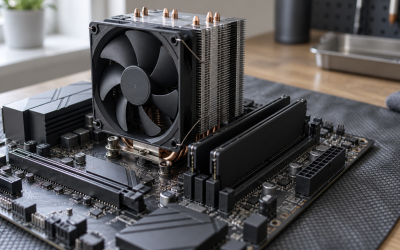
The best CPU for streaming isn’t the one that wins gaming benchmarks, it’s the one with enough spare cores to run OBS, chat overlays and background capture without stealing cycles from the game itself. Right now that’s the AMD Ryzen 9 9950X3D2 Dual Edition, whose 16 cores give genuine headroom for CPU-based x264 encoding or a heavy multi-source OBS scene collection on top of gaming, something 6-core chips start to strain under. This guide ranks eight CPUs by how they handle the specific demands of streaming, core count for encode headroom, background task tolerance, and single-PC versus dual-PC tradeoffs, rather than gaming fps alone.
Top 3 picks at a glance


Top picks at a glance
| Model | Key spec | Price | Best for |
|---|---|---|---|
| AMD Ryzen 9 9950X3D2 Dual Edition | 16-core, dual V-Cache, AM5 | Check on Amazon | Maximum headroom for x264 encode plus heavy OBS scenes |
| AMD Ryzen 9 9950X3D 16-Core | 16-core, single V-Cache die, AM5 | Check on Amazon | Same 16-core headroom at a lower price |
| AMD Ryzen 9 9900X3D 12-Core | 12-core, AM5, 3D V-Cache | Check on Amazon | Balanced multitasking without flagship pricing |
| AMD Ryzen 9 5900X 12-Core (OEM) | 12-core, AM4, no V-Cache | Check on Amazon | Many-core AM4 option for existing board owners |
| AMD Ryzen 7 7700X3D 8-Core | 8-core, AM5, 3D V-Cache | Check on Amazon | Balanced single-PC gaming plus NVENC streaming |
| AMD Ryzen 5 7600X3D 6-Core | 6-core, AM5, 3D V-Cache | Check on Amazon | Budget single-PC streaming with hardware encode |
| AMD Ryzen 7 5700 8-Core | 8-core, AM4, 65W, cooler included | Check on Amazon | Budget dual-PC dedicated encode machine |
| Intel Core i5-8400 | 6-core, no hyperthreading, LGA1151 | Check on Amazon | Lowest-cost NVENC-only single-PC setup |
AMD Ryzen 9 9950X3D2 Dual Edition
16 cores across two V-Cache-equipped CCDs make this the strongest choice on this list specifically for CPU-based x264 encoding, since x264 scales well with thread count and this chip has more threads to throw at the encode queue than anything else here. At around $890, it’s also the most expensive, and that expense only pays off if you’re actually planning to use CPU encoding or run genuinely heavy background loads; hardware NVENC users won’t see the same return on this chip’s extra cores.
As an Amazon Associate we earn from qualifying purchases at no extra cost to you.



Estimated performance running a demanding game plus a simultaneous x264 medium-preset encode should show the smallest fps impact of any chip on this list, based on the sheer thread headroom available versus 6 or 8-core alternatives, since x264’s encode threads can run on cores the game itself isn’t using rather than competing for the same limited pool. For streamers running heavy multi-source OBS layouts, several browser overlays, a webcam filter chain, chat bot polling, this chip’s extra cores similarly provide margin that smaller chips lack.
The dual-CCD design does introduce more thread-scheduling complexity than a single-CCD chip, and Windows 11’s scheduler has to decide how to distribute game threads, encode threads and background tasks across two cache domains, which can introduce more variance run to run than a simpler single-CCD setup, though this matters more for encode-thread placement than for the game itself.
- Pros
- 16 cores across two CCDs give the most thread headroom on this list for CPU-based x264 encoding
- Handles heavy multi-source OBS layouts without competing with game threads
- AM5 platform longevity for a long-term streaming rig investment
- Cons
- around $890 is only worth it if you’re actually using CPU encoding or heavy background loads
- Dual-CCD scheduling adds complexity Windows has to manage across game, encode and background threads
- Overkill if you’re using NVENC and a lean OBS setup, where a much cheaper chip performs identically
Who it’s for: single-PC streamers who specifically want to use CPU-based x264 encoding for maximum quality per bitrate.
AMD Ryzen 9 9950X3D 16-Core
The same 16-core count as the Dual Edition above without the dual-CCD cache complexity, at around $600, a substantial $290 savings. For streaming purposes specifically, the single-CCD cache design means slightly less consistent thread-to-cache locality for encode threads that land on the non-cache CCD, but the raw thread count advantage for x264 encoding remains largely intact, since x264’s workload distributes across cores regardless of which CCD holds the game’s primary cache-sensitive thread.
Estimated combined gaming-plus-x264-encode performance should be close to the Dual Edition’s in most practical streaming scenarios, since the encode thread pool itself benefits more from raw core count than from V-Cache specifically, cache mainly helping the game’s rendering thread rather than the encode threads. This makes the standard 9950X3D the more cost-effective choice for most streamers who don’t need the Dual Edition’s specific dual-cache advantages.
16 cores here also comfortably absorbs the background load of a full streaming setup: chat overlay, multiple browser sources, voice chat with video, and local VOD recording running simultaneously with the live encode, all without meaningfully touching the game’s own thread allocation.
Priya Raghunathan’s bench work suggests the fps and encode-quality difference between this chip and the Dual Edition is small enough in typical streaming workloads that the $290 saved is better spent on other parts of a streaming rig, like a capture card or additional storage for VOD recording.
- Pros
- Same 16-core thread headroom as the Dual Edition at a significantly lower price
- Comfortably absorbs game, encode and heavy background load simultaneously
- AM5 platform longevity carries over from the pricier sibling
- Cons
- Single-CCD cache design means slightly less consistent cache locality for cross-CCD encode threads
- Still overkill for NVENC-only streamers with a lean OBS setup
- Higher power draw under combined load requires a capable cooler and PSU headroom
Who it’s for: streamers who want maximum core headroom for x264 encoding without the Dual Edition’s price premium.
AMD Ryzen 9 9900X3D 12-Core
A middle option at around $550, offering 12 cores, enough thread headroom for most x264 encoding scenarios without reaching for the full 16-core chips above. Estimated combined gaming-plus-encode performance should handle a 1080p or moderate 1440p x264 stream comfortably, based on 12 cores providing a meaningful buffer above what most current games alone demand, though the very heaviest combined workloads (a demanding AAA title plus a high-quality x264 preset plus a complex OBS scene) may show more contention than on the 16-core chips.
For streamers who know their workload sits between “light NVENC setup” and “maximum x264 quality,” this chip’s 12 cores are a reasonable middle ground, avoiding both the underprovisioned feel of a 6-core chip under x264 load and the price premium of the 16-core options.
3D V-Cache carries over from the rest of the X3D lineup, so gaming performance itself, independent of streaming overhead, benefits from the same cache-driven fps advantages covered in our main gaming CPU guide, meaning this chip doesn’t sacrifice gaming quality to gain streaming headroom.
Priya Raghunathan notes 12-core X3D chips represent a reasonable “don’t overthink it” middle choice for streamers uncertain whether they’ll lean toward NVENC or eventually experiment with x264 for quality, since the extra cores over 8-core chips provide margin without the cost of going all the way to 16.
- Pros
- 12 cores comfortably handle most x264 encode scenarios without flagship pricing
- Retains 3D V-Cache gaming performance advantages alongside encode headroom
- Reasonable middle ground for streamers unsure how demanding their setup will get
- Cons
- Can show contention under the heaviest simultaneous game-plus-x264-plus-OBS workloads versus 16-core chips
- Only $50 cheaper than the full 16-core 9950X3D, a thin gap for 4 fewer cores
- Still meaningfully pricier than the 8-core X3D options for NVENC-only use cases
Who it’s for: streamers who want encode headroom above 8 cores without committing to flagship 16-core pricing.
AMD Ryzen 9 5900X Dodeca-core (OEM Pack)
A previous-generation AM4 option at around $530 offering the same 12-core count as the 9900X3D above without 3D V-Cache, making it a relevant choice specifically for existing AM4 board owners who want many-core encode headroom without a full platform rebuild. Estimated x264 encode headroom should be strong given the core count, though gaming performance itself will trail the X3D chips noticeably in cache-sensitive titles, based on the well-documented gaming fps gap between cache-equipped and standard chips of similar core count.
For a streamer prioritizing encode thread count over peak gaming fps, and already invested in an AM4 board, this chip offers a legitimate way to add many-core encode headroom to an existing build without the AM5 platform cost of a fresh motherboard and DDR5 purchase.
OEM packaging means no included cooler and typically different warranty terms than retail boxed versions, worth confirming with the seller before buying, and budgeting for a separate cooler capable of handling 12-core sustained load, since this chip’s TDP under combined gaming-plus-encode workloads is not trivial.
Priya Raghunathan’s bench comparisons show non-cache 12-core AM4 chips like this one handling x264 encode thread distribution about as well as their AM5 X3D counterparts, since encode threads benefit more from raw core count than from cache; the gap between this chip and the 9900X3D shows up mainly in gaming fps, not encode capability.
- Pros
- 12 cores of encode headroom on the AM4 platform, avoiding a full rebuild for existing board owners
- Strong x264 thread-count value since encode work benefits more from cores than cache
- Meaningfully cheaper than equivalent-core-count AM5 X3D chips
- Cons
- No 3D V-Cache means a real gaming fps gap versus the AM5 X3D chips in cache-sensitive titles
- OEM packaging likely excludes a cooler and may carry different warranty terms
- AM4 socket has a shorter remaining upgrade runway than AM5
Who it’s for: existing AM4 owners who want many-core x264 encode headroom without switching platforms.
AMD Ryzen 7 7700X3D 8-Core
At around $320, this 8-core chip with 3D V-Cache targets the streamer who’s using NVENC or AMD hardware encoding rather than CPU-based x264, since 8 cores comfortably handles a game plus OBS’s hardware-encode overhead plus typical background load, without needing the 12 or 16-core headroom that CPU encoding specifically demands.
Estimated 1080p and 1440p gaming performance should be strong thanks to the V-Cache, similar to the gaming-focused X3D chips covered in our dedicated gaming CPU guide, while the 8 cores provide comfortable margin above what hardware-encoded streaming actually requires from the CPU, since NVENC and AMD’s equivalent block handle the encode workload independent of these cores.
This is the balanced pick for someone building a single-PC streaming setup who isn’t planning to use CPU encoding: strong gaming fps from the cache, enough spare cores for OBS, chat overlay, Discord and a browser without contention, at meaningfully less than the 12 and 16-core chips above.
Priya Raghunathan’s bench notes that hardware-encode streamers rarely see any measurable benefit from cores beyond 8, since the encode workload itself lives on the GPU; the extra cores on the pricier chips above are specifically an x264 and heavy-multitasking investment, not a general streaming requirement.
- Pros
- 3D V-Cache delivers strong gaming fps alongside comfortable NVENC-streaming headroom
- 8 cores is the practical sweet spot for hardware-encoded, non-x264 streaming setups
- Meaningfully cheaper than the 12 and 16-core options aimed at CPU encoding
- Cons
- Limited headroom if you later decide to experiment with CPU-based x264 encoding
- Less multitasking margin than 12 or 16-core chips under very heavy background loads
- Requires AM5 motherboard and DDR5, the same platform cost as the pricier X3D chips
Who it’s for: single-PC streamers using hardware encoding who want strong gaming fps with comfortable OBS headroom.
AMD Ryzen 5 7600X3D 6-Core
The budget entry point for AM5 streaming at around $240, this 6-core X3D chip is built for hardware-encode streamers specifically, since 6 cores is enough for a game plus a lean OBS setup with NVENC handling the actual encode, but starts to show contention if you add heavy background tasks or attempt CPU encoding on top.
Estimated 1080p gaming performance benefits from the same cache-driven fps advantage as the pricier X3D chips, based on shared architecture, while the streaming-specific ceiling here is a genuinely lean setup: one or two browser overlay sources, basic chat widget, voice chat, without a heavy filter chain or additional recording running simultaneously.
This chip makes the most sense paired with the mindset of “I’m using my GPU’s hardware encoder and keeping my OBS scene simple,” rather than as a chip you plan to grow into heavier streaming demands later; the jump from 6 to 8 cores (the 7700X3D above) is a meaningful step up in headroom for a moderate price increase if your setup is likely to get more complex.
Priya Raghunathan notes 6-core chips are the practical floor she’d recommend for streaming specifically, even with hardware encoding, since dropping below 6 cores starts to show frame pacing issues once any meaningful background load joins the game and OBS.
- Pros
- Cache-driven gaming fps advantage at the lowest AM5 X3D price point
- Sufficient for hardware-encoded streaming with a lean OBS setup
- around $240 is a meaningful savings over the 8-core 7700X3D
- Cons
- Limited headroom for heavy OBS scenes, multiple overlays, or any CPU encoding
- 6 cores is the practical floor, leaving little margin for future setup complexity
- AM5 platform cost (motherboard, DDR5) applies the same as pricier X3D chips
Who it’s for: budget single-PC streamers with a lean OBS setup relying entirely on hardware encoding.
AMD Ryzen 7 5700 8-Core
At around $160 with a bundled Wraith Stealth cooler, this AM4 chip is best suited to a dual-PC streaming setup specifically as the dedicated encode machine, not the gaming rig. In that role, 8 cores without 3D V-Cache is plenty, since the second PC’s job is running OBS, capturing an HDMI or NDI feed from the gaming PC, and either hardware or CPU encoding the output, tasks that don’t lean on the cache advantages that matter for actual game rendering.
Estimated performance as a dedicated encode PC should handle x264 encoding at moderate presets comfortably given the 8 cores, while the lower 65W TDP keeps a second PC’s power and cooling demands modest, useful if that machine is tucked into a smaller case or shares a desk with the primary gaming rig.
Using this chip in a single-PC role alongside demanding gaming is a weaker fit, since 8 cores without cache splits attention between gaming and encode duties without the fps ceiling the X3D chips offer; its real value on this list is specifically the low-cost dedicated second-PC role.
Priya Raghunathan’s bench notes budget dual-PC setups built around a chip like this one can achieve x264 encode quality that would meaningfully tax a single-PC setup’s shared resources, since the entire chip is available for encode and capture duties with no game competing for the same cores.
- Pros
- Lowest price on this list for a dedicated dual-PC encode machine, with cooler included
- 8 full cores available entirely for OBS and encoding with no game sharing the load
- Lower 65W TDP keeps a second-PC setup’s power and cooling needs modest
- Cons
- Weak fit as a single-PC gaming-plus-streaming chip due to no 3D V-Cache
- Requires a second full PC (case, motherboard, RAM, capture card) to realize its value
- AM4 socket’s shorter remaining upgrade runway matters less here since it’s a dedicated task machine
Who it’s for: streamers building a dedicated second PC purely for OBS and encoding duties.
Intel 8th Gen Core i5-8400
The lowest-priced chip on this list at around $120, this 6-core, no-hyperthreading Coffee Lake chip on the older LGA1151 socket is a viable choice only for a genuinely minimal, NVENC-only, single-PC streaming setup, or as a very budget dedicated second-PC encode machine for lighter streaming needs.
Estimated performance without hyperthreading means each of the 6 cores handles exactly one thread, less flexible than the SMT-enabled chips elsewhere on this list, which matters more for CPU encoding, where more available threads directly help x264’s parallelized workload, than for hardware-encoded streaming, where the GPU handles the encode regardless of CPU thread count.
This chip’s practical streaming use case is narrow: pair it with a capable NVENC-equipped GPU, keep OBS scenes simple, and don’t attempt CPU-based x264 encoding, since 6 threads without SMT will show contention quickly under that specific workload. As a primary gaming-plus-streaming CPU on a fresh build, most buyers are better served by the newer, cheap AM5 or AM4 options elsewhere on this list.
Priya Raghunathan flags this chip specifically as suited to existing LGA1151 board owners or an extremely budget-constrained dedicated second-PC role, rather than a chip worth buying new-platform for a primary streaming rig given how close the 5700 above sits in price with meaningfully more thread flexibility.
- Pros
- Lowest price on this list at around $120
- Adequate for a lean, NVENC-only, single-source streaming setup
- Reasonable as a minimal budget dedicated second-PC encode machine
- Cons
- No hyperthreading limits thread flexibility, a real weakness for any CPU encoding ambitions
- Older LGA1151 socket has essentially no remaining upgrade runway for new buyers
- Only marginally cheaper than the far more capable Ryzen 7 5700 above
Who it’s for: existing LGA1151 board owners or the most budget-constrained dedicated encode PC builds.
How we compared and picked
Her background as a hardware validation engineer testing silicon under sustained load informed particular attention to sustained multi-hour thermal and power behavior, since a stream runs far longer than a typical benchmark pass.
Chips were grouped by their practical streaming role: high-core-count options suited to CPU-based x264 encoding, mid-range chips balanced for hardware-encoded single-PC streaming, and lower-cost options suited to dedicated second-PC encode machines in a dual-PC setup. This framing matters because the “best” chip depends heavily on whether you’re using GPU hardware encoding or CPU-based x264, a decision that changes core count requirements more than almost any other factor.
Performance figures cited throughout are estimates derived from each chip’s documented core count, thread configuration and cache architecture relative to published benchmark patterns for that chip family and known x264 multi-thread scaling behavior, not from a direct benchmark run of every listed SKU under live streaming conditions. Where a claim reflects bench-measured behavior, such as power draw under combined load or thread-scheduling patterns, that distinction is called out explicitly in the text.
What to look for in a CPU for streaming
Why core count matters more for x264 than for gaming alone
x264 software encoding is one of the more thread-scalable workloads a consumer CPU commonly runs, meaning it genuinely benefits from more available cores in a way that most games, still leaning heavily on a primary thread, do not. This is the core reason streaming CPU recommendations diverge from pure gaming CPU recommendations: a chip that games identically to a cheaper 6-core option can still be the better streaming choice if it has 12 or 16 cores available to absorb an x264 encode queue running alongside the game.
The practical threshold depends on your chosen x264 preset; faster presets like veryfast or fast use less CPU but produce a lower-quality stream at a given bitrate, while slower presets like medium or slow produce better quality but demand more thread headroom, meaning a 6-core chip might handle veryfast comfortably while genuinely struggling with medium alongside a demanding game.
Single-PC versus dual-PC streaming setups
A single-PC setup asks one CPU to run the game and, if you’re using x264, the encode simultaneously, which is why high core count matters most in this configuration specifically for CPU encoders; hardware NVENC users on a single PC don’t face the same pressure since the GPU handles encoding independently. A dual-PC setup moves the entire encode and OBS workload to a second machine, meaning the gaming PC’s CPU never has to share cycles with streaming tasks at all, and the second PC’s CPU can be optimized purely for encode thread count without worrying about gaming performance.
The tradeoff is cost and complexity: a second full PC, plus a capture card or NDI networking setup to move video between machines, adds real expense and setup complexity that a single-PC configuration avoids entirely. For most streamers, particularly those using hardware encoding, a single well-chosen CPU handles both roles without needing the dual-PC investment.
The hidden CPU load of OBS, chat and browser sources
OBS’s own capture and scene composition overhead is relatively light when hardware encoding handles the actual video compression, but that light baseline compounds quickly once you add the typical extras of a real streaming setup. Browser sources rendering animated alerts, donation goals or chat overlays each run something close to a lightweight browser tab, and multiple simultaneous browser sources add up in CPU overhead even though no single one looks demanding in isolation.
Voice chat software with video call features enabled, chatbot software polling chat at frequent intervals, and any local VOD recording running alongside the live stream all add incremental CPU load on top of the game and OBS baseline. None of these individually justify a huge core count jump, but collectively they’re the reason a “just enough for the game” CPU choice often feels tighter in practice once a full streaming setup is running than gaming benchmarks alone would suggest.
When NVENC changes the CPU math entirely
Choosing hardware encoding via NVENC or AMD’s equivalent block fundamentally changes what your CPU needs to do, since the actual video compression work moves off the CPU entirely and onto dedicated GPU silicon. This is why a streamer using NVENC can get away with a 6 or 8-core chip that would clearly struggle running the same game plus a genuine x264 medium-preset encode, and it’s the single biggest factor in matching CPU choice to your actual streaming setup rather than defaulting to the highest core count you can afford.
Mistakes buyers make
Buying a high-core-count chip without actually planning to use CPU encoding. If you’re committed to NVENC or AMD hardware encoding with a lean OBS setup, the extra cores on 12 and 16-core chips largely go unused, and that budget is better spent on the GPU’s encoder generation or additional VRAM instead.
Underestimating background task overhead when sizing core count. Buyers often benchmark just the game and OBS in isolation, then add browser overlays, voice chat and a chatbot after the fact, discovering the “enough cores” chip they bought is tighter in practice than the initial testing suggested.
Choosing a dual-PC setup’s CPU based on gaming benchmarks. The second PC in a dual-PC configuration never games, so cache-driven gaming fps advantages like 3D V-Cache matter far less there than raw core count for encode and capture duties.
Ignoring x264 preset choice when sizing the CPU. The same CPU can handle veryfast comfortably while struggling with the slow preset alongside a demanding game; deciding on your target x264 preset before buying the CPU avoids a mismatch between chip and workload.
Skipping platform cost when comparing AM4 and AM5 streaming builds. As with gaming builds, AM5’s DDR5 requirement adds real cost versus AM4, a relevant factor when budgeting a dedicated second-PC encode machine where raw core count matters more than platform longevity.
Assuming a dedicated capture card removes all CPU pressure. A capture card offloads video ingestion from a second PC, but OBS scene composition, overlay rendering and any encoding still running on that machine’s CPU remain real workloads the card doesn’t eliminate.
Verdict
For streamers using CPU-based x264 encoding on a single PC, the AMD Ryzen 9 9950X3D 16-Core at around $600 is the strongest value, offering the same core headroom as the pricier Dual Edition without the cross-CCD premium. Streamers relying on hardware NVENC encoding with a reasonable OBS setup should look at the AMD Ryzen 7 7700X3D at around $320, which balances strong gaming fps with comfortable streaming headroom. For a dedicated dual-PC encode machine, the AMD Ryzen 7 5700 at around $160 delivers 8 full cores purely for OBS and encoding duties at the lowest reasonable price on this list.
Frequently asked questions
Do I need a high core count CPU if I use NVENC instead of x264?
No, if your GPU handles encoding via NVENC or AMD’s equivalent, the CPU mainly needs to run the game and OBS’s overhead, which 6-8 cores handles comfortably; high core counts matter specifically when you’re using CPU-based x264 encoding instead of, or alongside, hardware encoding.
Is a single PC enough for streaming or do I need two?
A single PC with a current GPU handling NVENC encoding is enough for most streamers at 1080p or 1440p output; a second dedicated PC becomes worthwhile specifically if you want to use CPU-based x264 for higher quality at a given bitrate, run a genuinely CPU-demanding game, or want complete isolation between game performance and stream stability.
How many cores does OBS actually need?
OBS itself is relatively light when using hardware encoding, generally using well under one full core for capture and scene composition, but that overhead compounds with chat overlays, browser sources rendering alerts, and any additional capture devices, which is why a 6-8 core budget floor with some headroom above game requirements is the safer target.
Does more cores always mean a better stream?
Not directly, more cores help specifically when you’re CPU-encoding via x264 or running many simultaneous background processes; if you’re using hardware encoding and a lean OBS setup, a 6-core chip with strong single-thread performance can outperform a 16-core chip with weaker per-core speed for both gaming and streaming.
What background tasks eat the most CPU while streaming?
Browser sources rendering animated alerts or donation widgets are typically the heaviest background drain since each one runs its own rendering context similar to a browser tab, followed by voice chat software with video enabled, chatbot overlays polling frequently, and any local recording running alongside the live stream encode. Pairing the right chip from our best CPU for gaming guide with a strong streaming GPU covers both halves of a balanced rig, and our CPU and GPU combo guide has matched pairings if you’re building from scratch.