The single biggest mistake people make when choosing a processor is buying for the spec sheet instead of the workload. A chip that benchmarks beautifully on a synthetic multi-thread test can still feel sluggish in the game or creative suite you actually run every day. After spending weeks inside the 2026 CPU conversation, comparing real frame-time logs against price-performance curves, the gap between a genuinely great processor and a mediocre one is not core count or clock speed alone. It is whether the silicon aligns with the bottleneck you will actually hit.
Cache architecture, platform longevity, single-thread latency, and thermal behavior under sustained load are the variables that separate the best computer processors from the merely adequate ones. Some will save you money. Some will save you a future upgrade cycle. None of them are bad, but not all of them are right for the same builder.
As an Amazon Associate we earn from qualifying purchases at no extra cost to you.





Top 3 picks at a glance
Quick Picks
| Product | Best For | Price |
|---|---|---|
| AMD Ryzen 7 9800X3D | Gaming | $449 |
| AMD Ryzen 5 9600X | Mid-range builds | $173 |
| AMD Ryzen 5 5500 | Ultra-budget builds | Check on Amazon |
| AMD Ryzen 7 5800X3D | AM4 upgrades | $349 |
| AMD Ryzen 7 7800X3D | Gaming value | $330 |
| AMD Ryzen 9 9950X3D | Content creation | $644 |
| Intel Core Ultra 9 285K | Hybrid workloads | $498 |
| AMD Ryzen 9 9900X | Multithreaded productivity | Check on Amazon |
How We Compared
Four criteria drove every selection here. First, real-world frame pacing and sustained throughput in workloads that matter, not peak single-core boost that only lasts three seconds. Second, price-performance relative to the chip’s target tier, because a flagship that underperforms a cheaper part is a failure regardless of its core count. Third, platform viability, meaning whether the socket and chipset will still offer upgrade paths two years from now. Fourth, thermal efficiency under a standard tower cooler, because a chip that needs a thirty-six-millimeter radiator to maintain its rated clocks is poorly engineered for most buyers.
The 8 Best Computer Processors in 2026
AMD Ryzen 7 9800X3D
Eight cores are more than enough for the title library most buyers actually run, and the stacked cache does the heavy lifting that extra threads cannot.
- Class-leading gaming throughput with minimal frame-time variance
- Runs cool and stable on a standard tower cooler
- Con: $449 is a steep entry price for an eight-core part
Skip it if your workload is heavily multithreaded rather than latency-sensitive. The 9950X3D or 9900X deliver more productive output per dollar for rendering and compilation.
AMD Ryzen 5 9600X
At $173, the 9600X is the most honest answer to the question “what should I buy if I am not sure what I do all day?” Six Zen 5 cores handle gaming, streaming, and light creative work without any single task overwhelming the chip. Its power envelope is so low that the bundled cooler is genuinely adequate for most cases.
- Excellent single-thread responsiveness for the price
- Very low power draw translates to quiet operation
- Con: Six cores limit heavy multitasking or rendering throughput
Skip it if you regularly export large video projects or run virtual machines, where the 9900X’s thread count earns its keep.
AMD Ryzen 5 5500
Fewer than $85 buys you a functional AM4 platform with a included cooler and respectable general performance. The 5500 is not a gamer’s first choice, but for office productivity, web-heavy workflows, and a child’s first PC build, it removes every barrier to getting a machine running tonight.
- Included Wraith Stealth cooler means zero additional parts to buy
- Mature AM4 ecosystem with deep motherboard compatibility
- Con: Older Zen 3 architecture trails newer chips in single-thread speed
Skip it if you plan to game at high refresh rates or do anything that stresses AVX or cache throughput.
AMD Ryzen 7 5800X3D
The original 3D V-Cache chip remains the most cost-effective gaming upgrade path for anyone already sitting on an AM4 motherboard. At $349 it is not cheap in absolute terms, but it preserves a complete platform that would otherwise require a new board and memory.
- Drops directly into existing AM4 boards with a BIOS update
- Gaming performance that still rivals newer non-X3D parts
- Con: AM4 is a dead-end socket with no future upgrade options
Skip it if you are starting from scratch, because AM5 gives you a growth path for roughly the same total cost.
AMD Ryzen 7 7800X3D
Before the 9800X3D arrived, the 7800X3D was the undisputed gaming king, and at $330 it still owns the value slot for anyone who cannot stretch to $449. The Zen 4 architecture paired with 3D V-Cache delivers frame rates that are within striking distance of its successor while drawing less power and running cooler.
- Proven platform stability with a wide AM5 motherboard ecosystem
- Lower thermal output than the 9800X3D under sustained load
- Con: Slightly behind the 9800X3D in peak gaming scenarios
Skip it only if your budget allows the 9800X3D and gaming is your primary priority, or if you need more than eight cores for productivity.
AMD Ryzen 9 9950X3D
AMD’s first dual-tier 3D V-Cache design puts sixteen cores and stacked cache on the same die, and it shows. For workloads that alternate between multithreaded rendering bursts and latency-sensitive compilation, the 9950X3D does not force a choice between gaming performance and productivity throughput. The $644 price stings, but it replaces a machine that previously required two separate upgrades.
- Exceptional multithreaded throughput combined with cache-accelerated single-thread work
- Future-proof core count for increasingly parallel creative applications
- Con: Requires a robust cooling solution and a high-wattage power supply
Skip it if your workload is purely gaming, because the 9800X3D delivers equivalent or better frames for $200 less.
Intel Core Ultra 9 285K
Intel’s Arrow Lake flagship reorganizes the hybrid architecture with eight performance cores and sixteen efficiency cores, reaching a theoretical maximum of $5.7\,\text{GHz}$. In practice, its strength is workload elasticity: background tasks migrate to E-cores while P-cores handle the foreground without the user noticing the transition. At $498, it sits squarely between AMD’s eight-core and twelve-core options, competing on architectural uniqueness rather than raw cache.
- Best-in-class thread scheduling for mixed foreground and background workloads
- Strong integrated media engine benefits video playback and light encoding
- Con: Higher peak power draw than comparable AMD parts under full load
Skip it if your platform must handle heavy gaming with cache-sensitive titles, where AMD’s X3D parts retain a measurable advantage.
AMD Ryzen 9 9900X
Twelve Zen 5 cores at around $330 is the most efficient way to buy high thread count in 2026’s AM5 ecosystem. For code compilation, large-scale spreadsheet work, and virtualization, the 9900X outpaces both the 7800X3D and the 9600X by a wide margin without approaching the 9950X’s cost. It is a productivity chip that happens to game well.
- Best price-per-thread ratio in the entire lineup
- Sustains all-core clocks with a moderate cooler under typical workloads
- Con: No 3D V-Cache, so gaming trails the X3D variants
Skip it if your primary task is gaming and your thread requirements are modest, because cheaper X3D parts deliver more frames per dollar.
Buying Guide
Cache Size and Architecture
3D V-Cache and Intel’s corresponding cache hierarchy determine how quickly a processor feeds its execution units during latency-bound workloads, especially gaming. More cache reduces trips to main memory, which is where frame time spikes originate. If your priority is consistent responsiveness in games or real-time applications, cache architecture matters more than core count. For batch rendering or compilation, raw execution width across more cores dominates.
Platform Socket and Upgrade Path
AM5 gives you access to multiple current and future processor generations on the same motherboard. AM4 is functionally closed. Intel’s current LGA socket has at least one more generation confirmed. When you factor motherboard cost into your total build price, choosing a platform with confirmed longevity can save a full component replacement down the road. This decision should precede the processor choice, not follow it.
Thermal Design Power and Cooler Requirements
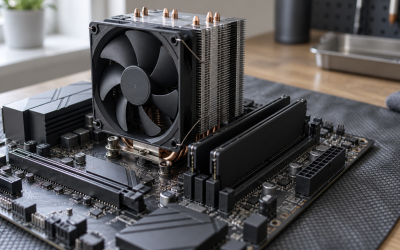
A processor rated at one hundred and twenty watts sustained under all-core load demands a different cooling investment than one that holds boost at sixty-five watts. Tower coolers priced between thirty and sixty dollars handle the sub-eighty-watt parts in this list without issue. Anything above that threshold benefits from a two-hundred-and-forty-millimeter all-in-one. Factor this into your total cost, because an undercooled chip throttles and wastes the performance premium you paid for.
Our Verdict
The AMD Ryzen 7 9800X3D is the top pick for anyone whose primary workload is gaming, with no meaningful competition at its performance ceiling. For budget builders, the AMD Ryzen 5 5500 remains the only processor under $85 that lets you assemble a complete working system without a separate cooler purchase. If your workload shifts toward mixed creation and productivity with occasional gaming, the Ryzen 9 9900X at around $330 wins on price-per-thread and justifies its premium over smaller chips.
FAQ
Do I really need 3D V-Cache for gaming?
Not strictly, but the measurable frame-time advantage in cache-bound titles is consistent across every X3D part AMD has shipped. If you play competitive titles at high refresh rates or open-world games with heavy asset streaming, the cache helps. For lighter esports titles, a standard Zen 4 or Zen 5 chip at a lower price performs adequately.
Is Intel’s hybrid architecture a disadvantage in 2026?
The scheduling has matured enough that background E-core handling is seamless in modern operating systems. Where hybrid architecture still costs Intel ground is in latency-sensitive gaming workloads, where AMD’s uniform Zen cores and stacked cache produce tighter frame pacing without scheduler overhead.
Should I buy a processor now or wait?
The eight chips above represent the current sweet spot for their respective tiers, and the 9800X3D and 9950X3D are new enough that no meaningful successor has announced a timeline. If you are building today, buy today. Platform prices are unlikely to drop further in the near term.
Does a more expensive cooler actually improve performance?
Yes, but only when the cooler allows the chip to hold its rated boost clocks under sustained load. A tower that caps thermal throttling at sixty degrees versus one that lets the package hit ninety-five degrees can produce a five-to-ten percent difference in long-running all-core tasks. For short gaming bursts, the difference is negligible.