
The best aquarium planting tweezers for most planted tanks are 25–30 cm stainless-steel tweezers with narrow, lightly textured tips, moderate spring tension, and a non-serrated closing surface; choose shorter 15–20 cm tweezers for nano tanks and longer 35–40 cm models for deep aquariums.
As an Amazon Associate we earn from qualifying purchases at no extra cost to you.

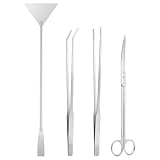


Top 3 picks at a glance
Best aquarium planting tweezers by planting situation
| Aquascaping situation | Recommended length | Tip shape | Best material choice | Why it fits |
|---|---|---|---|---|
| Plants in a 20–30 cm nano tank | 15–20 cm | Fine straight tip | 304 stainless steel | Better visibility and control in a small footprint |
| General stem planting in a 30–45 cm tank | 25–30 cm | Fine straight or slightly curved tip | 304 or 316 stainless steel | Good reach without excessive leverage |
| Carpet plants and tissue-culture portions | 20–30 cm | Very fine, pointed tip | 316 stainless steel preferred | Separates small plugs and enters tight substrate gaps |
| Deep tanks or thick foreground sand | 35–40 cm | Long narrow tip | 316 stainless steel | Reaches the bottom while keeping your hand out of the water |
| Hardscape planting around rocks and wood | 25–35 cm | Angled or curved tip | 304 or 316 stainless steel | Approaches planting pockets without scraping hardscape |
What separates good planting tweezers from frustrating ones?
Aquarium tweezers are not simply long household tweezers. The useful design balances reach, grip, closing force, and tip geometry. A model that grips firmly in the air may crush delicate stems underwater. A very sharp model may plant carpeting species precisely but split soft roots if squeezed too hard.
Stainless-steel grade and corrosion resistance
Most aquarium tweezers use stainless steel, but “stainless” does not mean rust-proof. 304 stainless steel is the normal dependable choice for freshwater aquascaping. It tolerates routine immersion, fertilizer residue, and drying between uses when rinsed and dried properly.
316 stainless steel adds better resistance to chlorides and other corrosive contaminants. It is particularly worthwhile for saltwater, brackish setups, aquariums treated with mineral-rich additives, or anyone who frequently leaves tools wet. The price difference is usually modest: basic stainless planting tweezers often cost about $8–$20, while better-finished 316 models commonly cost $20–$45.
Steel grade is only part of the equation. Poor polishing, contaminated welds, and scratches can create rust spots even on a nominally corrosion-resistant alloy. Look for smooth, uniform surfaces and a hinge-free construction where possible. After planting, rinse the tool in fresh water, wipe it dry, and store it outside the humid aquarium cabinet.
Tip shape
- Straight fine tips: The most versatile option for stem plants such as Rotala, Ludwigia, and Bacopa. They enter the substrate vertically and release the stem cleanly.
- Curved tips: Useful when planting beneath overhanging wood, around stones, or at an angle in a sloped layout. They can be less intuitive for perfectly vertical planting.
- Broad flat tips: Better for larger rooted plants and firmly holding moss pads or tissue-culture clumps. They are less suitable for tiny carpet plugs.
- Serrated tips: Add holding power but can damage fragile stems, tear moss, or leave visible marks. They are most useful for bulky plants that slip from smooth tips.
- Ultra-pointed tips: Excellent for Monte Carlo, dwarf hairgrass, and small tissue-culture portions, but require a gentle grip and careful alignment.
For one all-purpose tool, choose a fine straight tip with a small flat contact area rather than a needle point. It gives enough precision for most stems without concentrating all closing force on one fragile spot.
Length: reach versus control
Long tweezers reduce the need to submerge your hand, but they also amplify movement at the tip. A simple leverage example explains why. If a 40 cm tweezer has a handle movement of 2 mm, the tip can shift noticeably more than the tip of a 20 cm tool during the same hand motion. That makes deep-tank work easier but nano-tank planting less stable.
Measure from the finger-contact area to the tip, not simply the manufacturer’s overall packaging length. For a tank with approximately 30 cm of water depth, a 25–30 cm tool is usually easier to control than a 40 cm model. For a 45–60 cm deep aquarium, a 35–40 cm tool is more practical because it lets you plant at the bottom without bending your wrist sharply.
Owning two lengths is often more useful than buying one oversized pair: a 20 cm fine-tip tool for detailed foreground work and a 30–40 cm tool for stems in deep substrate.
Grip, spring tension, and release control
Planting tweezers work by springing open when you relax your fingers. A good pair should open smoothly, close evenly, and hold a stem with light pressure. If the tips cross, scrape, or require excessive force, accurate planting becomes difficult.
Use this practical tension test before putting the tool in the aquarium:
- Place a single soft stem between the tips without squeezing hard.
- Lift it 5–10 cm. The stem should remain secure without flattening.
- Squeeze slightly harder and confirm that the tips still meet evenly rather than sliding sideways.
- Release the grip slowly. The plant should stay in the substrate instead of being pulled back out.
Light spring tension is best for Rotala cuttings, pearlweed, moss, and small carpet plants. Medium tension suits most stem plants and larger rooted specimens. Very stiff tweezers are useful for compact soil or gravel but can fatigue your fingers during a large planting session and crush delicate material.
Grip texture matters as much as spring force. A matte or lightly brushed handle is easier to control with wet fingers than highly polished steel. Deep grooves can collect algae and fertilizer residue, so choose shallow texturing that can be rinsed clean.
Choosing tweezers without disturbing the substrate
The key technique is to insert the tips at a slight angle, open them only after reaching the desired depth, and withdraw vertically. Do not push a closed bundle deep into the substrate and then force the tips apart; that action creates a large cavity and can uproot nearby plants.
For a stem cutting, hold the lower 2–3 cm, insert it about 2 cm into aquasoil, release the stem, and pull the tweezers out while still closed. The surrounding substrate should collapse around the stem. If the plant rises with the tweezers, either the roots are caught between the tips or the hole is too shallow.
For carpet plants, plant small portions rather than a large mat. A useful starting size is a plug approximately 5–10 mm wide. Smaller plugs require more time but leave fewer floating fragments and allow the carpet to spread evenly. Pointed tips help create a narrow opening, while broad tips tend to lift more substrate.
Head-to-head: common tool types
Fine straight tweezers versus curved tweezers
Fine straight tweezers win for repetitive stem planting because the tip direction matches the hand direction. Curved tweezers win around hardscape, where a straight tool may hit a stone before reaching the planting pocket. If your layout contains many rocks or branches, curved tips are a useful second pair rather than a universal replacement.
Smooth tips versus serrated tips
Smooth tips are safer for soft stems and moss. Serrated tips provide extra security for heavy plants, but their teeth can bruise stems and trap small debris. For most planted freshwater aquariums, smooth or micro-textured tips offer the better balance.
304 versus 316 stainless steel
304 is the value choice for ordinary freshwater use and careful maintenance. 316 is the safer long-term choice where salt, brackish water, high mineral content, or consistently wet storage is unavoidable. Neither grade eliminates the need to rinse and dry the tool.
Maintenance that prevents rust and slipping
- Rinse fertilizer, soil, salt, and plant sap from the tips immediately after use.
- Wipe the entire tool dry, including the junction where the two arms meet.
- Do not leave tweezers submerged in the aquarium between planting sessions.
- Inspect the tips for bending; misaligned tips can pinch and cut stems.
- Use a soft cloth rather than abrasive pads that scratch the finish.
- Replace a tool with pitting, flaking, or tips that no longer meet evenly.
Frequently asked questions
Can aquarium planting tweezers be used for both stem plants and carpet plants?
Yes, a fine straight tip with a small flat contact area works for most stem plants and can also handle carpet plants when used gently. Ultra-pointed tips provide better precision for small carpet portions, while broad tips are more suitable for larger rooted plants or moss pads. Planting small carpet plugs helps the carpet spread evenly and reduces floating fragments.
How should I plant a stem without pulling it back out?
Hold the lower 2–3 cm of the stem, insert it about 2 cm into the aquasoil, release the stem, and withdraw the tweezers while they remain closed. Insert the tips at a slight angle and open them only after reaching the desired depth. The surrounding substrate should collapse around the stem as the tool is removed.
Are aquarium tweezers safe to leave in the tank between planting sessions?
No, tweezers should not be left submerged between planting sessions. Fertilizer, soil, salt, and plant sap should be rinsed from the tips immediately after use. Wipe the entire tool dry, including the junction where the arms meet, and store it outside the humid aquarium cabinet. These steps help reduce rust and keep the tips from slipping.
What should I do if the tweezers pull the plant out of the substrate?
If the plant rises with the tweezers, the roots may be caught between the tips or the hole may be too shallow. Insert the tool at a slight angle, open it only after reaching the desired depth, release the plant, and withdraw vertically while the tweezers remain closed. Avoid forcing closed tips apart deep in the substrate.
How can I tell whether aquarium tweezers are suitable for wet fingers?
Choose a matte or lightly brushed handle because it is easier to control with wet fingers than highly polished steel. Shallow texturing is preferable because deep grooves can collect algae and fertilizer residue. The tweezers should also open smoothly, close evenly, and hold a soft stem securely without flattening it when light pressure is applied.
Final buying recommendation
For most aquascapers, the best aquarium planting tweezers are a 25–30 cm pair made from 304 or 316 stainless steel, with fine smooth straight tips, a matte grip, and medium-light spring tension. Add a 35–40 cm curved pair for deep tanks and hardscape planting, or a 15–20 cm ultra-fine pair for nano aquariums. Prioritize tip alignment and controllable release over maximum sharpness: precise planting depends on placing the plant securely while leaving the surrounding substrate intact.


