The best 5×7 coaxial speaker for most drivers is a mid-range 2-way model with a silk or textile dome tweeter, sensitivity of about 90 dB or higher, and 40–60 watts RMS of power handling. It sounds clearly better than factory paper cones on a stock stereo and also holds up if you add a small amplifier later. Check fit first (cutout, mounting depth, tweeter height), then choose by sensitivity and power handling, not by the peak-power number on the box.
As an Amazon Associate we earn from qualifying purchases at no extra cost to you.
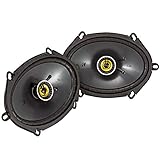


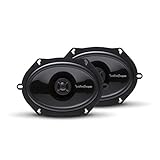
Top 3 picks at a glance
Quick comparison of the best 5×7 coaxial speaker classes
Many 5×7 and 6×8 car speakers share the same mounting pattern, so manufacturers often sell one model for both sizes. The picks below are spec classes rather than single models. Pioneer, Kicker, JBL, Alpine, Polk Audio, Kenwood and Rockford Fosgate all sell speakers in these classes. Confirm the exact size on the spec sheet before buying.
| Pick | Best for | Key specs (typical) | Price range |
|---|---|---|---|
| Best overall: mid-range 2-way | Most daily drivers, factory or aftermarket radio | 40–60 W RMS, 90–92 dB sensitivity, 4 ohm, silk or textile dome tweeter | Mid-range |
| Best budget: entry 2-way | Replacing blown or paper-rotted factory speakers | 15–30 W RMS, 87–90 dB, 4 ohm, polypropylene cone, PEI or mylar tweeter | Budget |
| Best for factory head units: high sensitivity | Stock radios making 12–20 W RMS per channel | 92 dB or higher, 20–45 W RMS, low-mass cone | Budget to mid-range |
| Best for an amplifier: high power handling | Small 4-channel amp at 45–75 W RMS per channel | 60–100 W RMS, rubber or foam surround, stiff cone | Mid-range to premium |
| Best 3-way/4-way upgrade | Drivers who want more top-end detail without a component set | 40–75 W RMS, 90 dB or higher, extra super-tweeter or mid-tweeter | Budget to mid-range |
| Best marine / powersports | Boats, UTVs, motorcycles, open cabs | UV-resistant cone, sealed or coated parts, 40–70 W RMS | Mid-range |
Best overall: mid-range 2-way coaxial
This class suits most buyers. A silk or textile dome tweeter usually sounds smoother than the stiff mylar tweeters in entry models. A polypropylene or similar mineral-filled cone handles midrange and bass better than treated paper. With 90–92 dB sensitivity it plays loudly from a factory radio, and with 50 W RMS or more it won’t clip a modest amp.
Trade-off: a 5×7 cone is small, so it won’t produce deep bass. Expect a useful response down to roughly 60–70 Hz. For low bass you still need a subwoofer or a door-sealing treatment.
Best budget: entry 2-way coaxial
If the goal is working speakers instead of cracked, foam-rotted ones, an entry coaxial is enough. Look for a rubber or foam surround, a polypropylene cone and a 4-ohm rating. Skip any model that markets only a 200 W “max power” figure. Check the RMS rating on the spec sheet instead, because it reflects what the speaker can handle continuously.
Trade-off: the tweeter is often harsh at higher volumes, and the cone can distort when pushed. They are fine on a stock radio but won’t scale well if you add an amp.
Best for a factory head unit: high-sensitivity coaxial
Factory radios often put out only about 12–20 W RMS per channel. At that power, sensitivity matters more than a high power rating. The worked example below shows why.
Best for an amplifier: high power handling
If you plan to add a compact 4-channel amp, match the speaker’s RMS rating to the amp’s output per channel at 4 ohms. A speaker rated 60–100 W RMS gives you headroom, and the amp won’t be run at its clipping point. Stiff cones and durable surrounds hold up better at those levels.
Trade-off: these speakers often have lower sensitivity, which means they need the amp to reach the same volume. On a weak factory radio they can sound quiet and flat.
Best 3-way or 4-way coaxial
Extra tweeters add some high-frequency detail and widen the dispersion. They are a cheap step up from a 2-way, although not always a real improvement. Poorly designed crossovers can add edge or brightness. Choose this class only if the model lists a real crossover network and the sensitivity doesn’t drop below about 90 dB.
Best for marine and powersports
Look for a UV-resistant cone, a sealed or coated motor, and corrosion-resistant hardware. A water-resistance claim is useful only when the manufacturer states what it covers. Check the spec sheet for a specific marine or ingress rating, not just a generic “weatherproof” label. Marine models often come with grilles, which matters if the speaker sits in an open door or a fairing.
Worked example: why sensitivity beats power on a stock radio
Sensitivity is the volume a speaker produces at 1 watt measured at 1 meter. Every 3 dB of sensitivity is equivalent to doubling the amplifier power. The ratio is 10(difference in dB ÷ 10).
- Speaker A: 88 dB sensitivity. Speaker B: 92 dB. The difference is 4 dB.
- Power ratio: 100.4 ≈ 2.5.
- If Speaker A gets 15 W from a stock radio, Speaker B matches its loudness with about 6 W.
- At the same 15 W, Speaker B plays about 4 dB louder. That is clearly noticeable.
Estimating maximum output: SPL ≈ sensitivity + 10 × log10(watts). A 90 dB speaker at 15 W gives roughly 90 + 11.8 = about 102 dB at 1 meter in ideal conditions. Cabin noise at highway speed is often 70–75 dB, so a car needs that headroom. These figures are idealized calculations. Real in-car response differs because of door acoustics, seating position and the speaker’s frequency curve.
The reverse also applies. A 100 W RMS speaker with 87 dB sensitivity needs a lot more amplifier power to play loudly than a 40 W RMS speaker rated 92 dB. High power handling doesn’t make a speaker louder on its own.
Decision matrix: match your setup to a pick
| Your situation | Choose | Target specs | Why |
|---|---|---|---|
| Stock radio, no amp, want clearer sound | High-sensitivity 2-way | 91–93 dB, 20–45 W RMS | Gets the most volume from 12–20 W |
| Stock radio, tight budget, speakers blown | Entry 2-way | 87–90 dB, 15–30 W RMS | Fixes the problem at the lowest cost |
| Aftermarket radio (about 20 W RMS per channel) | Mid-range 2-way | 90–92 dB, 40–60 W RMS | Good balance of efficiency and durability |
| Adding a 4-channel amp at 50–75 W RMS per channel | High-power 2-way | 60–100 W RMS, 4 ohm | Power handling should be at or above the amp’s RMS output |
| Open-cab vehicle or boat | Marine-rated coaxial | UV-resistant cone, 40–70 W RMS | Withstands sun and moisture |
| Want more treble detail, no component set | 3-way or 4-way | 90 dB or higher, crossover listed | Adds dispersion at modest cost |
How to choose: fit and specs to check
- Confirm the real size. Some vehicles use 5×7 openings, others 6×8, and some accept both. Use a vehicle fit guide from a car-audio retailer or the manufacturer, then check the cutout dimensions on the spec sheet.
- Measure mounting depth. Many 5×7 speakers need about 2 to 3 inches of clearance. Door window tracks, regulators and brackets can block deeper magnets. Measure before buying.
- Check tweeter height. Some tweeters sit tall enough to hit the grille or door panel. Look for a “top-mount depth” figure.
- Match impedance. Use 4 ohm for nearly all car radios and amps unless the manual says otherwise. Don’t mix impedances on one channel.
- Use RMS, not peak. Pair the RMS rating with the head unit or amp output. A speaker rated at or slightly above the source is a safe target.
- Weigh sensitivity. Aim for 90 dB or higher on a factory radio. With an amp, 87–90 dB is fine.
- Consider add-ons. Mounting adapters, harness plugs and sound-deadening mats can matter more than the speaker itself. A little deadening on the door skin can tighten midbass noticeably.
Installation tips that affect sound
- Seal the speaker against the door panel with foam rings. This prevents rattling and improves midbass.
- Check phase. Reverse wiring makes bass sound thin and weak.
- If the radio has a high-pass filter, set it around 60–80 Hz so the small cone isn’t asked to play deep bass.
- Leave tone controls flat at first, then adjust treble down a notch if the tweeter sounds bright.
Frequently Asked Questions
Are 5×7 and 6×8 speakers the same size?
They are close, and many models are sold as 5×7/6×8 and fit either opening. The mounting holes and cutout can still differ slightly between vehicles. Check the spec sheet and a fit guide for your car.
Will 5×7 coaxial speakers work with my factory radio?
Yes, in most cases. Choose a model with sensitivity around 90–92 dB or higher, because factory radios usually provide only modest power. A 4-ohm speaker is the normal match.
Do I need an amplifier for 5×7 speakers?
No. A good high-sensitivity pair plays well from a typical radio. An amp adds volume, clarity at higher levels and lower distortion, so it helps if you listen loudly or want more bass response.
What does RMS power mean for car speakers?
RMS is the continuous power a speaker can handle without damage, according to the manufacturer’s spec sheet. Peak or max power is a short-burst number and says little about real use. Compare RMS to the output of your radio or amp.
Are coaxial speakers worse than component speakers?
Coaxials are simpler and often easier to fit, since the tweeter sits on the cone. Component sets can sound more precise because the tweeter can be mounted higher and aimed, but they cost more and take more work. For a straightforward replacement, a good coaxial is usually enough.
How long do car speakers last?
Many last for years, though foam surrounds and paper cones can degrade with heat, humidity and sun. Rubber surrounds and polypropylene cones tend to hold up better. If your speakers sound crackly, thin or rattly, the surround or voice coil may be failing.
Related guides
More from Amazon
Programs that pair well with the guide above. Offers and eligibility are set by Amazon and may change.
A free business account with business pricing and bulk-buying tools for work, shop or home office.
Create a business accountFree shipping on eligible items, Prime Video and more. Eligible new members can start with a free trial.
Start a Prime free trialAudiobooks and podcasts to listen to on the go. Eligible new members can start with a free trial.
Try Audible freeAd-free music streaming. Eligible new subscribers can start with a free trial.
Try Music Unlimited freeAs an Amazon Associate we earn from qualifying purchases.


