This review analyzes published product information. We have not performed hands-on testing of this unit.
As an Amazon Associate, we earn from qualifying purchases.
A board worth evaluating beyond its OC label
The ASUS Prime Radeon RX 9070 EVO 16GB GDDR6 OC Edition combines a listed 2.5-slot cooler with selectable BIOS profiles and software-adjustable operating modes. Those details are more useful for understanding this exact board than treating the OC badge as a performance verdict. The supplied retailer listing identifies the EVO, 16GB GDDR6, OC configuration; this review does not substitute specifications from another Prime or RX 9070 variant.
This is a specification-based analysis, not a hands-on test. The listing provides clock ceilings and several cooling features, but leaves important power, connection and installation details unresolved. Its strongest buying case is the combination of cooling controls and a stated slot footprint, provided the missing compatibility information is checked before committing to a build.
The specifications actually supplied
| Exact configuration | ASUS Prime Radeon RX 9070 EVO OC Edition |
|---|---|
| Listed graphics memory | 16GB GDDR6 |
| Default-mode clocks | Up to 2590 MHz boost; up to 2120 MHz game |
| GPU Tweak III OC-mode clocks | Up to 2610 MHz boost; up to 2140 MHz game |
| Listed cooler footprint | 2.5 slots |
| Cooling features | Axial-tech fans, dual-ball bearings, phase-change GPU thermal pad, 0dB technology |
| BIOS choices | Quiet and Performance profiles via a switch |
| Software | GPU Tweak III for tuning, thermal control and monitoring |
| Unspecified essentials | Board power, power connectors, PSU recommendation, display outputs and PCIe interface details |
What the two clock modes tell you
ASUS lists default-mode ceilings of 2590 MHz boost and 2120 MHz game, with GPU Tweak III OC mode raising those figures to 2610 MHz and 2140 MHz respectively. Each listed ceiling therefore increases by 20 MHz. That is a clear distinction between operating modes, but it is not evidence of a particular improvement in games or applications.
The wording matters: these are advertised upper limits, not measured sustained operating speeds. Nothing supplied establishes how frequently the card reaches them, how clock behavior changes under prolonged load, or what power settings accompany either mode. Buyers should not treat the OC configuration as a promise of a specific performance margin.
The 16GB GDDR6 specification establishes memory capacity and type, but the evidence does not include memory speed, bus width or bandwidth. Capacity alone cannot settle suitability for a chosen resolution, texture setting or workload. For those decisions, this listing needs to be supplemented with relevant independent testing rather than extrapolation from the memory label.
Cooling flexibility without acoustic guarantees
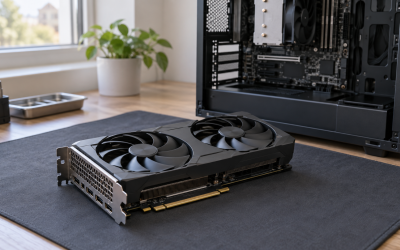
The listed Axial-tech design uses a smaller hub, longer blades and a surrounding ring intended to direct more pressure downward. ASUS also specifies a phase-change thermal pad at the GPU. These describe the intended cooling approach; the accompanying claims about lower temperatures and improved reliability are manufacturer assertions, not results established here.
Dual-ball fan bearings are another listed feature. The seller relays a lifespan claim of up to twice that of conventional sleeve-bearing designs, but supplies no test conditions or board-specific endurance results. It is reasonable to regard the bearing choice as a design consideration, not as a guaranteed service life for the complete card.
The Quiet and Performance BIOS switch offers a more directly understandable benefit: a choice between named operating profiles. GPU Tweak III separately provides advertised tuning, thermal-control and monitoring functions. Together, these give a prospective owner more configuration options, although the listing does not explain the BIOS profiles’ fan curves, power limits or relationship to the software OC mode.
Likewise, the advertised 0dB feature is relevant to someone prioritizing lower noise during lighter use, but the evidence does not state its activation thresholds or exact fan behavior. Neither that feature nor the Quiet profile proves silence across a particular set of games. There are no supplied acoustic measurements to support that conclusion.
Case clearance and power remain the critical checks
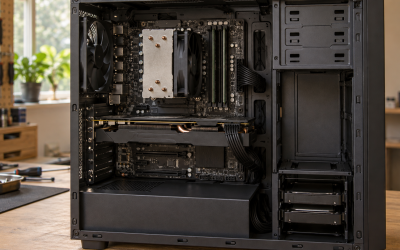
The 2.5-slot designation is useful for initial layout planning. It should nevertheless be treated as a clearance requirement rather than as proof of broad case compatibility. Check the space available around the intended graphics-card position and whether the cooler would interfere with other planned expansion hardware.
There is a significant inconsistency in the listing’s dimensional data: it gives dimensions of 12 by 5 by 0.1 inches alongside the 2.5-slot cooler claim. The very thin third dimension is not a credible basis for validating that cooler’s installed clearance. Rather than silently replacing it with dimensions from a related model, obtain a reliable mechanical specification for this exact EVO OC board.
Power planning is also unfinished. The supplied evidence does not state total board power, connector type or count, or a recommended PSU capacity. Consequently, it cannot establish whether an existing supply has the required capacity and cabling. Display outputs and PCIe interface details are absent too, so monitor connections and platform requirements need separate confirmation. None of these omissions proves a defect; they limit what this listing can safely answer.
Verdict: appealing controls, incomplete build guidance
The ASUS Prime Radeon RX 9070 EVO 16GB GDDR6 OC Edition is worth considering for its listed dual BIOS, software controls and 2.5-slot cooling design. Its small advertised clock-mode step is less compelling as a decision point than whether the board suits your case, power supply and noise priorities. Confirm those unresolved requirements and seek workload-specific testing before choosing it on performance grounds.
For broader selection context, our graphics card buying guide can help frame the comparison without treating this specification sheet as a benchmark result.
Sources: Supplied retailer listing for the ASUS Prime Radeon RX 9070 EVO OC Edition. All product specifications and advertised feature claims discussed here come from that listing.
Check the exact product and current offer on Amazon