
A 5V power supply is the quiet backbone of countless projects and devices — from LED pixel strips and security cameras to single-board computers and industrial controllers. The problem is that most failures in these setups trace back to an underpowered or poorly regulated adapter. A supply that nominally delivers 5 volts but sags under load will flicker your lights, reboot your camera, or corrupt data on your Raspberry Pi before you ever think to check the brick.
What separates a worthwhile adapter from a cheap gamble comes down to regulation accuracy, thermal headroom, connector compatibility, and whether the unit carries any safety certification at all. Price alone is a poor signal here: the cheapest adapters sometimes perform adequately for low-draw gadgets, while mid-range units with proper Class 2 ratings justify their premium for permanent installs. This guide compares the published specifications, street prices, and recurring owner-reported strengths and weaknesses across eight widely available options to help you match the right supply to the right job.
As an Amazon Associate we earn from qualifying purchases at no extra cost to you. Product prices and availability are accurate as of the date shown and are subject to change.
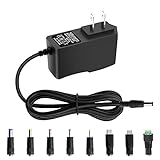


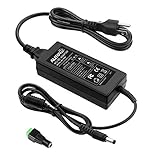


Top 3 picks at a glance
Quick Picks
| Product | Best for | Price |
|---|---|---|
| Arkare 5V 1A | Low-draw gadgets (baby monitors, small cameras) | $7.99 |
| MTYTOT 5V 3A | Budget LED strip or CCTV power on a single barrel connector | $7.29 |
| 5V 5A with Screw Terminal | 3D printers, POE switches, and wired LED matrix projects | $9.99 |
| ALITOVE 5V 3A | WS2812B and SK6812 pixel strips at modest lengths | $8.59 |
| ALITOVE 5V 5A | Longer pixel runs and multi-camera CCTV clusters | $16.49 |
| BTF-LIGHTING 5V 3A ETL | Code-compliant residential LED installs | $12.99 |
| BTF-LIGHTING 5V 6A ETL | Large-scale WS2812B arrays needing certified power | $18.99 |
| Facmogu 5V 2A (6-Pack) | Stocking multiple small-device wall outlets at once | $23.99 |
How We Picked
We evaluated these supplies against four criteria that consistently determine real-world suitability: output current headroom relative to your expected draw (running a supply near its rated ceiling shortens its life and destabilizes voltage), connector and terminal flexibility for your wiring scenario, presence of a recognized safety listing such as ETL or Class 2 for installations where electrical code applies, and the value per watt when comparing across the price range. We cross-referenced published specs with aggregate owner feedback to flag recurring complaints like cable length, heat under sustained load, and plug-size mismatches.
The 8 Best 5V Power Supply in 2026
Arkare 5V 1A DC Power Supply Adapter
This is the go-to replacement brick for gadgets that sip power — baby monitors, small indoor security cameras, TV boxes, and the occasional Graco swing controller. The standout feature is its Type-C output paired with eight interchangeable barrel tips, so one unit covers dozens of legacy ports. Owners praise the compact footprint and the broad device compatibility that eliminates drawer clutter. The downside is the 5W ceiling: anything that draws more than 1A will stall it, making it unsuitable for even short LED runs. Skip this if your project involves addressable pixels, multi-camera systems, or anything with motors beyond a small servo. For trickle-charge applications under 5W, it is the most versatile connector package on the list.
MTYTOT 5V 3A DC Power Supply Adapter
At $7.29 this adapter offers 15W of regulated 5V output through a 5.5×2.5mm barrel plug, making it the cheapest entry for short WS2812B strips or a single CCTV camera. Owners frequently highlight the price-to-watt ratio and reliable voltage hold under a 2A draw. The trade-off is a single fixed connector size — if your device uses 5.5×2.1mm, you need an adapter dongle. Thermal reports note the unit runs warm during extended 3A loads, so derating to about 2.5A for 24/7 operation is advisable. Skip it if you require ETL certification or screw terminals; this is a bare utility adapter, not a code-listed supply.
5V 5A Power Supply with Screw Terminal and Barrel Plug
This unit covers two wiring philosophies at once: a 5.5×2.5mm barrel for plug-in devices and a screw terminal for hard-wired connections to 3D printer controllers, POE switch injectors, or custom LED matrices. The 25W rating and five-foot cable length are generous for its price tier. Owners call out the dual-connector design as its biggest win, and the 5.5×2.1mm compatibility via the terminal block adds flexibility. The main complaint centers on the lack of any safety certification, which limits placement options in commercial or code-inspected spaces. Skip it if your install must pass electrical inspection or if you need a compact form factor — the housing is bulkier than barrel-only adapters.
ALITOVE 5V 3A AC to DC Power Supply Adapter
ALITOVE’s 15W adapter is a staple in the pixel-art and LED community for its dual-plug design (5.5×2.5mm and 5.5×2.1mm) and consistent voltage regulation under 3A draw. Owners running WS2812B, WS2811, WS2801, and SK6812 strips report clean signal behavior with minimal voltage drop at the far end of short runs. The compact brick fits inside most enclosure cutouts without modification. The limitation is thermal: pushing a sustained 3A load in an enclosed cabinet can cause the unit to throttle. For open-air or well-ventilated strips under roughly 100 LEDs at full white, it performs well. Skip if you need more than 15W or require a listed supply for insurance purposes.
ALITOVE 5V 5A AC to DC Power Supply Adapter
Doubling the current to 5A gives this 25W supply headroom for 250-pixel WS2812B runs or clusters of two to four CCTV cameras on a single output. Owners in the pixel-art community prefer it for its stable regulation across the full load range and the familiar 5.5×2.5mm plug. The trade-off is the near-double price compared to the 3A variant, and the unit’s physical size grows correspondingly — confirm your enclosure before purchasing. For permanent installations behind drywall, the lack of an ETL or UL listing remains a concern. Skip it for small projects where 3A suffices; you are paying for amperage you will not use.
BTF-LIGHTING 5V 3A ETL Listed Class 2 Power Supply
This is the adapter to choose when an inspector, an HOA, or your homeowner’s insurance policy demands a code-compliant supply. The ETL listing and Class 2 designation mean the output is limited to safe voltage and current thresholds by design, and it has passed third-party testing against recognized standards. Owners running addressable LED projects in residential kitchens, bathrooms, and outdoor soffit areas specifically cite the listing as the reason they chose BTF-LIGHTING over uncertified alternatives. The premium over the MTYTOT and ALITOVE 3A units buys you compliance and typically better component quality inside. Skip it if you are working in a garage hobby setup where no inspection applies — the extra cost is unnecessary for non-permanent builds.
BTF-LIGHTING 5V 6A ETL Listed Class 2 Power Supply
At 30W this is the highest-rated ETL-listed supply on the list, and it earns its $18.99 tag by supporting roughly 300 WS2812B pixels at moderate brightness or four simultaneous PoE cameras without sag. Owners building large matrix displays or multi-zone LED home installations repeatedly name it as their default for certified power. The trade-off is size and cost — the housing is larger than uncertified 30W supplies, and you pay a premium for the listing. Skip it if 3A or 5A suffices for your current project; 6A is meaningful only when you are filling the amperage or planning expansion headroom.
Facmogu DC 5V 2A Wall Plug Power Converter (6-Pack)
Buying six 10W wall warts for $23.99 works out to roughly $4 each, making this the most economical route when you need to power a set of small 5V devices across multiple rooms or on a workbench. Owners appreciate the flat wall-plug form factor that avoids dangling bricks and the uniform 5.5×2.1mm output for easy cable matching. The 2A rating handles Raspberry Pi Zero, small cameras, and sensor nodes without issue. The limitation is clear: 10W per unit means no single brick supports LED strips or multi-port hubs. Skip it if your application exceeds 2A per outlet — the pack is about quantity, not raw amperage.
Buying Guide
Matching Current Rating to Your Load
Sum the maximum amperage draw of every device on a single supply, then multiply by 1.5 for thermal headroom. A WS2812B strip at 300 pixels theoretically needs 18A at full white, so a 5A supply should only drive about 80 pixels at full brightness or more pixels at reduced brightness levels. Cameras and controllers with inrush currents during startup demand even more margin than steady-state ratings suggest. Running a supply at its rated maximum shortens capacitor life and can cause brownouts on sensitive digital devices.
Connector Type and Wiring Flexibility
Barrel plugs in 5.5×2.5mm and 5.5×2.1mm sizes dominate consumer devices, but screw terminals, pigtail leads, and Type-C outputs each serve distinct scenarios. A screw terminal lets you wire directly to a device’s PCB without relying on a mating plug, which is ideal for embedded controllers and custom enclosures. Interchangeable tip kits, like the Arkare’s eight-piece set, cover legacy ports but add a point of mechanical failure at the contact interface. Match the connector to your final wiring method before committing.
Safety Certification and Installation Context
ETL, UL, and Class 2 designations matter when a supply is installed permanently in walls, near combustible materials, or in commercial spaces subject to inspection. An uncertified adapter is fine on a soldering iron bench but could void insurance coverage if it fails behind drywall. Class 2 specifically limits the output to voltage and power thresholds recognized as low-risk, reducing the severity of fault conditions. If your project is a one-off art piece on a shelf, certification adds cost without benefit; if it is part of your home’s fixed wiring, the listing is non-negotiable.
Our Verdict
For most hobbyist LED pixel and camera projects that do not require code compliance, the ALITOVE 5V 3A is the best value pick — dual-plug compatibility, stable regulation, and a price that undercuts ETL-listed alternatives while covering the vast majority of single-strip or single-camera scenarios. For budget-focused buyers stocking a workbench with small-device power, the Facmogu 6-Pack delivers wall-plug convenience at roughly $4 per unit. If your install faces any inspection, insurance, or permanent-concealment requirement, the BTF-LIGHTING 5V 6A ETL becomes the only rational choice on this list despite its premium, because no uncertified supply should be embedded in your structure regardless of how favorable its specs look on paper.
FAQ
Can I use a higher-current 5V supply than my device requires?
Yes. The device draws only the current it needs; a 5A supply powering a 1A camera will simply have extra headroom. The risk runs the opposite direction — a supply rated below your device’s draw will overheat or trip its protection.
What is the difference between 5.5×2.5mm and 5.5×2.1mm plugs?
Both have the same outer diameter, but the center pin differs: 2.1mm uses a 2.1mm inner pin and 2.5mm uses a 2.5mm pin. A 2.1mm plug often fits loosely into a 2.5mm jack, which can cause intermittent contact. Always verify which size your device’s DC barrel jack actually requires.
How many WS2812B LEDs can a 5V 3A supply drive?
Each WS2812B draws up to 60mA at full white (20mA per channel), so 3A (3000mA) supports roughly 50 pixels at 100% brightness. In practice, most users cap brightness to 30-50% via software, which extends the safe count to 100-160 pixels on the same supply.
Is a switching supply better than a linear supply for 5V?
For 5V adapters that convert 120V or 230V AC, switching supplies are the standard because they are far more efficient and run cooler. Linear supplies at 5V are mostly obsolete for AC-to-DC conversion but appear as small on-board regulators in devices. The units in this roundup are all switching designs.


