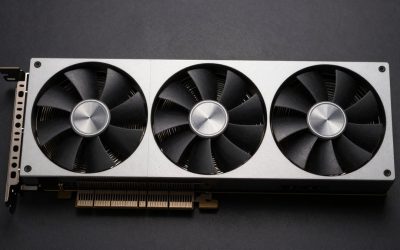
Pick the RX 9060 XT 16GB for almost any new build: it is clearly faster than the Arc A770, uses about 65 W less power, needs just one 8-pin connector and gets AMD’s FSR 4 upscaler. The Arc A770 only makes sense if you find a used one for far less than a 9060 XT, or if you specifically want Intel’s media engine and are willing to accept its older Alchemist drivers and higher power draw. Both cards have 16 GB of VRAM, so the choice comes down to speed, efficiency and software rather than memory.
Same 16 GB, Very Different Silicon
On paper the A770 looks like the bigger GPU. It has twice the shader count (4096 vs 2048), a 256-bit memory bus instead of 128-bit, and 512 GB/s of bandwidth against 322.3 GB/s. It was Intel’s first-generation flagship, launched in October 2022 at $329.
The RX 9060 XT 16GB arrived in June 2025 on AMD’s RDNA 4 architecture. It uses a smaller, much higher-clocked chip (up to 3130 MHz) with a 32 MB Infinity Cache that makes up for the narrow bus. RDNA 4’s per-shader efficiency, mature drivers and a newer 4 nm process give it more frame rate per watt and more consistent results across games.
Spec Sheet Comparison
| Intel Arc A770 | AMD RX 9060 XT 16GB | |
|---|---|---|
| Architecture | Generation 12.7 (Alchemist) | RDNA 4.0 |
| Released | 12 October 2022 | 4 June 2025 |
| Launch MSRP | $329 | $349 |
| Shaders | 4096 | 2048 |
| Boost clock | 2400 MHz | 3130 MHz |
| Process node | 6 nm | 4 nm |
| VRAM | 16 GB GDDR6 | 16 GB GDDR6 |
| Bus / bandwidth | 256-bit / 512.0 GB/s | 128-bit / 322.3 GB/s |
| Cache | 16 MB L2 | 4 MB L2 + 32 MB L3 |
| Interface | PCIe 4.0 x16 | PCIe 5.0 x16 |
| TDP | 225 W | 160 W |
| Power connectors | 1x 6-pin + 1x 8-pin | 1x 8-pin |
| Size | 2-slot | 267 mm, 2-slot |
| Outputs | 1x HDMI 2.1, 3x DP 2.0 | 1x HDMI 2.1b, 2x DP 2.1a |
Frame Rates in Practice
The A770 usually sits around RTX 3060 to RX 6650 XT territory in review suites, with better showings in some newer DX12 and Vulkan games and weaker ones in older APIs. TechSpot’s RX 9060 XT 16GB review placed AMD’s card near the RX 7700 XT, averaging about 70 FPS at native 1440p across 18 games and sitting just behind the RTX 5060 Ti. That is a full performance tier above the A770’s usual place.
Direct comparisons point the same way. In Gamers Nexus’ 9060 XT review, the AMD card led the A770 by about 20% in one test, and the gap was wider in heavier modern games and ray-traced titles. Aggregated benchmark databases disagree on the exact size, which is common with Arc because results vary so much from game to game. A fair summary is that the RX 9060 XT 16GB is roughly 25–45% faster on average, with the largest gaps in ray tracing and in games where Arc drivers are less tuned.
In practice, if the A770 manages roughly 50–60 FPS at 1440p medium-high in a recent AAA game, the 9060 XT 16GB tends to land in the 65–80 FPS range with the same settings. Treat these as approximate, and expect them to change with CPU, settings and patches.
Consistency matters as much as averages
Intel has improved Alchemist drivers a great deal since launch, and DX11 performance is much better than in 2022. The A770 still tends to have more outlier games, where performance falls well below expectations or frame times are uneven, than a Radeon card does. Intel’s development focus has also moved to the newer Battlemage (Arc B-series) cards. If you want to install a card and not think about it, the 9060 XT is the lower-maintenance option.
Ray Tracing and Upscaling
Alchemist’s ray tracing was respectable for a first-generation design and often better than RDNA 2. RDNA 4 is a much bigger step, though, and the 9060 XT handles moderate RT at 1080p and lighter RT at 1440p more comfortably.
- RX 9060 XT 16GB: FSR 4 ML upscaling, which looks much sharper than FSR 3.1, plus AMD frame generation. Many FSR 3.1 games can be upgraded to FSR 4 through the driver.
- Arc A770: XeSS with XMX acceleration, which looks very good on Arc hardware. Since early 2026, XeSS 3 Multi-Frame Generation is also available on Alchemist through a driver override, but only in games that already support XeSS 2 frame generation.
Both upscalers are good. FSR 4 is in more games now and keeps growing, which gives the AMD card the practical edge.
Power and Efficiency Math
The A770 is rated at 225 W and needs both a 6-pin and an 8-pin connector. The 9060 XT 16GB is rated at 160 W and uses one 8-pin. Combine that with the performance gap and the AMD card delivers roughly 75–100% more performance per watt.
For PSU sizing, use GPU TDP + CPU + about 150 W:
- Arc A770 + 105 W-class CPU: 225 + 105 + 150 = 480 W, so a quality 550–650 W PSU
- RX 9060 XT 16GB + same CPU: 160 + 105 + 150 = 415 W, so a quality 500–550 W PSU
Running costs add up too. A 65 W difference under load, at four hours of gaming a day, is about 95 kWh a year. Depending on your electricity price, that is a noticeable amount over the life of the card. Like other Alchemist cards, the A770 can also have high idle power unless ASPM is configured correctly.
Value Per Frame at Launch Prices
| Card | Launch MSRP | Relative performance (A770 = 100) | Cost per point |
|---|---|---|---|
| Arc A770 | $329 | 100 | $3.29 |
| RX 9060 XT 16GB | $349 | ~135 (mid-range of 25–45%) | ~$2.59 |
At launch pricing the 9060 XT gives about 20% more performance per dollar, before counting its lower power draw. For a used A770 to match on value, it has to cost about 75% or less of a new 9060 XT’s price, and lower still to cover the higher power use and older platform.
Case and Platform Fit
Both are 2-slot designs. The 9060 XT figure is 267 mm long, and A770 partner models are usually similar, so most mid-towers fit either one. Two platform notes:
- Resizable BAR: Arc cards need it enabled to perform properly. On pre-2019 platforms without ReBAR support, the A770 loses a lot of performance. The 9060 XT also benefits from Smart Access Memory but does not depend on it as heavily.
- PCIe link: both use a full x16 link, so neither is held back badly on PCIe 3.0 boards.
Pick X If, Pick Y If
| Situation | Choose |
|---|---|
| New 1080p/1440p gaming build | RX 9060 XT 16GB |
| Used A770 available at a deep discount | Arc A770 |
| Older PC without Resizable BAR | RX 9060 XT 16GB |
| Small PSU with one PCIe cable | RX 9060 XT 16GB |
| Video encoding and streaming focus (AV1) | Either, both have AV1 encode |
| Older DX9/DX11 game library | RX 9060 XT 16GB |
Buying an A770 Secondhand
Used Arc A770 16GB cards usually sell for roughly $170–$230, depending on the model, with Intel Limited Edition cards and better partner coolers at the top of that range. Check that the card has no physical damage around the power connectors, test it with the latest Intel driver, and confirm Resizable BAR is enabled before benchmarking. Some 8 GB A770 variants also exist, so make sure the listing is the 16 GB version.
Frequently Asked Questions
Is the RX 9060 XT 16GB faster than the Arc A770?
Yes, usually by about 25–45% depending on the game and resolution. The gap is largest in ray-traced titles and in games where Arc drivers are weaker. In some modern DX12 titles the A770 gets closer.
Why is the A770 slower when it has twice the shaders and a wider bus?
Raw shader counts are not comparable across architectures. RDNA 4 runs at much higher clocks, uses a large Infinity Cache to make up for its narrow bus, and has more mature drivers. Alchemist also leaves more performance unused in many games.
Is 16 GB of VRAM useful on either card?
Yes. Both can use high-resolution textures at 1440p without hitting memory limits in current games. That is the main reason either card is a better long-term buy than an 8 GB alternative.
What PSU do I need for the Arc A770?
A quality 550–650 W unit with one 6-pin and one 8-pin PCIe connector covers most systems. The 9060 XT 16GB is happy on 500–550 W with a single 8-pin.
Does the Arc A770 support frame generation?
Yes, but only in limited cases. Intel enabled XeSS 3 Multi-Frame Generation for Alchemist cards in early 2026 through a driver override, and it only works in games that already support XeSS 2 frame generation.
Related guides
More from Amazon
Programs that pair well with the guide above. Offers and eligibility are set by Amazon and may change.
A free business account with business pricing and bulk-buying tools for work, shop or home office.
Create a business accountFree shipping on eligible items, Prime Video and more. Eligible new members can start with a free trial.
Start a Prime free trialAudiobooks and podcasts to listen to on the go. Eligible new members can start with a free trial.
Try Audible freeAd-free music streaming. Eligible new subscribers can start with a free trial.
Try Music Unlimited freeAs an Amazon Associate we earn from qualifying purchases.