
Top 3 picks at a glance
Best LiPo Batteries for RC Cars, Drones, and More: The Short Answer
The best all-around pick in this group is the Zeee 3S 2200mAh 50C shorty pack with an XT60 plug for RC vehicles that are designed for a 3-cell battery and have room for its shorty form factor. It offers a useful middle ground: 11.1V nominal voltage, enough capacity for many compact RC setups, and a widely used connector. For a 2S RC car that takes a Traxxas plug, the HOOVO 7.4V 6200mAh 70C hard-case two-pack is the better fit; for a small 1S toy-grade aircraft that specifically accepts JST, choose the URGENEX 600mAh battery instead.
There is no universal best LiPo: voltage, dimensions, connector, and the vehicle’s battery limits matter more than a headline capacity or C rating. A 3S pack is not an upgrade for a 2S vehicle unless its manufacturer explicitly allows it. Likewise, a battery with the right voltage but the wrong plug or shape may not fit safely. This roundup compares seven listed options by their stated specifications and intended fit, then gives practical checks for choosing a compatible pack, estimating runtime, and charging and storing it responsibly.
Quick Comparison
| Product | Best for | Key specs stated in listing | Price tier |
|---|---|---|---|
| Zeee 3S 2200mAh 50C Shorty Pack | Compact 3S RC cars, trucks, and boats with XT60 | 3S, 11.1V, 2200mAh, 50C, shorty pack, XT60 | Mid-range |
| OVONIC 3S 550mAh 130C Soft Case | Small RC models that specifically fit a 3S XT30 pack | 3S, 11.1V, 550mAh, 130C, soft case, XT30 | Mid-range |
| Hilldow 3S 2200mAh 40C | Budget 3S RC vehicles with an XT60 connection | 3S, 11.1V, 2200mAh, 40C, XT60 | Budget |
| HOOVO 2S 6200mAh 70C Hard Case, Two Pack | Compatible 2S cars needing a Traxxas plug and larger capacity | 2S, 7.4V, 6200mAh, 70C, hard case, Traxxas plug, two packs | Premium |
| Zeee 3S 2200mAh 50C Shorty Pack | Budget-minded 3S vehicle owners seeking the listed XT60 shorty format | 3S, 11.1V, 2200mAh, 50C, shorty pack, XT60 | Budget |
| OVONIC 3S 2200mAh 50C | 3S aircraft and quadcopters designed for an XT60 pack | 3S, 11.1V, 2200mAh, 50C, XT60 | Premium |
| URGENEX 1S 600mAh with X5 Charger | Specified small UDI models using a 1S JST battery | 1S, 3.7V, 600mAh, JST plug; listing includes X5 battery charger | Budget |
Price tiers are relative categories, not live quotes. Prices and pack configurations can change, so check the current listing and confirm the exact connector, dimensions, and included accessories before buying.
How We Chose
This roundup is based on the specifications and use cases stated in each product name, alongside established LiPo battery conventions. We compared cell count and nominal voltage first, because using a pack with an unsupported cell count can damage electronics or create a safety hazard. We then considered capacity, stated C rating, connector, case style, and the type of vehicle named in the listing. These details help distinguish a large 2S hard-case pack for a compatible car from a compact 1S battery for a small aircraft, even though both are rechargeable lithium-polymer batteries.
Category fit matters as much as the numbers: an XT30 is not interchangeable with an XT60, and a Traxxas plug is not automatically compatible with either. We also considered whether a product could serve as a practical upgrade or spare for a vehicle already built around its voltage and connector. No product here is presented as personally tested or benchmarked. Check the vehicle manual and battery bay measurements before ordering; the listed specs alone do not establish fit for every model.
1. Zeee 3S 2200mAh 50C Shorty Pack – Best for compact 3S RC vehicles
As an Amazon Associate we earn from qualifying purchases at no extra cost to you.

The Zeee 3S 2200mAh 50C shorty pack is the strongest all-around choice in this selection for an RC car, truck, or boat that explicitly supports a 3S battery and accepts an XT60 connector. “Shorty” describes a compact pack format used in some RC vehicle battery bays; it does not guarantee compatibility with every shorty tray. Measure the available space and compare it with the pack’s current dimensions before purchase, particularly if the vehicle has a hold-down strap or a snug battery compartment.
At 11.1V nominal, a 3S pack contains three cells in series. A fully charged conventional 3S LiPo reaches 12.6V, so the vehicle’s speed controller and other electronics must be rated for that voltage. The 2200mAh capacity is a reasonable class for compact setups where a larger pack would be too heavy or would not fit. The 50C figure is the manufacturer’s stated discharge rating; it should be treated as a claimed specification rather than a promise that any particular vehicle will draw or sustain a specific current.
- Cell count and voltage: 3S, 11.1V nominal
- Capacity and discharge label: 2200mAh, 50C
- Format and connector: shorty pack, XT60
- Listed uses: RC cars, trucks, vehicles, and boats
The practical advantage of this combination is balance. A 2200mAh pack is more substantial than a tiny micro-model battery, but it remains a more compact capacity class than a large 5000mAh-plus car pack. That can suit a smaller 3S vehicle where weight and physical room are constraints. XT60 is a common connector family in hobby RC equipment, but connector popularity does not make it universal: check both the battery plug and the vehicle’s socket, and do not force mismatched connectors together.
Pros
- Combines a common 3S voltage class with a moderate 2200mAh capacity.
- Shorty format may suit compact battery compartments designed around that shape.
- XT60 connector is useful when the vehicle already has a matching connection.
- Stated 50C rating places it in a higher-discharge category than the listed 40C alternative.
Cons
- Not suitable for a vehicle limited to 2S or 1S.
- Shorty dimensions still need to be checked against the actual battery bay.
- Requires a compatible balance charger and a safe charging setup.
- The 50C label alone does not establish real-world runtime or sustained current performance.
Compared with the nearest alternative: The Hilldow 3S 2200mAh pack shares the nominal voltage and capacity class and also has XT60, but its listed C rating is 40C and the listing does not call it a shorty pack. Choose this Zeee when a compact shorty shape and the stated 50C rating are useful. Choose Hilldow if budget is the deciding factor and the standard pack shape fits. The other Zeee shorty listing has the same headline specifications but is categorized as budget rather than mid-range, making the current price and exact listing details the main points to compare.
2. OVONIC 3S 550mAh 130C Soft Case – Best for small 3S models using XT30

This OVONIC battery is the specialist pick for a small RC car, truck, plane, or drone whose specifications call for a 3S pack with an XT30 connection. Its 550mAh capacity is far smaller than the 2200mAh 3S packs elsewhere in this roundup, which can be an advantage on a lightweight model that cannot carry a larger battery. It is not a substitute for a 2200mAh pack simply because both are 3S: capacity, dimensions, weight, and expected current draw all affect whether a model can use it well.
The listing specifies 11.1V nominal, 3S, 130C, a soft case, and XT30. The high stated C rating signals the product’s intended high-discharge category, but the number should not be used in isolation to choose a battery. A small-capacity pack can have a high advertised C figure and still be inappropriate for a particular power system. Check the vehicle maker’s battery recommendation, connector, cell count, physical fit, and current requirements rather than estimating capability from the C label alone.
- Cell count and voltage: 3S, 11.1V nominal
- Capacity and discharge label: 550mAh, 130C
- Case and connector: soft case, XT30
- Listed uses: RC cars, trucks, planes, and drones
The soft-case format may be easier to accommodate in some compact designs, but it offers less external protection than a rigid hard case. Secure the pack so it cannot shift, rub against sharp edges, or contact hot components. If the model is an aircraft or multirotor, keeping battery weight low can help preserve its intended balance, but a pack that is too small for the power demand may sag in voltage or run out sooner than expected.
Pros
- Compact 550mAh capacity class for compatible small models.
- XT30 connector suits equipment specifically designed for that plug.
- Listed across both ground and air RC use cases.
- Soft-case format can suit a model with a flexible or non-rigid battery compartment.
Cons
- Much less capacity than the 2200mAh 3S options in this roundup.
- XT30 is not interchangeable with XT60 without a proper, compatible solution.
- Soft case needs careful mounting and protection from impact or abrasion.
- Not appropriate for a 2S vehicle or a model requiring a larger pack.
Compared with the nearest alternative: The OVONIC 3S 2200mAh 50C pack has the same nominal voltage but a different capacity class and XT60 connector. The 550mAh XT30 option is the more plausible choice for a small model designed around XT30 and low battery mass. The 2200mAh pack is a better starting point for a larger compatible aircraft or vehicle that specifically accommodates XT60 and needs more capacity. Neither connector nor capacity should be adapted casually to make a battery fit a model that was not designed for it.
3. Hilldow 3S 2200mAh 40C – Best budget 3S XT60 pack

Hilldow’s 3S 2200mAh 40C battery is the budget-oriented choice for an RC car, truck, boat, or other listed vehicle that calls for 11.1V nominal and has an XT60 connection. Its core specifications overlap with the Zeee 3S 2200mAh packs, so its appeal is not a unique voltage or capacity advantage. It is a simpler value candidate when the vehicle accepts a regular 3S 2200mAh XT60 pack and the buyer does not need the shorty format named on the Zeee options.
The listed 40C rating is lower than the 50C figure on the Zeee 2200mAh packs. In a theoretical calculation, capacity in amp-hours multiplied by the C rating gives a claimed maximum discharge figure: 2.2Ah × 40C = 88A. That arithmetic explains the label, but it should not be treated as a verified continuous output or as a target load. Real current demand depends on the motor, gearing, terrain, propeller if applicable, controller, battery condition, wiring, and temperature. The vehicle manufacturer’s battery guidance remains the better compatibility reference.
- Cell count and voltage: 3S, 11.1V nominal
- Capacity and discharge label: 2200mAh, 40C
- Connector: XT60
- Listed uses: RC cars, trucks, boats, drones, and other RC vehicles
Before buying, verify battery-bay length, width, and height. The listing name does not identify a shorty shape, so owners of shorty-specific trays should not assume this pack has the same dimensions as a shorty battery. Also check the connector polarity and the vehicle’s maximum permitted cell count. A 3S pack can damage a system designed only for 2S, even if the battery physically fits and the connector matches.
Pros
- Budget tier with useful 3S voltage and 2200mAh capacity.
- XT60 connector matches many hobby setups that use that connector family.
- Listed for multiple RC vehicle categories, including cars and boats.
- Offers a direct value comparison against higher-tier 3S 2200mAh options.
Cons
- Stated 40C rating is lower than the 50C Zeee alternatives.
- The listing name does not establish that it is a shorty pack.
- XT60 and 3S specifications still require exact vehicle compatibility.
- Capacity and C rating cannot guarantee a particular runtime or vehicle performance.
Compared with the nearest alternative: Against the Zeee 3S 2200mAh 50C shorty pack, Hilldow is the budget pick with the same listed capacity, cell count, and XT60 connector, but a lower stated C rating and no shorty designation in its name. If a short battery tray is essential, the Zeee shorty is the clearer fit to investigate. If the tray accommodates Hilldow’s actual dimensions and price matters most, Hilldow is the sensible value candidate. Confirm the size rather than relying on product category labels.
4. HOOVO 2S 6200mAh 70C Hard Case, Two Pack – Best for compatible 2S cars and spares
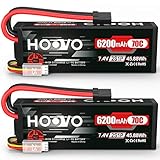
The HOOVO two-pack is the choice here for a compatible RC car that uses 2S voltage, a Traxxas plug, and a battery bay large enough for a 6200mAh hard-case battery. The listing specifies two packs, each in the 7.4V, 6200mAh, 70C class. That makes it a different kind of purchase from the compact 3S batteries: it is aimed at a 2S setup and offers a high-capacity format, with a second battery available as a spare or rotation option.
Two cells in series give 7.4V nominal voltage; a fully charged conventional 2S LiPo reaches 8.4V. The vehicle’s electronic speed controller and any other connected equipment must support this voltage range. The 6200mAh capacity can provide more stored energy than a 2200mAh battery at the same voltage, but actual runtime varies substantially with the vehicle, driving style, terrain, motor, gearing, temperature, and battery condition. A larger battery also usually occupies more space and adds mass, so it is not automatically an upgrade for a small vehicle.
- Cell count and voltage: 2S, 7.4V nominal
- Capacity and discharge label: 6200mAh, 70C
- Case and connector: hard case, Traxxas plug
- Pack configuration: two batteries
The hard case is a practical distinction for RC cars, where a battery may sit in a compartment exposed to movement and debris. It is not a reason to ignore proper restraint or inspect the pack after impacts. The connector is equally important: “Traxxas plug” identifies the stated connection, but vehicle generations and modifications can vary. Check the actual connector on the car and avoid improvised wiring that risks reversed polarity, a poor connection, or excess resistance.
Pros
- Two-pack configuration provides a spare or a second battery for rotation.
- 6200mAh capacity is substantially larger than the listed 2200mAh packs.
- Hard case suits vehicle installations that require a more rigid battery shell.
- Stated 2S voltage and Traxxas plug target a specific, identifiable type of setup.
Cons
- Only appropriate for equipment that supports 2S and the stated connector.
- Large capacity and hard-case dimensions may not fit compact battery bays.
- Higher mass can alter handling and may exceed a vehicle’s intended battery weight.
- A two-pack bundle needs appropriate storage and charging capacity for both packs.
Compared with the nearest alternative: None of the other listed products is a close substitute in voltage and connector. The 3S Zeee and Hilldow packs operate at a higher nominal voltage and use XT60; they are not drop-in replacements. If the vehicle manual specifies 2S and a Traxxas plug, this HOOVO pack is the clear category match. If the manual specifies 3S, choose among the 3S products instead. Do not select a pack based on capacity alone or assume a plug adapter makes an unsupported cell count safe.
5. Zeee 3S 2200mAh 50C Shorty Pack – Best budget shorty for 3S setups

This Zeee listing is the budget-tier counterpart to the other Zeee 3S 2200mAh 50C shorty pack in this roundup. Its stated specifications are 3S, 11.1V, 2200mAh, 50C, shorty format, and XT60. For a compatible RC car, truck, vehicle, or boat, it offers the same headline combination that makes the mid-range Zeee listing a broadly useful compact 3S candidate. The budget tier makes it worth comparing when the current listing and pack configuration match the buyer’s needs.
Do not assume that two listings with similar names are identical in every detail. Confirm the pictured pack dimensions, connector, included quantity, and any other current listing information before ordering. In battery selection, even a small difference in dimensions can decide whether a pack fits securely. A loose battery can move during a crash or hard turn, while a pack that is squeezed into an undersized compartment may be damaged or place stress on its leads.
- Cell count and voltage: 3S, 11.1V nominal
- Capacity and discharge label: 2200mAh, 50C
- Format and connector: shorty pack, XT60
- Listed uses: RC cars, trucks, vehicles, and boats
Its likely role is a replacement or spare for a model already set up around a 3S shorty XT60 battery. It is not a universal first upgrade for an older vehicle: confirm that the speed controller supports 3S, that the motor and gearing are suitable, and that the battery tray accommodates the pack. A higher voltage can increase electrical and mechanical load on a power system, and a battery that fits physically can still be electrically incompatible.
Pros
- Budget-tier option with a useful 3S 2200mAh specification class.
- Shorty shape is relevant to compatible compact battery trays.
- XT60 connector is clearly stated in the listing name.
- Stated 50C rating matches the other Zeee shorty option in this roundup.
Cons
- Requires 3S-rated electronics and a matching XT60 connection.
- Shorty shape does not mean it fits every shorty tray.
- Similar listing names make it important to verify the exact pack and contents.
- Budget status does not remove the need for a balance charger and safe handling.
Compared with the nearest alternative: The mid-range Zeee shorty listing has the same core numbers and form-factor wording. The available information does not establish a performance advantage for one over the other, so compare the exact listing details, current price tier, and dimensions rather than paying more based on brand wording alone. Hilldow is another budget 3S 2200mAh XT60 option, but its listing states 40C and does not call the pack shorty. This Zeee is the more clearly specified candidate when both the shorty shape and 50C label are priorities.
6. OVONIC 3S 2200mAh 50C – Best for compatible 3S aircraft

The OVONIC 3S 2200mAh 50C battery is the best match in this roundup for an RC airplane, helicopter, or quadcopter that explicitly uses a 3S pack with XT60. The listing names those air-model categories and states 11.1V, 2200mAh, and 50C. That combination is more appropriate to consider for a larger model than the 550mAh OVONIC pack, provided the aircraft’s battery bay, balance point, connector, and power requirements all match.
Aircraft are particularly sensitive to battery placement and mass. A pack that fits into the compartment may still move the center of gravity outside the model maker’s recommended range. Before flying, use the aircraft’s stated balance point and secure the battery so it cannot shift. For a multirotor, verify that the flight controller, electronic speed controllers, and motors are configured for the chosen cell count; for a plane or helicopter, follow the model and power-system guidance rather than assuming every 3S airframe can accept every 3S battery.
- Cell count and voltage: 3S, 11.1V nominal
- Capacity and discharge label: 2200mAh, 50C
- Connector: XT60
- Listed uses: RC airplanes, helicopters, and quadcopters
A 2200mAh 3S pack stores about 24.4 watt-hours of nominal energy: 11.1V × 2.2Ah = 24.42Wh. This is a useful way to compare capacity at different voltages, but it does not predict flight time by itself. A model’s average power draw changes with throttle, propeller, payload, wind, and flight style. For a rough illustration, if a setup averages 150W, dividing 24.4Wh by 150W gives about 0.163 hours, or 9.8 minutes in an idealized calculation. Real usable flight time is lower because a pilot should land before exhausting the pack, and actual average power can vary widely.
Pros
- Named for common RC aircraft categories rather than only ground vehicles.
- 2200mAh capacity offers more stored energy than the 550mAh OVONIC option.
- XT60 and 3S specifications are explicit for compatibility checks.
- 50C stated rating is in the same category as the Zeee 2200mAh packs.
Cons
- Not suitable for an aircraft designed for 2S or a different connector.
- Battery mass and placement can affect aircraft balance and handling.
- Capacity alone cannot provide a reliable flight-time estimate.
- Aircraft power demands and acceptable pack dimensions vary considerably by model.
Compared with the nearest alternative: The OVONIC 550mAh 3S pack shares the brand, voltage, and air-model use case, but has a smaller capacity and XT30 rather than XT60. This 2200mAh option is the more natural candidate for a larger aircraft that is designed around XT60 and can carry its size and weight. The 550mAh version better suits a smaller compatible model. Do not use a connector adapter as a substitute for checking the aircraft’s battery and current requirements.
7. URGENEX 1S 600mAh with X5 Charger – Best for specified small UDI models
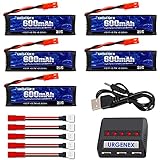
The URGENEX battery is the budget choice for a small UDI U817, U817A, or V95 model that uses a 1S 3.7V LiPo with JST and is compatible with the included X5 battery charger. This product is in a different category from the larger hobby packs: it is a single-cell battery for specific small models, not a 3S or 2S car battery. Its value depends on exact model compatibility, connector fit, and whether the X5 charger is the correct charger for the battery.
The listing states 600mAh capacity and a JST plug. “JST” is a family of connector types, not a guarantee that every JST plug has the same shape, polarity, or pin arrangement. Compare the physical connector and wiring polarity with the original battery. The listing’s named model compatibility is a useful starting point, but versions and revisions can differ. Check the model’s manual or existing battery label before buying, and stop if the plug does not match cleanly.
- Cell count and voltage: 1S, 3.7V nominal
- Capacity: 600mAh
- Connector: JST, with the exact connector fit to be verified
- Included accessory: X5 battery charger, as stated in the listing
- Listed model fit: UDI U817, U817A, and V95
A small 1S pack is typically intended for a lightweight model with a low-voltage power system. Connecting a higher-voltage pack to such a model can damage its electronics, while a physically similar battery with different wiring polarity can also cause problems. Use the charger specified for the battery and follow its instructions; do not assume the included charger is suitable for unrelated packs. Charging should take place on a nonflammable surface, with the battery attended and removed from the model where the model instructions call for it.
Pros
- Clear 1S 3.7V category for compatible small models.
- 600mAh capacity is stated, making it easier to compare with an original pack.
- Listing names several specific UDI models.
- Includes an X5 battery charger according to the product name.
Cons
- Not a replacement for 2S or 3S hobby RC vehicle batteries.
- JST connector type and polarity need confirmation against the original battery.
- Model fit should be checked against the exact revision and battery compartment.
- Included charger should be used only as directed for compatible batteries.
Compared with the nearest alternative: The OVONIC 550mAh battery may look similar by capacity, but it is a 3S 11.1V pack with an XT30 connector; it is electrically and physically a different class. For the named UDI models, the URGENEX 1S JST pack is the relevant candidate. For a small 3S RC model that calls for XT30, consider the OVONIC 550mAh only if its specifications match the model. Capacity figures alone are not enough to establish compatibility.
How to Choose
Start with the vehicle’s manual or the label on its original battery. Do not begin with capacity, C rating, or price. Record the permitted cell count, connector, maximum pack dimensions, and any stated capacity or weight range. A battery needs to satisfy all of these constraints at once. If the manual says 2S, a 3S battery is not a performance upgrade unless the manufacturer explicitly supports 3S operation and the rest of the power system is configured for it.
1. Match cell count and voltage
Cell count is the first electrical filter. A conventional LiPo cell has a nominal voltage of about 3.7V and reaches 4.2V when fully charged. That means a 1S pack is 3.7V nominal and 4.2V full; 2S is 7.4V nominal and 8.4V full; 3S is 11.1V nominal and 12.6V full. The URGENEX is 1S, the HOOVO is 2S, and the remaining listed batteries are 3S.
Check the maximum input voltage of the electronic speed controller, receiver, flight controller, and any other connected electronics. A motor’s ability to tolerate a higher voltage does not mean the entire vehicle can. In a car, extra voltage can increase motor speed and mechanical load. In an aircraft, a higher cell count can also change current draw, propeller loading, heat, and flight behavior. Use the manufacturer’s approved configuration instead of relying on a connector that happens to fit.
2. Confirm connector, polarity, and wiring
Match the plug family named in the product listing to the actual connector on the model. This roundup includes XT60, XT30, a Traxxas plug, and JST. These are not interchangeable. Some users install connectors to standardize a fleet, but soldering or adapting should be done only by someone who understands polarity, wire gauge, insulation, and the battery’s charging leads. A connector adapter does not change a battery’s cell count or make an unsupported battery safe.
Pay attention to the balance connector as well as the main power plug. A balance charger needs access to the cell connections through the correct balance lead. Never force a connector, reverse wires, or trim a plug to make it fit. For the URGENEX, the word “JST” alone does not prove that the plug’s exact housing and polarity match every UDI model revision; compare it with the original battery.
3. Measure the battery bay
Measure the open space inside the battery tray, not just the outer dimensions of the chassis. Record length, width, and height, then allow room for the wires, connector bend, retaining strap, and any cushioning. A shorty pack is shorter or otherwise shaped for a particular class of tray, but the label does not establish the exact fit in a specific vehicle. The Zeee shorty packs should still be checked against the car’s dimensions, while the HOOVO hard-case pack may need more room than a compact soft pack.
Also consider mass. A larger battery can change a car’s weight distribution and handling or move an aircraft’s center of gravity. In an aircraft, repositioning a pack to achieve the required balance may be possible only within the model’s battery bay. Do not compress, bend, puncture, or force a LiPo into a tight compartment.
4. Choose capacity for the job, not just the biggest number
Capacity in milliamp-hours is a measure of charge, not a direct runtime guarantee. To compare energy across different voltages, convert capacity to amp-hours and multiply by nominal voltage. For example, the OVONIC 3S 2200mAh pack has an approximate nominal energy of 11.1V × 2.2Ah = 24.4Wh. The HOOVO 2S 6200mAh pack is approximately 7.4V × 6.2Ah = 45.9Wh. The HOOVO stores more nominal energy, but it is also a different size, voltage, connector, and vehicle fit; the comparison does not make it a replacement for the 3S battery.
A rough runtime calculation is: estimated runtime in hours = usable battery energy in watt-hours ÷ average power draw in watts. If a compatible setup averages 100W and uses 80% of a nominal 24.4Wh pack before landing or stopping, the estimate is 24.4 × 0.8 ÷ 100 = 0.195 hours, or about 11.7 minutes. The 80% is a planning assumption, not a universal discharge rule. Actual safe use should follow the battery and vehicle maker’s guidance, and average power changes with acceleration, terrain, payload, throttle, wind, and temperature.
For a compact model, a smaller pack may be better because it keeps weight and dimensions down. For a larger car designed around a hard case, a 6200mAh battery may provide more energy per run. If you want a spare, two smaller packs can be easier to rotate than one large pack, but only if both fit the model and you can charge and store them properly.
5. Treat C ratings as one clue
A C rating is a claimed discharge-rate multiplier. To see what it means mathematically, convert capacity to amp-hours and multiply by the stated C rating. A 2200mAh battery is 2.2Ah, so a stated 50C rating gives 2.2 × 50 = 110A as a theoretical label calculation. A 550mAh, 130C pack gives 0.55 × 130 = 71.5A by the same calculation. These figures are not independently verified continuous-current guarantees, and different manufacturers’ ratings may not be directly comparable.
Choose a battery whose specifications align with the vehicle maker’s current demands rather than choosing the largest printed C number. A high C rating cannot compensate for the wrong connector, insufficient capacity, poor fit, or unsupported voltage. Watch for excessive warmth, swelling, unusual odor, or damage, and stop using a pack that appears compromised.
6. Select the right case and charging setup
A hard case, as listed for the HOOVO pack, provides a rigid exterior that suits some car compartments. A soft-case battery, such as the small OVONIC XT30 pack, needs careful mounting and protection from sharp edges and loose hardware. Neither case style makes a damaged battery safe. Inspect the pack, lead insulation, and connectors before use; retire a battery that is swollen, punctured, leaking, or otherwise damaged.
Use a charger designed for LiPo batteries with the correct cell count and a balance-charging function where appropriate. Set the chemistry and cell count correctly; for conventional LiPo charging, the normal maximum is 4.2V per cell, but follow the specific battery and charger instructions. Do not leave charging unattended, charge on a flammable surface, or charge a hot pack immediately after a run. Allow it to cool and inspect it first. Store packs in a cool, dry place at the storage voltage recommended by the charger or battery maker, away from heat and combustibles.
Decision matrix
| Your situation | Most relevant listed option | Why | Check before purchase |
|---|---|---|---|
| Compact RC car needs 3S, XT60, and shorty shape | Zeee 3S 2200mAh 50C Shorty Pack | Matches the named voltage, connector, capacity class, and shorty format | Exact dimensions, 3S support, and listing details |
| 3S XT60 car or boat on a budget | Hilldow 3S 2200mAh 40C | Budget-tier 3S 2200mAh option with XT60 | Pack shape, 40C suitability, and battery-tray fit |
| Small 3S model requires XT30 | OVONIC 3S 550mAh 130C Soft Case | Small capacity class and XT30 connector | Current demand, dimensions, and soft-pack restraint |
| 3S aircraft uses XT60 and can carry 2200mAh | OVONIC 3S 2200mAh 50C | Listing names airplanes, helicopters, and quadcopters | Center of gravity, power-system limits, and pack mass |
| 2S car needs a Traxxas plug and hard case | HOOVO 2S 6200mAh 70C Two Pack | Matches the stated 2S, hard-case, and plug categories | Dimensions, total mass, and whether the vehicle supports 6200mAh packs |
| Specified small UDI model uses 1S JST | URGENEX 1S 600mAh with X5 Charger | Names U817, U817A, and V95 compatibility | Exact JST housing, polarity, model revision, and charger instructions |
Frequently Asked Questions
Can I use a 3S LiPo in a vehicle that came with a 2S battery?
Only if the vehicle manufacturer explicitly supports 3S operation and the speed controller, motor, wiring, and other electronics are suitable. A 3S pack reaches 12.6V fully charged, compared with 8.4V for 2S. Physical fit or a matching connector does not establish electrical compatibility.
What does 3S 11.1V mean?
“3S” means three LiPo cells connected in series, with a nominal voltage of about 11.1V. A conventional fully charged 3S pack reaches 12.6V. The corresponding nominal and full-charge voltages for 2S are 7.4V and 8.4V.
Will a higher-mAh battery make my RC car faster?
Capacity alone does not determine speed. A higher-mAh pack may offer more stored energy, but speed depends on voltage, motor, gearing, controller, and vehicle setup. A larger-capacity pack may also be heavier or too large for the battery bay.
How long will a 2200mAh LiPo last?
There is no fixed runtime because current draw changes with the vehicle and how it is used. As a rough illustration, a 3S 2200mAh pack stores about 24.4Wh nominal; if a compatible setup averages 100W and uses 80% of that energy, the arithmetic suggests roughly 11.7 minutes. Treat that as an estimate only, and land or stop according to the battery and vehicle guidance.
Can I use an XT60 battery where the model has XT30?
Not directly: the plug sizes differ, and a connector adapter does not resolve voltage, current, wiring, or physical-fit concerns. Use the connector and battery type specified by the model maker. Any connector change should be handled by someone qualified to work safely with LiPo wiring and polarity.
Is a higher C rating always better?
No. C ratings are manufacturer-stated discharge multipliers and are not, by themselves, a verified measure of real performance. Match the battery to the vehicle’s electrical requirements, then consider capacity, connector, dimensions, and weight alongside the rating.
How should I charge and store LiPo batteries?
Use a compatible LiPo balance charger with the correct cell count and follow the battery and charger instructions. Charge on a nonflammable surface while attended, and do not charge a damaged, swollen, or unusually hot pack. For storage, use the recommended storage voltage and keep batteries away from heat and combustible materials.
Can I leave a LiPo fully charged between uses?
For longer periods, follow the battery maker’s storage guidance rather than leaving a pack fully charged indefinitely. A balance charger’s storage mode can bring the battery to an appropriate storage level. Check the pack before the next use and do not use one that is swollen or damaged.
Final Recommendations
For a compact 3S RC vehicle that needs XT60 and a shorty pack, start with the Zeee 3S 2200mAh 50C shorty options and compare their current listing details and price tier. Choose Hilldow for a budget 3S 2200mAh XT60 option when its dimensions and 40C rating suit the vehicle. For a 2S car that takes a Traxxas plug, consider the HOOVO hard-case two-pack; for an XT30-equipped small 3S model, the 550mAh OVONIC is the relevant category. Aircraft owners should check balance and weight carefully, and owners of the specified small UDI models should verify the URGENEX plug and charger fit. In every case, the safest choice is the pack that matches the model’s approved cell count, connector, and dimensions—not the one with the biggest number on its label.


